Hello! Welcome to the first lesson in our course on mastering Notion for businesses.
This first module, "Foundations of Scalable Database Architecture," lays the groundwork for everything that follows. Building powerful, scalable systems requires a solid understanding of how to structure data correctly. Without this foundation, even the most cleverly designed Notion workspaces can become slow, buggy, and difficult to maintain.
Today, we'll start with a core principle of database design: normalization. Our goal is to explain the principles of database normalization up to the Third Normal Form (3NF) and understand its crucial role in ensuring data integrity. This might sound academic, but it has very practical implications for your work as a Notion consultant. A well-normalized structure is the blueprint for a system that is easy for your clients to use, update, and scale over time.
Let's begin!
What is Database Normalization and Why Is It Important?
At its core, database normalization is a systematic process for organizing data to minimize two key problems:
- Data Redundancy: Storing the same piece of information in multiple places. For example, writing a client's email address on every single project they have in your system.
- Data Anomalies: Logical errors that can occur when you try to insert, update, or delete data in a redundant system.
When a database isn't normalized, it's vulnerable to these anomalies, which compromise data integrity—the overall accuracy, completeness, and consistency of data.
To understand these problems more concretely, let's watch a short introductory video.
Learn Database Normalization - 1NF, 2NF, 3NF, 4NF, 5NF
This first video from the Decomplexify channel introduces the concept of normalization and explains the types of logical inconsistencies and data anomalies that can happen in a poorly designed database.
Please watch from the beginning until 2:47. Pay close attention to the definition of data integrity and the brief explanation of insertion, update, and deletion anomalies.
As the video explained, an unnormalized database can lead to three main types of anomalies:
- Insertion Anomaly: You can't add a new piece of information because another, unrelated piece of information is missing. For example, you can't add a new potential client to your system if they haven't been assigned to a project yet, because the project field is a required part of the "master" table.
- Update Anomaly: You have to change the same piece of information in multiple places. If you miss one, your data becomes inconsistent. For example, if a client changes their company name, and you have to manually update it on dozens of separate project pages, you might miss one, leading to conflicting information.
- Deletion Anomaly: Deleting one piece of information unintentionally deletes another, unrelated piece of information. For example, if you delete the only project associated with a particular consultant, you might lose their contact information entirely if it was only stored on that project page.
Here is a great visual that shows the difference between an unnormalized table and a normalized structure.
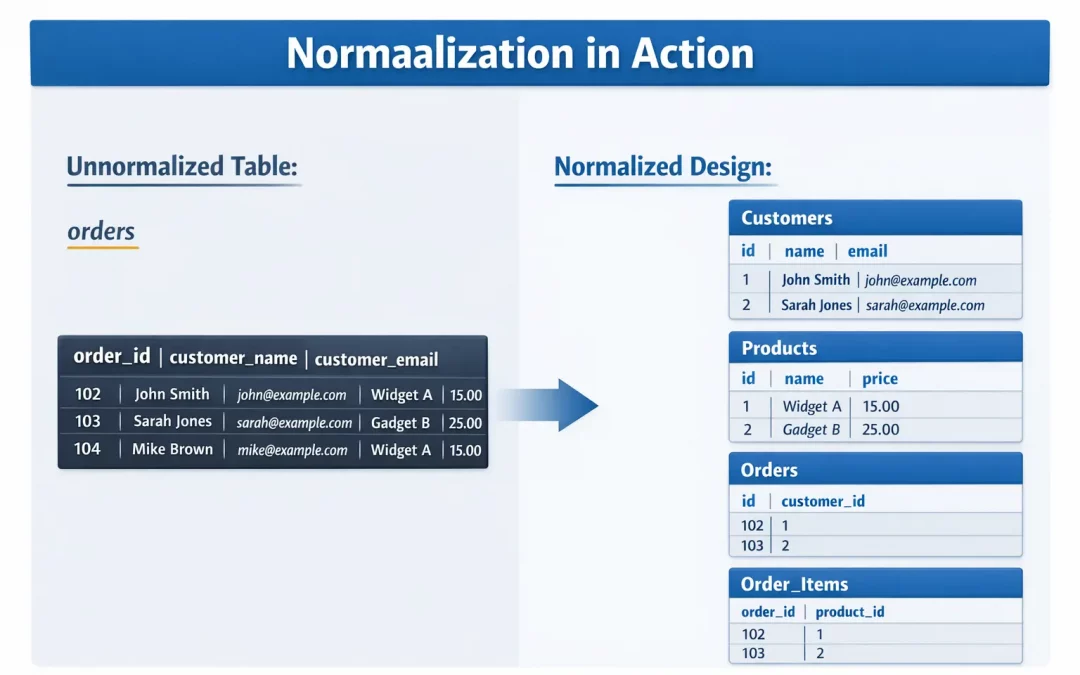
Notice how in the normalized version, a customer's name is stored only once. This structure prevents the anomalies we just discussed.
The Building Blocks: Understanding Keys
To organize data into separate but connected tables, we need a way to link them. This is done using keys. In Notion, you're already familiar with this concept through Relation properties. Let's formalize the key terms.
Database Normalization: A Guide to Organizing Data ...
This article from Rootstrap provides clear, concise definitions of the different types of keys that form the backbone of relational databases.
Please read the section titled 'Keys' to understand the definitions of Primary Key, Foreign Key, and Composite Key.
To summarize in the context of Notion:
- Primary Key (PK): The unique identifier for an item in a database. In Notion, the
Titleproperty often serves as a human-readable primary key, but every page also has a unique ID that Notion uses under the hood. - Foreign Key (FK): A key that links to the primary key of another table. When you create a Relation property in Notion (e.g., linking a
Projectsdatabase to aClientsdatabase), you are essentially creating a foreign key relationship. - Composite Key: A key made up of two or more columns to uniquely identify a row. This is less direct in Notion but can be achieved with "junction" databases, which we will explore in a later lesson.
Now that we have the fundamentals, let's explore the "Normal Forms," which are the rules we follow to achieve a normalized database.
The Journey Through Normal Forms
Normalization is a step-by-step process, with each step called a "Normal Form." For most business systems, especially in Notion, understanding the first three normal forms (1NF, 2NF, and 3NF) is sufficient to build robust and scalable architectures.
This next video provides excellent, practical explanations for each of these forms. We will watch it in three parts.
First Normal Form (1NF): Ensuring Atomicity
The first step is about breaking down complexity within a single cell.
Learn Database Normalization - 1NF, 2NF, 3NF, 4NF, 5NF
Let's return to the Decomplexify video to learn about the first normal form (1NF).
Please watch from 3:35 to 10:25. Focus on the four rules, especially the concept of 'repeating groups'.
To recap, a table is in 1NF if:
- Row order doesn't matter.
- All values in a column are of the same data type.
- Every row has a unique primary key.
- There are no "repeating groups"—each cell holds a single, atomic value.
The last point is the most common violation in Notion. For example, using a single Text property for "Tasks" and listing them as "Design mockup, Write copy, Get approval" is a repeating group. To achieve 1NF, you should create a separate Tasks database and link each task to the project. This makes each task a distinct, manageable item.
Second Normal Form (2NF): Eliminating Partial Dependencies
2NF builds on 1NF and deals with how data relates to the primary key, especially when you have a composite key.
Learn Database Normalization - 1NF, 2NF, 3NF, 4NF, 5NF
Now, let's continue with the same video to understand the second normal form (2NF).
Please watch from 10:25 to 16:12. The key concept here is 'partial dependency'—where a non-key attribute depends on only part of the composite primary key.
A table is in 2NF if it is in 1NF and every non-key attribute is fully dependent on the entire primary key.
Let's translate this to a business scenario in Notion. Imagine a Client Project Deliverables database where each row is a unique deliverable for a project. The primary key could be considered {Client Project ID, Deliverable Name}. If you added a column for Project Manager, this would violate 2NF because the Project Manager depends only on the Client Project ID, not the full {Project ID, Deliverable Name} key. This creates redundancy; the same project manager's name would be repeated for every deliverable on that project.
The solution is to keep Project Manager information in the Client Projects database, where it depends on the whole key (the Client Project ID).
Third Normal Form (3NF): Eliminating Transitive Dependencies
3NF takes us one step further, removing dependencies between non-key fields.
Learn Database Normalization - 1NF, 2NF, 3NF, 4NF, 5NF
Finally, let's look at the third normal form (3NF), which is often the target for well-structured databases.
Please watch from 15:59 to 20:13. Focus on understanding 'transitive dependency'—where a non-key attribute depends on another non-key attribute.
A table is in 3NF if it is in 2NF and has no transitive dependencies. This means a non-key attribute cannot depend on another non-key attribute.
A classic business example: You have a Projects database that includes columns for Department Name and Department Head. The Department Head is determined by the Department Name, not directly by the Project ID. This is a transitive dependency. If the department head changes, you would have to update it on every project assigned to that department, risking an update anomaly.
The 3NF solution is to create a separate Departments database containing Department Name and Department Head, and then link your Projects database to it.
The video offers a fantastic, memorable summary for achieving 3NF:
Every non-key attribute in a table should depend on the key, the whole key, and nothing but the key.
If you follow this one rule, your databases will almost always be in 3NF.
Test your understanding!
You are designing a CRM in Notion. You create a single database called "Interactions" to log every meeting, call, and email with contacts. The database has the following properties: Interaction ID, Contact Name, Contact's Company Name, Contact's Company Address, and Interaction Date.
Which normal form does this design violate, and why?
Show answer
This design violates the Third Normal Form (3NF).
The Contact's Company Address depends on the Contact's Company Name, which is a non-key attribute. It does not depend directly on the primary key, Interaction ID. This is a transitive dependency. If the company moves, you would have to update its address on every single interaction log for every contact at that company, leading to a high risk of update anomalies.
The proper 3NF solution would be to have three separate databases:
Companies(with Company Name, Company Address)Contacts(with Contact Name, related to one Company)Interactions(with Interaction Date, related to one Contact)
The Strategic View: Normalization is a Guideline, Not a Law
As a consultant focused on strategy and architecture, it's vital to understand that normalization involves trade-offs. While a highly normalized structure (like in 3NF) provides maximum data integrity and flexibility, it can sometimes impact performance, especially in Notion where every Relation and Rollup adds to the computational load.
Balancing Structure and Performance in Data Modeling
This article from Medium, 'Balancing Structure and Performance in Data Modeling,' provides a great strategic overview of normalization, including real-world examples and the trade-offs involved.
Please read the sections 'Normalization in Practice: Real-World Scenarios' and 'The Art of Balancing Normalization and Performance'. This will help connect the theory to practical business systems like CRMs and project management tools, and frame it as a strategic balancing act.
The process of intentionally violating a normal form rule to improve performance is called denormalization. We will cover optimization strategies like this in a later lesson. For now, the key is to recognize that designing a scalable system is about making informed choices, not blindly following rules. Aiming for 3NF is the best starting point for creating a clean, maintainable, and scalable foundation.
Conclusion
Congratulations on completing your first lesson! We've covered a lot of ground, moving from the foundational "why" of database design to the specific rules that help us build better systems.
Here are the key takeaways:
- Normalization is a process for organizing data to reduce redundancy and prevent data anomalies (insertion, update, deletion).
- The goal is to improve data integrity, ensuring your data is reliable and consistent.
- 1NF requires that every cell holds a single, atomic value (no repeating groups).
- 2NF requires that all non-key attributes depend on the entire primary key.
- 3NF requires that no non-key attribute depends on another non-key attribute.
- A great guiding principle is that every attribute should depend on "the key, the whole key, and nothing but the key."
- In practice, normalization is a strategic balance between perfect data structure and system performance.
In our next lesson, "Apply normalization principles to design a relational database structure for a given business process," we will move from theory to practice. You'll take these principles and use them to architect a database structure for a real-world business scenario, translating these concepts directly into a practical Notion design.