Introduction
Welcome to the fifth module of our course, "Validating Claims with FLOATER." In the previous modules, we focused on the foundational steps of data work: formulating SMART questions, ensuring ethical practices with CTO POC, checking information validity with ROCCC, and documenting our data with SAD metadata. We have successfully prepared our raw materials—the data itself.
Now, we pivot from the data to the conclusions drawn from it. Data rarely speaks for itself; it is interpreted to make claims. This module is about scrutinizing those claims.
Today's lesson addresses our first learning outcome: to explain why claims derived from data must be systematically validated before being accepted. We will explore the critical thinking principles that bridge the gap between a dataset and a trustworthy conclusion, setting the stage for the FLOATER framework that we will use throughout this module.
1. The Leap from Data to Claim
A dataset, no matter how clean or well-structured, is simply a collection of observations. A claim is an assertion of truth based on an interpretation of that data. This interpretive leap is where errors, biases, and faulty logic can enter the picture. Therefore, it requires careful scrutiny.
Consider these scenarios:
-
Bra Design: Imagine your research team develops a new bra with a novel underwire shape. You collect data from 50 test subjects and find a strong statistical correlation between wearing the new design and participants reporting lower discomfort scores compared to a standard design.
- The Data: A set of discomfort scores and the type of bra worn.
- The Claim: "Our new underwire design makes bras more comfortable."
- The Problem: Is the claim fully justified? The data shows a correlation, but it doesn't automatically prove causation. What if the new bra was also made from a softer fabric? What if the participants, knowing they were testing a new product, had a psychological expectation of greater comfort (a placebo effect)?
-
Polyamorous Relationships: You analyze communication logs from several single-female-multiple-male polyamorous V-triads. The data shows that triads where the partners report more frequent in-person "check-in" conversations also report higher overall relationship satisfaction scores.
- The Data: Logs of communication frequency/type and self-reported satisfaction ratings.
- The Claim: "Frequent in-person check-ins are key to maintaining high satisfaction in a V-triad."
- The Problem: Again, this is a leap from correlation to a causal-sounding claim. Perhaps a pre-existing high level of satisfaction is what motivates the frequent check-ins, not the other way around. Maybe other variables, like the length of the relationships or the financial stability of the members, are the true drivers of both communication and satisfaction.
These examples illustrate that a claim is more than a summary of data; it's an argument. And like any argument, it must be evaluated for its soundness. This evaluation is the core of what we call critical thinking.
2. The Mindset of Validation: Critical Thinking and Skepticism
To validate claims effectively, we must adopt a mindset of scientific skepticism. This doesn't mean being cynical or dismissive; rather, it means proportioning our belief to the strength of the evidence.
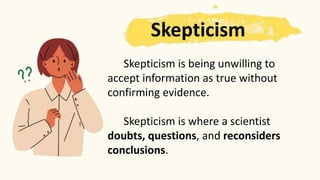
The formal process for applying this skeptical mindset is known as critical thinking. A common definition describes it as "reasonable, reflective thinking that is focused on deciding what to believe or do." It is the engine of scientific progress and the safeguard against misinformation.
To explore why this mindset is so crucial, the following reading explains that the process of science is more valuable than its accumulated facts.
[PDF] teach skills, - not facts
This excerpt from the article 'Teach Skills, Not Facts' by Melanie Trecek-King makes a powerful case for focusing on how we know things rather than just what we know. It directly addresses why a framework for evaluating claims is an essential skill.
Please read the first two parts of the article: the section titled 'Critical thinking and science literacy' and the paragraphs under the 'Changing focus' heading, ending just before the author says, 'I convinced my institution...'. Focus on the connection the author draws between understanding the scientific process and the ability to distinguish reliable from unreliable claims.
As the author argues, without a process for scrutiny, we are ill-equipped to navigate a world filled with information, misinformation, and disinformation. A claim's origin—whether from a scientific study, a marketing department, or a social media post—doesn't guarantee its validity. Its validity comes from its ability to withstand systematic examination.
3. Why Validation Must Be Systematic
If critical thinking is the engine, a systematic framework is the steering wheel, guiding us through the evaluation process in a structured, comprehensive, and objective way. Why is this formal structure so important?
Because human reasoning, left to its own devices, is notoriously unreliable. We are all susceptible to cognitive biases that can lead us to flawed conclusions:
- Confirmation Bias: We tend to favor information that confirms our existing beliefs. If you believe your new bra design is superior, you are more likely to notice and emphasize the data that supports this belief.
- Motivated Reasoning: We are more critical of evidence that contradicts our desired outcome and less critical of evidence that supports it.
- Post Hoc Fallacy (Post hoc, ergo propter hoc): We mistakenly assume that because one event happened after another, the first event caused the second. This is the classic "correlation does not imply causation" error.
A systematic validation framework acts as a crucial check on these natural human tendencies. At its core, as Melanie Trecek-King notes in her article, "science is a way of knowing—a way that recognizes and corrects for our biases." The following resource outlines the components of such a corrective process.
[PDF] CRITICAL THINKING: AN OVERVIEW - Robotic Technology Inc
Dr. Robert Finkelstein's presentation, 'CRITICAL THINKING: AN OVERVIEW', details a set of rules for what he calls 'evidential reasoning.' This provides an excellent example of a systematic framework for validating claims.
Please read the section titled 'EVIDENTIAL REASONING,' which covers six rules from Falsifiability to Sufficiency. Notice how these rules form a checklist that forces a claim to be evaluated from multiple angles, leaving little room for bias to hide.
The rules you just read—Falsifiability, Logic, Comprehensiveness, Honesty, Replicability, and Sufficiency—are designed to force objectivity. They demand that we not only look for supporting evidence but also consider contradictory evidence, check the logic of the argument, and ensure the evidence is strong enough to justify the claim.
4. Introducing the FLOATER Framework
The principles of evidential reasoning are precisely what this module aims to instill. To make them memorable and practical, we will use the FLOATER acronym as our toolkit. The FLOATER framework is our systematic process for validating any claim derived from data. An unreliable claim will fail on at least one of these criteria.
Here is a brief overview of the components we will be exploring in depth in the upcoming lessons:
- Falsifiability: Is the claim testable? Can it be proven false?
- Logic: Does the conclusion follow logically from the evidence?
- Objectivity: Has the process minimized bias from the researchers and participants?
- Evidence: Is the evidence supporting the claim sufficient, relevant, and high-quality?
- Alternative Explanations: Have other plausible explanations for the finding been considered and ruled out?
- Tentative Conclusions: Are the conclusions presented with an appropriate degree of certainty, acknowledging the study's limitations?
- Reproducibility: Can another researcher take the data and methods and reproduce the same results?
By methodically applying each of these checks, we move from a passive acceptance of claims to an active, rigorous validation process. This is the transition from simply consuming information to thinking like a scientist.
Conclusion
In this introductory lesson, we have established the fundamental reason for systematically validating data-driven claims. We've seen that claims are not direct readouts of data but are interpretations that can be flawed by logical fallacies and cognitive biases.
Key Takeaways:
- A claim is an interpretive leap from data, and this leap must be justified.
- Critical thinking and scientific skepticism are the essential mindsets for evaluating claims, demanding that belief be proportioned to evidence.
- A systematic framework is necessary to counteract our inherent biases and ensure a comprehensive and objective evaluation.
- The FLOATER model is the framework we will use to structure our validation process, ensuring claims are robust, reliable, and trustworthy.
Preview of the Next Lesson:
We are now ready to begin our journey through the FLOATER framework. In our next lesson, we will tackle the first and most crucial criterion: Falsifiability. We will discuss why a claim that cannot be tested and potentially proven false is not a scientific claim at all.