Introduction
Welcome to our lesson on assessing metadata quality. In our previous sessions, we established the "SAD" framework, learning how to identify and classify metadata as Structural, Administrative, or Descriptive. We practiced this classification with examples from both bra design and polyamorous relationship studies.
Before we conclude our module on metadata, we need to address one more critical skill. It's not enough to simply know that metadata exists and to classify it. As analysts, we must be able to judge whether the metadata provided with a dataset is sufficient for us to understand, trust, and use that data correctly. A dataset without adequate metadata is like a complex machine with no instruction manual—potentially powerful, but functionally useless and even dangerous if used incorrectly.
Today's learning outcome is to assess whether the metadata accompanying a dataset is sufficient for a new analyst to understand and use it correctly. We will establish the criteria for what makes metadata "good" and then apply these criteria to practical scenarios.
1. What Makes Metadata "Sufficient"?
First, it's important to distinguish between data quality and metadata quality. Data quality refers to the accuracy and reliability of the actual values in the dataset (e.g., are the bust measurements correct?). Metadata quality, our focus today, refers to the quality of the information about that data. As you'll see, poor metadata can render even the highest-quality data unusable.
To begin, let's explore the key dimensions of metadata quality.
Metadata Quality: Types, Process, and Best Practices - lakeFS
The article 'Metadata Quality' from lakeFS provides an excellent overview of what constitutes high-quality metadata. It introduces several dimensions we can use as a checklist.
Please read the sections 'What is Metadata Quality?' and 'Metadata Quality Dimensions & Metrics'. Focus on the definitions for Completeness, Accuracy, Consistency, and Validity. These will be our core criteria for assessment.
Based on that reading and adding a crucial element of usability, we can say that sufficient metadata must be:
- Complete: Does it contain all the information necessary for interpretation? This includes all three SAD types: descriptive context, structural layout, and administrative rules.
- Accurate: Does the metadata correctly reflect the data? An error in the metadata (e.g., mislabeling a measurement unit) can be as damaging as an error in the data itself.
- Consistent: Is the metadata consistent within the dataset and across related datasets? Do terms and definitions remain the same?
- Clear: Is the metadata written in plain language, avoiding undefined jargon or acronyms? This is crucial for an analyst who is new to the project.
Imagine you receive a dataset for a bra design project. The file contains a column named wire_flex. If the metadata is insufficient, you are left with critical questions:
- Incomplete: What does "flex" mean? Is it a measure of force in Newtons? A displacement in millimeters? A categorical rating from 1 to 5? Without a definition (Descriptive metadata), the column is meaningless.
- Inaccurate: The metadata states the unit is
N/mm, but it was actually recorded asmm/N. Your calculations would be inverted. - Inconsistent: In one accompanying document, it's called
wire_flex, but in another, it'sflexibility_rating, causing confusion. - Unclear: The definition reads, "Standard U-wire flex under Z-protocol." What is the Z-protocol? This jargon makes the definition useless to an outsider.
Sufficient metadata preempts these questions, making the data immediately and reliably usable.
2. The README File: A Practical Standard for Metadata
A common and effective way to provide sufficient metadata is through a README file. This is a simple text file that accompanies a dataset and serves as its primary documentation. It's designed to give a new user all the information they need to get started.
Let's look at the standard components of a good README file, which serve as a practical checklist for assessing metadata sufficiency.
Create a README File | Research Data Management
This guide from the University of British Columbia outlines the purpose and best practices for creating a README file. It provides an excellent template for what constitutes comprehensive documentation.
Read the introduction 'What is a README?', the 'Stylistic Considerations', and pay close attention to the table under 'Recommended Content'. This table is a fantastic blueprint for what sufficient metadata looks like in practice.
The "Recommended Content" table in the UBC guide provides a robust checklist. Notice how its elements map directly to our SAD framework:
- Information (contact), Sharing and Access, Acknowledgements: These are primarily Administrative metadata. They tell you who created the data, what the usage rights are, and how it was funded.
- Description, Methodology: These are core Descriptive metadata. They explain the "what" and "why" of the dataset.
- Data and File Overview, Data-Specific Information: This is a blend of Structural (file structure, relationships) and Descriptive (variable definitions, codes) metadata.
A well-documented dataset will have a README file that addresses most of these points. Here is a visual example of a simple README template.
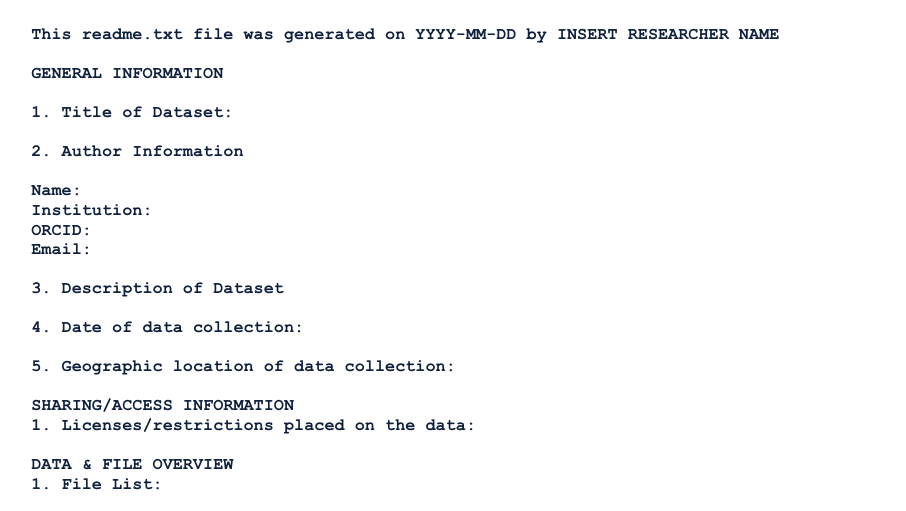
3. Assessment in Practice: Is the Metadata Sufficient?
Let's apply these concepts to assess the metadata for two hypothetical datasets.
Scenario 1: A Study on Polyamorous Dynamics
You receive a folder for a study on a single-female-multiple-male polyamorous arrangement. The folder contains a data.csv file and a metadata.txt file with the following content:
Title: Poly-Comm Study Data
Contact: R. Smith

Dataset contains weekly survey responses.
Variables: participant_id, week_num, dyad_id, satis_score, comm_freq

Data collected in 2022.
Your Assessment Task: Using the criteria of completeness, accuracy, clarity, and the README checklist, is this metadata sufficient for you to begin a rigorous analysis? What specific, critical questions are left unanswered?
Click to reveal the assessment
This metadata is insufficient. Here are just a few of the critical gaps:
- Incomplete (Descriptive):
- What does
satis_scorerepresent? Is it a scale of 1-5, 1-7, or 1-100? What question was asked to generate this score? - What is
comm_freq? Is this the number of conversations per day? Text messages per week? Hours of quality time? Is it self-reported or tracked?
- What does
- Incomplete (Structural):
- What is the relationship between
participant_idanddyad_id? How do you know which participants belong to which dyad? Without this structural information, you cannot analyze interactions correctly.
- What is the relationship between
- Incomplete (Administrative):
- Who is "R. Smith"? What is their institution or email? You have no way to ask for clarification.
- What were the specific data collection dates? "2022" is too vague to assess timeliness or to correlate with external events.
- Are there any restrictions on data use? Can it be published?
- Unclear:
- The title "Poly-Comm Study" is jargon. A more descriptive title would be helpful (e.g., "A Longitudinal Study of Communication and Satisfaction in V-Triad Relationships").
An analyst receiving this could not confidently use the data without making potentially incorrect assumptions.
Scenario 2: A Bra Measurement Dataset
You are tasked with analyzing a dataset to inform a new bra design. You receive a zipped folder containing the data and a README.md file with this content:
# Bra Measurement Dataset for Project Aphrodite - v1.1


## General Information
*   **Title:** Bra Measurement Dataset for Project Aphrodite
*   **Principal Investigator:** Dr. Elena Vance, Institute of Textile Engineering, evance@textile.edu, ORCID: 0000-0002-1825-0097
*   **Data Collection Dates:** 2023-01-15 to 2023-05-30
*   **Description:** This dataset contains 350 anonymized records of static and dynamic torso measurements from volunteers, collected to inform the design of a new supportive, wire-free bra.


## Sharing and Access Information
*   **License:** Creative Commons Attribution-NonCommercial (CC BY-NC 4.0)
*   **Restrictions:** For internal R&D use only. Not for publication without explicit permission.


## Data & File Overview
*   **File List:** `aphrodite_measurements.csv`
*   **File Structure:** CSV file with a header row. Each row represents one measurement session for one participant.


## Data-Specific Information
*   **`participant_id` (integer):** Unique, anonymous identifier for each participant.
*   **`underbust_circ_cm` (float):** Circumference of the torso directly under the breast tissue, measured in centimeters on full exhalation.
*   **`bust_circ_cm` (float):** Circumference of the torso at the fullest point of the bust, measured in centimeters.
*   **`cup_volume_ml` (integer):** Estimated breast volume in milliliters, derived from a 3D scan.
*   **`wire_trace_type` (string):** The shape of the underwire trace, classified as 'U', 'Demi', or 'Plunge' based on root shape.
*   **Missing Values:** Blank cells indicate a measurement was not taken or was invalid.
Your Assessment Task: Is this metadata sufficient for a new analyst? Justify your answer by referencing the SAD framework and our quality criteria.
Click to reveal the assessment
This metadata is sufficient. It provides a strong foundation for a new analyst to begin working with the data confidently and correctly.
- Complete: It covers all three types of metadata thoroughly.
- Descriptive: It has a clear overall description and provides specific, unambiguous definitions for each variable, including units (
cm,ml). - Administrative: It includes contact information, data collection dates, versioning (
v1.1), and clear licensing/access rules. - Structural: It explains the file structure (CSV with header) and how to handle missing values.
- Descriptive: It has a clear overall description and provides specific, unambiguous definitions for each variable, including units (
- Accurate: We assume the descriptions are a correct representation of the data.
- Clear: The variable names are descriptive, and the definitions are written in plain language without jargon.
- Consistent: The terminology is used consistently throughout the document.
An analyst receiving this would know exactly what the data represents, how it was collected, its limitations (missing values), how it can be used, and who to contact with further questions. They can begin their work immediately and with a high degree of trust in the data's context.
Conclusion
In this lesson, we elevated our understanding of metadata from simple classification to critical assessment. We learned that for metadata to be sufficient, it's not enough for it to just exist; it must be complete, accurate, consistent, and clear.
Key Takeaways:
- Sufficient metadata is essential for a dataset to be discoverable, understandable, and trustworthy.
- We can assess metadata sufficiency using four key criteria: Completeness, Accuracy, Consistency, and Clarity.
- A well-structured README file is a practical and standard tool for providing sufficient metadata, covering all aspects of the SAD framework.
- Assessing metadata involves asking what a new analyst would need to know to use the data responsibly and effectively. If critical questions remain, the metadata is insufficient.
Preview of the Next Lesson:
We have now learned how to identify, classify, and assess metadata. The final step in this module is to put this knowledge into practice by creating it ourselves. In our next lesson, we will tackle the learning outcome: Construct appropriate SAD metadata documentation for a simple dataset. You will be given a raw dataset and tasked with writing a comprehensive README file for it from scratch.