Hello! Welcome to the first lesson in our study of Electrostatic Potential and Capacitance.
In the previous chapter, we explored electric fields and forces. These are vector quantities, meaning they have both magnitude and direction, which can sometimes make calculations complex. In this chapter, we'll introduce a powerful and simpler way to describe the electrical environment using a scalar quantity: electrostatic potential.
Today's lesson will focus on defining electrostatic potential and potential difference. More importantly, we'll aim to understand their physical significance—what they actually represent and why they are so useful in physics. We'll build this understanding by drawing an analogy to a concept you're already familiar with from Class 11 physics: gravitational potential energy.
1. From Gravity to Electricity: An Analogy for Potential
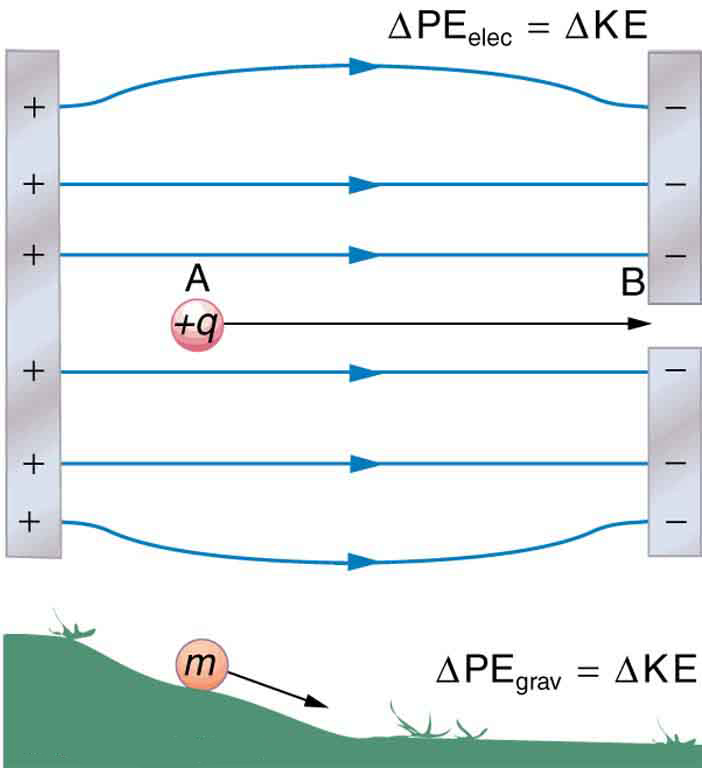
Before diving into formal definitions, let's build some intuition. The concepts of potential energy and potential in electricity are very similar to their gravitational counterparts.
A great way to see this connection is by watching the following video from Khan Academy. It starts with the familiar example of a bowling ball in Earth's gravitational field and masterfully extends the logic to electric charges.
Intro to electric potential | Electric potential and capacitance | Physics | Khan Academy
This video, "Intro to electric potential," explains the core concept by analogy with gravity.
Please watch the following segments: The first part develops the idea of potential energy per unit mass (gravitational potential) from the more familiar concept of gravitational potential energy. Then, from this point, it applies the exact same reasoning to an electric charge, defining electric potential as potential energy per unit charge. Finally, watch the concluding explanation from the end to solidify your understanding of what a "Volt" represents.
As the video explains, the key idea is to define a quantity that describes the energy landscape of a field, independent of the specific object (or charge) we place in it.
- Gravitational Potential at a point is the gravitational potential energy per unit mass ().
- Electric Potential at a point is the electric potential energy per unit charge ().
This analogy is powerful. When you lift a mass against gravity, you do work, and that work is stored as gravitational potential energy. Similarly, when you move a charge against an electrostatic force, you do work, and this work is stored as electrostatic potential energy.
2. Formal Definitions: Potential Energy and Potential
Now that we have the core intuition, let's establish the formal physics definitions as presented in your NCERT textbook. We'll start with electrostatic potential energy, which is the foundation for defining potential.
[PDF] ELECTROSTATIC POTENTIAL AND CAPACITANCE
This reading from your NCERT textbook provides the formal definitions we need.
First, in Section 2.1, please read from the start of the introduction to the definition of potential energy difference. Focus on how work done by an external force (W_{ext}) against the electrostatic force (F_E) is stored as potential energy (\Delta U). Note the important condition that this process happens without acceleration, meaning F_{ext} = -F_E. Next, read the two comments that follow, particularly the part about choosing the zero of potential energy. This establishes the crucial convention of setting potential energy to zero at infinity. Finally, move to Section 2.2 ELECTROSTATIC POTENTIAL. Read the entire section from the beginning to the end. This part makes the critical step from potential energy to potential.
Let's summarize the key definitions from this reading.
Electrostatic Potential Energy Difference ()
The change in potential energy, , when moving a charge from a point R to a point P is defined as the work done by an external force in moving the charge from R to P without acceleration.
Since the electrostatic force is a conservative force (just like gravity), this work done is independent of the path taken.
Electrostatic Potential Energy at a Point ()
By convention, we define the potential energy to be zero at infinity (). With this, the potential energy of a charge at any point P is the work done by an external force in bringing that charge from infinity to point P.

Electrostatic Potential at a Point ()
This is the central concept of today's lesson. The electric potential at a point P is the potential energy per unit charge at that point. It's defined as the work done by an external force in bringing a unit positive charge from infinity to that point.
The SI unit of potential is the volt (V), where 1 Volt = 1 Joule / 1 Coulomb. Electric potential is a scalar quantity.
Electric Potential Difference ()
The potential difference between two points, P and R, is the work done per unit charge to move a charge from R to P. This is what we commonly refer to as voltage.
It is the potential difference that is physically most significant, as it's what drives the movement of charge.
3. The Physical Significance: What Does Potential Tell Us?
Defining these terms is one thing, but understanding what they tell us about the physical world is another. Why is potential such a useful concept?
The short answer is that the electric potential creates an "energy map" of space. By simply knowing the value of the potential (a single number) at different points, we can predict how any charge will behave.
This next video provides a very clear explanation of the "rules" of how charges move in an electric field based on potential.
The video "Electric Potential" from The Organic Chemistry Tutor clearly explains the practical consequence of potential.
Please watch the section from this timestamp. It vividly illustrates how positive and negative charges behave when placed in a region with varying electric potential.
As the video explains, the key rules are:
- An electric field always points from a region of higher potential to a region of lower potential.
- When released in an electric field, a positive charge will spontaneously accelerate from a region of higher potential to a region of lower potential (it "falls" down the potential hill).
- Conversely, a negative charge will spontaneously accelerate from a region of lower potential to a region of higher potential (it's "pushed" up the potential hill).
This predictive power is the true physical significance of electric potential. It tells us the direction of the force on a charge and determines how the charge's potential energy will be converted into kinetic energy. A high potential value at a point means a positive charge placed there will have a large amount of stored energy, ready to be converted to kinetic energy if released.
Conclusion
Let's summarize what we've learned in this lesson.
- Electric Potential (V) is the electrostatic potential energy per unit charge at a point in space. It is defined as the work done to bring a unit positive charge from infinity to that point. It is a scalar quantity measured in Volts (V).
- Electric Potential Difference (), or voltage, is the work done per unit charge in moving a charge between two points.
- Physical Significance: The value of the potential at different points in space creates an "energy map". This map dictates the motion of charges: positive charges naturally move from high to low potential, and negative charges from low to high.
You now have a solid conceptual foundation for what electric potential is. In our next lesson, we will build upon this by deriving the mathematical expression for the potential created by a single point charge. This will give us the tool to calculate the potential for any arrangement of charges using the superposition principle.