Hello! Let's continue our exploration of electrostatic potential.
In our last lesson, we established the fundamental definition of electric potential as the work done per unit charge to bring a charge from infinity to a specific point. We focused on the physical meaning, understanding that potential creates an "energy map" in space. Today, we will build on that foundation by deriving the mathematical formula for the potential created by a single point charge. This is a crucial step, as it provides the building block for calculating the potential of any charge distribution. We will then see how to use this formula, along with the superposition principle, to find the potential from a system of multiple charges.
1. Deriving the Potential of a Point Charge
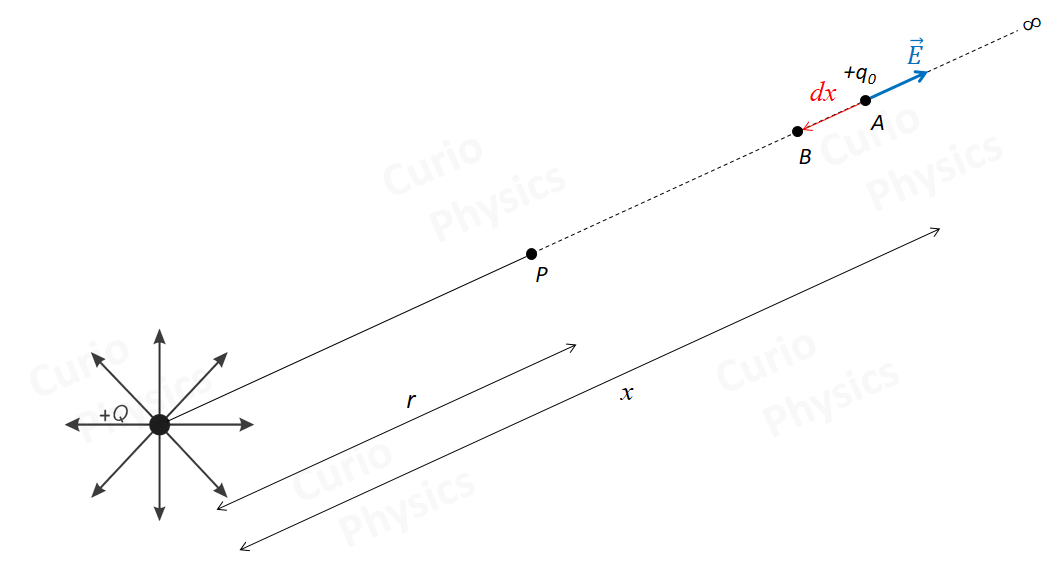
Our goal is to find the potential at a point P, which is at a distance from a single point source charge .
From our previous lesson, we know that potential is defined as the work done () in bringing a unit positive test charge () from infinity to point P:
The challenge is that the electrostatic force exerted by on our test charge is not constant; it changes with distance according to Coulomb's Law (). Therefore, we cannot simply use . This is where your knowledge of calculus becomes essential. To find the total work done against a variable force, we must integrate.
The setup for this derivation is shown in the image below. We calculate the work done to move a unit positive charge from infinity to a point P against the electric field of the source charge .
A video is a great way to see this derivation unfold step-by-step. The following video explains the process very clearly, from setting up the integral to solving it.
Electric potential due to a point charge - class 12 physics
Watch the video "Electric potential due to a point charge" by Dr. Sharath Gore. It provides an excellent walkthrough of the derivation.
Pay close attention to these key stages: Recap of the definition: The initial explanation reinforces why the derivation must be based on calculating work done. Setup and the need for integration: The segment from "according to the definition" explains why the variable force necessitates using calculus. The integration process: The core of the derivation is from this point. Follow how the integral for work is set up and solved, using the limits from infinity to r. The final result: The video concludes from this point by presenting the final formula and discussing its properties.
Now that you've seen the derivation, let's solidify it by reviewing the formal steps in your NCERT textbook. This will ensure you are familiar with the standard presentation for your curriculum.
[PDF] Chapter Two - ELECTROSTATIC POTENTIAL AND CAPACITANCE
Please read the section "POTENTIAL DUE TO A POINT CHARGE" in the textbook.
Focus on the derivation presented in this section. Trace the steps from the definition of work done (Eq. 2.6) to the final integrated result for potential (Eq. 2.8).
After integrating the work done by the external force in moving a unit positive charge from to , we arrive at the fundamental expression for the electric potential due to a point charge at a distance :
Let's note a few important characteristics of this result:
- Scalar Quantity: Potential is a scalar. This is a huge advantage, as we will see shortly.
- Sign: The potential is positive if the source charge is positive and negative if is negative.
- Dependence on Distance: Potential from a point charge decreases with distance, following a relationship. This is a slower fall-off compared to the electric field, which decreases as .
- Zero Reference: This formula assumes that the potential at infinity is zero (), which is the standard convention.
2. Potential due to a System of Charges: The Superposition Principle
What if we have multiple charges and want to find the potential at a point? This is where the scalar nature of potential makes our lives much easier compared to dealing with electric field vectors.
Since potential is a scalar, the net potential at a point P due to a system of point charges is simply the algebraic sum of the potentials created by each charge individually at that point. This is the superposition principle for electric potential.

Mathematically, if are the distances of the charges from point P, the total potential is:
The key is to remember that this is an algebraic sum. You must include the signs of the charges . A positive charge contributes a positive potential, and a negative charge contributes a negative potential.
Let's review the formal statement in your textbook.
[PDF] Chapter Two - ELECTROSTATIC POTENTIAL AND CAPACITANCE
Now, please read the section "POTENTIAL DUE TO A SYSTEM OF CHARGES".
Read the explanation starting from this part up to Equation (2.18). This formally states the superposition principle for potential.
3. Numerical Practice
As you requested, let's put this theory into practice. Working through numerical problems is the best way to master these concepts.
A very common type of problem asks you to find a point where the net potential is zero. Let's look at Example 2.2 from your NCERT book, which addresses exactly this scenario.
In this problem, we have two charges, C and C, separated by 15 cm. The goal is to find the point(s) on the line joining them where the potential is zero.
Let the positive charge be at the origin () and the negative charge at cm. Let the point where be at a position .
The total potential is the sum of the potentials from each charge:
Setting gives:
Solving this equation for the two possible cases (the point is between the charges, or outside) gives the answers cm and cm, as shown in the textbook's solution.
For more practice, the following web resource has a good collection of solved and unsolved problems.
Electric Potential Due to a Point Charge - GeeksforGeeks
This article provides excellent practice problems.
First, review the four Sample Problems to see how the formulas for single charges and systems of charges are applied. Then, I encourage you to try solving the questions in the Unsolved Problems section on your own after this lesson to test your understanding.
Conclusion
Today, we've taken a significant step from concept to calculation. Let's summarize the key takeaways:
- Potential of a Point Charge: We derived the fundamental formula for the potential at a distance from a point charge : .
- Superposition Principle: The potential from a system of charges is the simple algebraic sum of the potentials from each individual charge. This is much simpler than vector addition for electric fields.
- Scalar Nature: Electric potential is a scalar quantity, making calculations for complex systems more straightforward. Remember to include the sign of each charge.
You now have the primary tools to calculate electrostatic potential in many situations. In our next lesson, we will apply these tools to a particularly important configuration: the electric dipole. We will derive expressions for the potential at points along its axis and on its equatorial plane.