Hello! Welcome to your next lesson in thermodynamics.
In our last session, we explored steady-state heat conduction where thermal conductivity, , could vary with temperature. A key feature of steady-state is that temperatures at different points in the object are constant over time.
Today, we shift our focus from steady-state to transient phenomena. What happens when a hot object is placed in a cooler environment and its temperature changes over time? This process is governed by Newton's Law of Cooling. This law is fundamental for understanding how systems equilibrate with their surroundings.
Our goal for this lesson is to apply Newton's law of cooling to solve transient cooling and heating problems. We will derive the law from its differential form—a process your background in calculus and differential equations will make very familiar—and then apply it to the types of problems frequently seen in the JEE Advanced.
1. The Physics and Mathematics of Cooling
Newton's Law of Cooling states that the rate at which an object's temperature changes is directly proportional to the temperature difference between the object and its surroundings.
Mathematically, this is expressed as a first-order ordinary differential equation:
Where:
- is the rate of change of the body's temperature ().
- is the constant temperature of the surroundings.
- is a positive constant that depends on the properties of the object (like surface area and material) and the surrounding medium.
- The negative sign is crucial: if the body is hotter than the surroundings (), then is positive, and must be negative, indicating cooling. Conversely, if , the body heats up ( is positive).
To find how temperature evolves with time, we must solve this differential equation. The following video provides a clear, step-by-step derivation.
Class 11 Physics | Heat Transfer | #25 Instantaneous Analysis of Newton's Law of Cooling |JEE & NEET
This video, 'Instantaneous Analysis of Newton's Law of Cooling' by Physics Galaxy, walks through the process of solving the governing differential equation using separation of variables and integration. This is the 'exact' or 'instantaneous' form of the law.
Watch the video from the beginning up to the timestamp 02:33. Focus on how the variables are separated and how the definite integral is set up with initial conditions (temperature T_0 at time t=0) to arrive at the final expression for temperature T as a function of time t.
The Exponential Cooling Formula
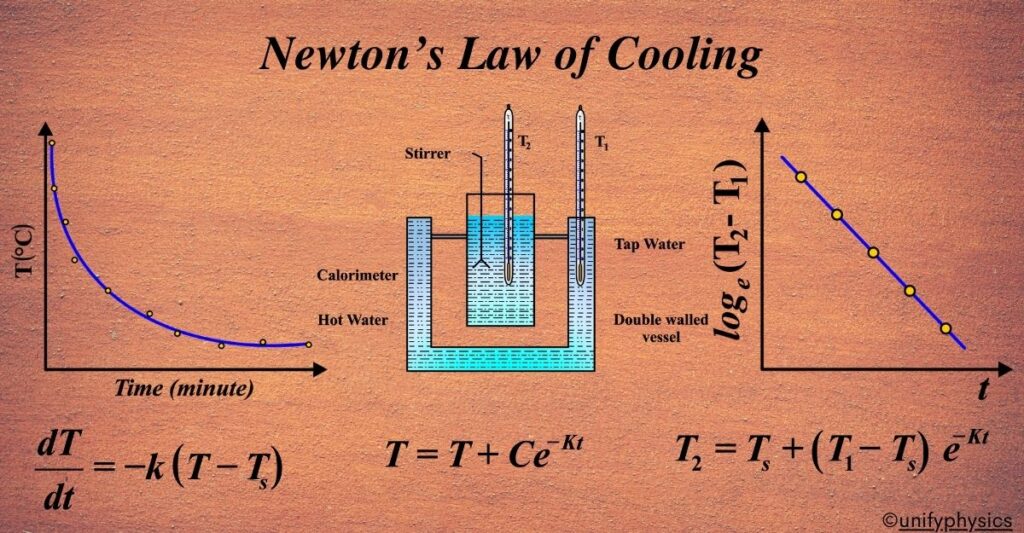
As derived in the video, solving the differential equation gives us the temperature of the body at any time :
Here, is the initial temperature of the body at . This equation describes an exponential decay (or growth, if heating) of the temperature difference .
The temperature asymptotically approaches the surrounding temperature as . This behavior is visualized in the graph below.
2. The Approximate Form: A Practical Tool for Exams
While the exponential formula is exact, many exam problems (especially multiple-choice questions) are designed to be solved more quickly using an approximation. This is valid when we're interested in the time it takes to cool over a specific, relatively small temperature interval.
For a body cooling from temperature to in a time interval , we can make two approximations:
- The instantaneous rate of cooling can be approximated by the average rate: .
- The body's temperature can be approximated by the average temperature over the interval: .
Substituting these into the original law gives us the average form:
Note that the constant here is related to but not identical to the in the exponential formula (it incorporates other factors like mass and specific heat). The key is that it's a constant for a given object and surroundings. This form is extremely useful for problems that involve comparing two different stages of cooling.
Let's see how both the exact and approximate methods can be applied.
Newton's Law of Cooling Formula - BYJU'S
The article 'Newton's Law of Cooling Formula' from BYJU'S provides solved examples that showcase both techniques. It's particularly useful to see them side-by-side.
Please read 'Example 1' in the 'Solved Examples' section. First, study the main solution, which uses the exact exponential formula. Then, carefully read the 'Aliter : (by approximate method)' which solves the same problem using the average form. Notice how both methods yield very similar results (14.096 min vs 14 min).
Test your understanding!
A bucket full of hot water cools from 80°C to 75°C in minutes, from 75°C to 70°C in minutes, and from 70°C to 65°C in minutes. The room temperature is constant. How do , , and relate to each other?
Show answer
According to Newton's Law of Cooling, the rate of cooling is proportional to the temperature difference with the surroundings. In the first interval (80°C to 75°C), the average temperature is highest, meaning the temperature difference is largest. Therefore, the rate of cooling is fastest, and the time taken, , is the shortest.
As the water cools, the average temperature in each subsequent interval decreases, reducing the temperature difference and slowing the rate of cooling. Therefore, it takes longer to cool through each subsequent 5°C interval.
This means . This is a direct consequence of the exponential nature of cooling.
3. Advanced Problem-Solving with Ratio Analysis
A common pattern in JEE Advanced problems is to provide information about one cooling process to find a property of the object, which is then used in another process. The approximate formula is ideal for this, as it allows us to eliminate the unknown constant by taking ratios.
The next video demonstrates a problem where Newton's Law of Cooling is used to determine the density of a liquid. This is a great example of combining different physics concepts, a hallmark of advanced problems.
14. Advance Illustration | Heat Transfer | Density calculation by Newton's Law of Cooling
In this 'Advance Illustration' from Physics Galaxy, the average form of Newton's Law of Cooling is applied to two different liquids (water and an unknown liquid) cooling under the same conditions. Pay close attention to how the two equations are set up and then divided to solve for the unknown density.
Watch the entire video. Notice how the rate of cooling (T1 - T2) / Δt is related to the properties of the substance through the term k / (ms). When comparing two scenarios, the unknown calorimeter constant k and the temperature term (T_avg - T_s) cancel out, simplifying the problem significantly.
4. Practice Problems
To solidify your understanding, let's work through a couple of typical exam-style questions. Try to solve them yourself first before looking at the solution.
Objective Question Answer for Newton's law of cooling Quiz - Testbook
This resource from Testbook provides a set of multiple-choice questions. Let's tackle two representative problems.
First, attempt 'Newton’s law of cooling Question 2'. This one is best solved using the exact exponential form. Then, solve 'Newton’s law of cooling Question 3', which is a classic application of the approximate (average) method. Compare your approach to the provided detailed solutions.
Finally, it's important to remember the conditions under which Newton's Law of Cooling is a good model. The law works best when:
- The temperature difference between the object and surroundings is not too large (typically < 30-40°C).
- The surrounding temperature remains constant.
- Heat loss is primarily through convection and radiation, and the properties of the surface don't change as it cools.
Conclusion
In this lesson, we have thoroughly analyzed Newton's Law of Cooling, a key principle for describing how objects thermally interact with their environment over time.
Key Takeaways:
- Transient cooling is governed by the differential equation .
- The exact solution gives an exponential decay of temperature: .
- For problems involving cooling over finite intervals, the approximate formula is a powerful and efficient tool.
- Many complex problems can be simplified by setting up ratios to eliminate unknown constants.
Preview of the Next Lesson:
We have now studied steady-state conduction and transient cooling (convection) as separate topics. The next logical step is to combine them. In our next lesson, we will solve steady-state problems combining heat conduction through a body with convection at its boundaries. We will analyze scenarios where heat flows through a wall and is then carried away by a fluid, a situation that requires us to link Fourier's Law with Newton's Law.