Hello! Let's dive into our next lesson on heat transfer.
In our last session, we focused on Newton's Law of Cooling, which describes the transient process of an object's temperature changing over time due to heat exchange with its surroundings, a process dominated by convection. Before that, we established the principles of steady-state heat conduction using Fourier's Law.
Today, we'll combine these two concepts. Our goal is to solve steady-state problems combining heat conduction through a body with convection at its boundaries. This is a very common scenario in both engineering and physics problems—think of heat leaking through the wall of a house on a cold day. The heat is conducted through the wall and then carried away from the outer surface by wind (convection).
To tackle these combined problems efficiently, we will introduce a powerful analytical tool: the concept of thermal resistance. Given your background, the analogy to electrical circuits will be particularly direct and useful.
1. The Concept of Thermal Resistance
The core idea is to reframe our heat transfer equations to mirror Ohm's Law, . In our thermal analogy:
- Heat flow rate, (in Watts), is analogous to electric current, .
- Temperature difference, , is analogous to voltage difference, .
- Thermal Resistance, , is analogous to electrical resistance, .
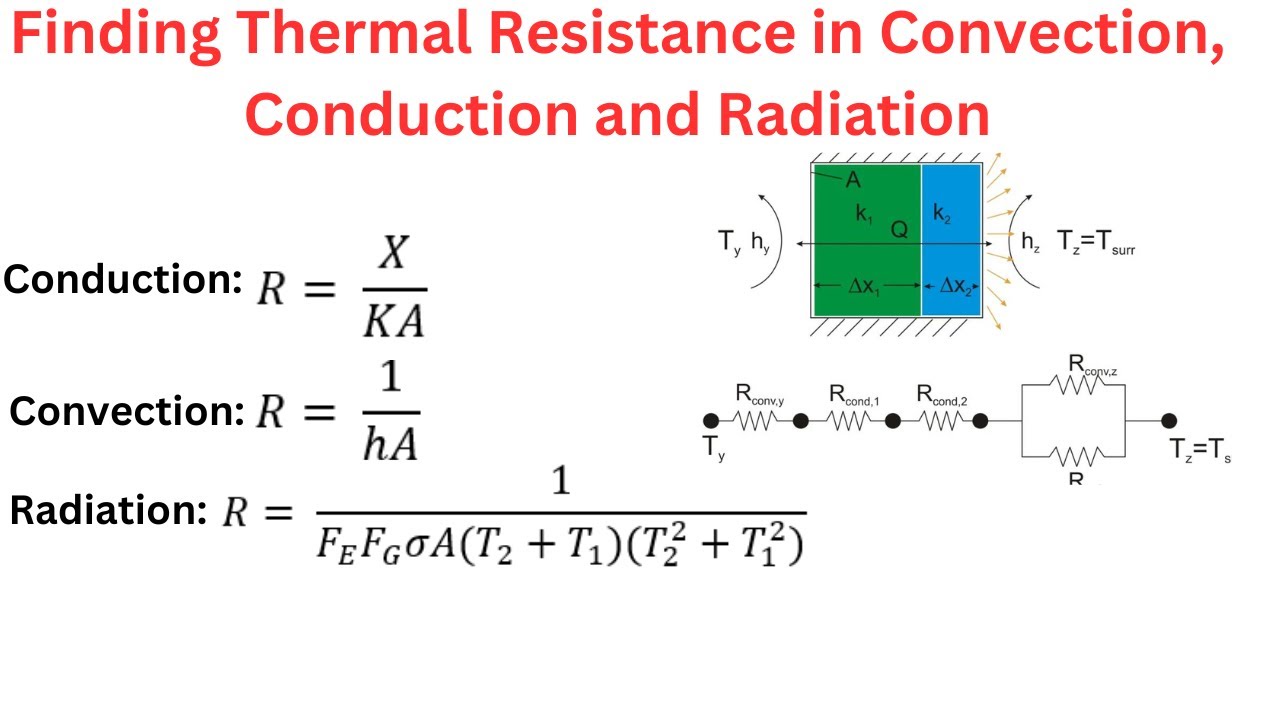
Conduction Resistance
Let's start with Fourier's Law for steady-state conduction through a plane wall:
where is the thermal conductivity, is the cross-sectional area, and is the thickness.
Rearranging this into the Ohm's Law format gives:
From this, we can define the conduction thermal resistance:
Convection Resistance
Now, let's look at the heat transfer at a fluid-solid boundary. In the previous lesson, we saw Newton's Law describing the rate of temperature change. In a steady-state scenario, the same law describes the constant rate of heat flow from a surface to a surrounding fluid:
where is the convective heat transfer coefficient.
Rearranging this into the resistance format:
This gives us the convection thermal resistance:
The image below summarizes these resistance formulas. For now, focus on the expressions for conduction and convection.
2. Combining Resistances: The Series Circuit Analogy
Consider a plane wall separating a hot fluid from a cold fluid. For heat to get from the hot fluid to the cold fluid, it must pass through three stages sequentially:
- Convection from the hot fluid to the inner wall surface.
- Conduction through the wall itself.
- Convection from the outer wall surface to the cold fluid.
Since the heat must flow through each of these stages one after the other, their thermal resistances are in series.

Just as with electrical resistors in series, the total thermal resistance is the sum of the individual resistances:
The total steady-state heat flow rate, , is then easily found:
This is a much more systematic approach than solving a system of three separate heat transfer equations. Once you find the total heat flow , you can easily find the intermediate surface temperatures. For example, to find the temperature of the inner wall surface, :
3. Worked Example
Let's apply this to a typical problem.
Problem: An industrial freezer has a wall made of concrete ( W/m·K) that is 20 cm thick. The inside air temperature is maintained at and the outside air temperature is . The heat transfer coefficients are W/m²·K on the inside and W/m²·K on the outside. Calculate the heat loss per square meter of the wall and find the temperatures of the inner and outer surfaces of the wall.
Solution:
-
Identify Resistances (per unit area, A=1 m²):
- Inner convection: K/W
- Conduction: K/W
- Outer convection: K/W
-
Calculate Total Resistance:
- K/W
-
Calculate Heat Flow Rate (H):
- The total temperature difference is K.
- W.
- So, the heat loss is 100 W per square meter.
-
Calculate Surface Temperatures:
- Inner surface temperature, : The temperature drops from the inside air to the inner surface.
.
Wait, this is incorrect. The heat flows from outside (hot) to inside (cold). The direction of temperature drop follows the heat flow. Let's write the equations correctly:
. - Inner surface temperature, :
. - As a check, let's verify the temperature drop across the concrete wall: K. The temperature drop is . It matches perfectly.
- Inner surface temperature, : The temperature drops from the inside air to the inner surface.
Test your understanding!
A problem from a JEE preparation manual asks you to find the steady-state temperature of a tank. This problem is similar to one in the provided resources.
Problem: A metal tank contains a 1 kW immersion heater. The tank is covered with a 4 cm thick layer of insulation ( W/m·K). The total surface area of the tank is 5 m². The surrounding air is at 25°C, and the convective heat transfer coefficient on the outer surface is W/m²·K. In steady state, what is the temperature of the tank wall, ? (Assume the metal tank wall itself has negligible thermal resistance).
Show answer
In steady state, the heat generated by the heater must equal the heat leaving the tank.
- Heat Flow, W.
The heat flows from the tank wall, through the insulation, and then into the air. This involves two thermal resistances in series:
- Conduction resistance of the insulation:
K/W. - Convection resistance from the outer surface to the air:
K/W.
The total thermal resistance from the tank wall to the surrounding air is:
K/W.
Now we can use the main thermal resistance equation:
.
4. Practice for JEE Advanced
The thermal resistance model is extremely versatile. To practice with problems at the JEE Advanced level, which often involve complex arrangements, it is helpful to master the series resistance concept first. The following resource contains past JEE problems. Try to re-solve Problem 17 from the EXERCISE (JA) section, which involves two cylinders in series. While it only deals with conduction, it reinforces the core idea of calculating heat flow through a series of thermal resistances.
[PDF] Elasticity, Thermal Expansion, Calorimetry & Heat Transfer
Let's review a classic JEE Advanced problem involving series thermal resistance. This problem, from a PDF of previous exam questions, tests the application of series resistance for cylindrical conductors.
Find problem 17 in the 'EXERCISE (JA)' section (page 63 of the PDF). The problem describes two conducting cylinders of different radii connected in series. Read the problem statement and the provided solution. Your task is to re-derive the result for the ratio K1/K2 using the thermal resistance framework we've developed. Note that for a cylinder, the area is A = πr².
Conclusion
Today, we've developed a robust method for analyzing systems with both conduction and convection. By framing heat transfer in terms of thermal resistance, we can simplify complex, multi-step problems into straightforward circuit analysis.
Key Takeaways:
- The concept of thermal resistance () allows us to model heat transfer using an analogy to electrical circuits.
- The resistance for conduction through a plane wall is .
- The resistance for convection at a surface is .
- When heat flows sequentially through different materials or processes, their thermal resistances add up in series: .
Preview of the Next Lesson:
We've now mastered the series combination of resistances. The next logical step is to see what happens when heat has multiple paths to follow. In our next lesson, we will analyze heat conduction through composite slabs in series and parallel using thermal resistance networks. This will expand our circuit analogy to handle more complex geometries, fully preparing you for the intricate conduction problems often seen in the JEE Advanced.