Hello! Welcome to our next lesson.
In our last session, we derived and applied the master formulas for calculating the entropy change, , for an ideal gas undergoing processes where temperature, pressure, and volume change. We saw that could be found using initial and final states, because it is a state function.
Today, we'll address a different but equally important scenario: what happens to entropy during a phase transition, like ice melting or water boiling? These processes occur at a constant temperature. This lesson will equip you to calculate entropy changes during phase transitions at constant temperature, a crucial skill for analyzing multi-step thermodynamic problems you'll encounter in JEE Advanced.
We'll start with the fundamental formula, understand its physical meaning in terms of molecular disorder, and then apply it to solve complex problems that combine both temperature changes and phase transitions.
1. The Entropy of Phase Transition
Recall the fundamental definition of entropy change from our previous discussions:
A phase transition, such as the melting of ice at 0°C (273.15 K) and 1 atm, is a prime example of a reversible process that occurs at a constant temperature. Because the temperature is constant, we can pull it out of the integral:
The heat absorbed or released during a phase transition is the latent heat. At constant pressure, this heat transfer is equal to the change in enthalpy, . Therefore, for a phase transition, the formula becomes exceptionally straightforward.
To understand this core concept, please review the following brief article and video.
Entropy Changes in Reversible Processes
This reading from Chem LibreTexts provides a concise explanation of why the simple formula ΔS = q_rev/T is perfectly suited for phase changes and gives a clear example with the melting of ice.
Please read the sections titled 'Work and Reversibility' and the paragraph describing the reversible melting of ice. Focus on how the general entropy definition, ΔS, simplifies to ΔS = q_rev/T for constant-temperature processes and how this is applied using the enthalpy of fusion (ΔH_fus).
Entropy Change For Melting Ice, Heating Water, Mixtures & Carnot Cycle of Heat Engines - Physics
This short video provides a direct, no-frills calculation for the entropy change of melting ice. It's a perfect demonstration of applying the formula in practice.
Watch the first 1 minute and 20 seconds of the video, which calculates the entropy change for melting 15 grams of ice. Notice the direct application of Q = mL_f and ΔS = Q/T.
To summarize, the entropy change during a phase transition is given by:
where:
- is the molar enthalpy of transition (e.g., fusion, vaporization). Its units are typically J/mol or kJ/mol.
- is the absolute temperature (in Kelvin) at which the transition occurs.
If you are working with mass instead of moles, the formula is:
where is the mass and is the specific latent heat (e.g., J/g or J/kg).
2. Physical Interpretation: Disorder, Signs, and Magnitude
The sign of tells us whether the system is becoming more or less ordered. A phase transition is a perfect illustration of this.
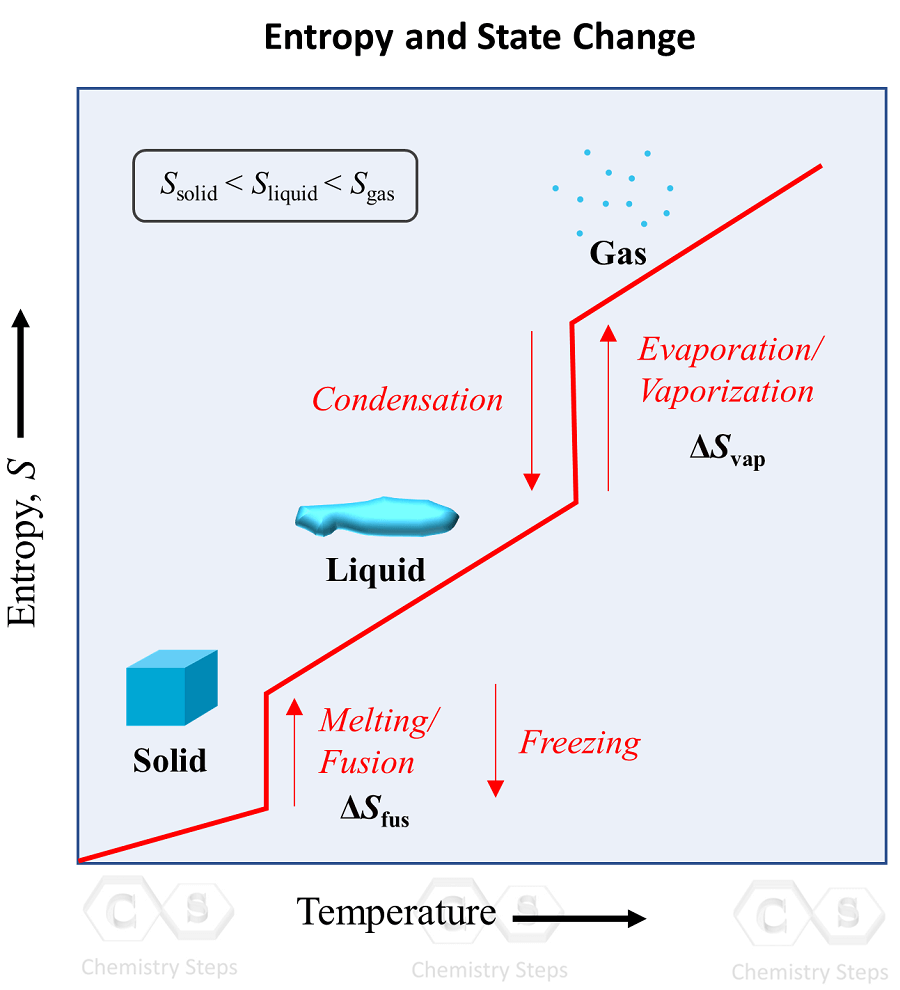
Let's watch a short video that connects the sign of to the physical process.
Entropy of Phase Transitions | Physical Chemistry I | 044
Professor Derricotte explains the relationship between the sign of entropy change and the nature of the phase transition (endothermic vs. exothermic). This provides the conceptual 'why' behind the calculations.
Watch from the beginning to 6:13. Pay close attention to: The link between heat at constant pressure (q_p) and enthalpy (\Delta H). Why endothermic transitions (melting, vaporization) lead to a positive \Delta S (increase in disorder). Why exothermic transitions (freezing, condensation) lead to a negative \Delta S (increase in order).
As the video explains:
- Melting (Solid Liquid) & Vaporization (Liquid Gas): These are endothermic processes (). The system absorbs heat to break intermolecular bonds, allowing molecules more freedom of movement. This increases the number of possible microstates, so disorder increases and .
- Freezing (Liquid Solid) & Condensation (Gas Liquid): These are exothermic processes (). The system releases heat as molecules settle into a more structured arrangement. This decreases the number of available microstates, so order increases and .
This aligns perfectly with our intuition about the states of matter: a gas is more disordered than a liquid, which is more disordered than a solid.
Test your understanding!
The molar enthalpy of vaporization of ethanol is 38.6 kJ/mol at its boiling point of 78°C. Calculate the molar entropy of vaporization for ethanol. Does the sign of your answer make sense?
Show answer
First, convert the temperature to Kelvin:
K
Next, convert the enthalpy to Joules:
Now, apply the formula:
The sign is positive, which makes physical sense. Vaporization is a transition from a relatively ordered liquid to a highly disordered gas, so the entropy of the system must increase.
3. Combining Concepts: Multi-Step Processes
JEE Advanced problems rarely test a single concept in isolation. A common problem type involves a substance undergoing both a temperature change and a phase change. Since entropy is a state function, we can calculate the total entropy change by summing the for a series of reversible steps that connect the initial and final states.
Problem: Calculate the total entropy change when 2 moles of supercooled liquid water at -10°C and 1 atm are converted to ice at -10°C.
Given:
Analysis:
The process is happening at a constant temperature of -10°C. However, this is not the equilibrium phase transition temperature. The process as stated (liquid to solid at -10°C) is irreversible and spontaneous.
To calculate , we must construct a hypothetical reversible path between the initial state (liquid water at -10°C) and the final state (ice at -10°C).
The logical reversible path is:
- Step 1: Heat the liquid water from -10°C (263.15 K) to 0°C (273.15 K).
- Step 2: Freeze the liquid water to ice at the equilibrium temperature of 0°C (273.15 K).
- Step 3: Cool the ice from 0°C (273.15 K) back down to -10°C (263.15 K).
The following image illustrates this exact strategy.

Calculation:
-
Step 1: (Heating liquid)
This is an entropy change with varying temperature, which we covered in the last lesson. -
Step 2: (Phase change at 0°C)
This is the core of today's lesson. Freezing is exothermic, so is negative. -
Step 3: (Cooling ice)
Another temperature-dependent change. -
Total Entropy Change:
The final entropy change is negative, which is what we expect for a spontaneous freezing process. This type of problem is a classic example of applying state functions to bridge an irreversible process with a calculable, reversible path.
Conclusion
Today we've added a crucial tool to your thermodynamics problem-solving kit. By understanding how to handle phase transitions, you can now calculate entropy changes for a much wider range of physical processes.
Key Takeaways:
- For a phase transition occurring at a constant equilibrium temperature , the entropy change is calculated with the simple formula: .
- The sign of reflects the change in molecular disorder:
- Positive for melting/vaporization (more disorder).
- Negative for freezing/condensation (more order).
- To calculate for complex or irreversible processes, you can construct a hypothetical path of simpler, reversible steps (like temperature changes and equilibrium phase transitions) and sum their individual entropy changes.
Preview of the Next Lesson:
We are now entering the final module of the course, which focuses on integrated problems. We will start by connecting thermodynamics to other areas of physics. In the next lesson, we will solve problems where work done during a thermodynamic process is converted to heat in a calorimeter, bridging the concepts of P-V diagrams and calorimetry.