Hello! Welcome to the final module of our course, where we'll focus on integrated problems that combine concepts from different areas of thermodynamics and calorimetry. This is where your skills will be sharpened for the multi-step challenges typical of the JEE Advanced exam.
In our previous lessons, we've explored calorimetry and thermodynamics in depth, culminating in the calculation of entropy changes. Today, we'll begin to weave these threads together. Our goal is to solve problems where work done during a thermodynamic process is converted to heat in a calorimeter. This lesson bridges the mechanical world of pistons and gases with the thermal world of temperature changes, all governed by the fundamental principle of energy conservation.
1. The Principle of Energy Conversion: Work into Heat
The idea that mechanical work can be transformed into heat was a cornerstone in the development of thermodynamics. Before this, work and heat were considered distinct phenomena. James Joule's experiments in the 1840s conclusively showed that a specific amount of mechanical work always generates a corresponding amount of heat. This relationship is known as the mechanical equivalent of heat.
While we now use the same unit, the Joule (J), for both energy and work, understanding this equivalence is key to solving integrated problems. Mechanical energy lost by a system (e.g., through friction, or work done on a gas) doesn't just vanish; it is often converted into thermal energy, causing a temperature rise.
To see this principle in action, let's watch a video that introduces the concept and applies it to a classic mechanics problem.
2 Heat capacity |Water equivalent | Mechanical equivalent of heat | Law of calorimetry | IIT JEE
This video from Mohit Tyagi explains the mechanical equivalent of heat and demonstrates how mechanical energy loss is converted into heat. Focus on the core idea of conversion and the first example.
Watch from 12:39 to 21:05. Pay attention to: The introduction to the 'Mechanical Equivalent of Heat' and the relationship between Joules and calories. The first solved example of a block sliding down an incline. Notice how the work done by friction (mechanical energy loss) is calculated and then equated to the heat gained by the block (ms\Delta T).
A Classic Example: Joule's Paddle Wheel
The most famous demonstration of this principle is Joule's paddle wheel experiment. In this setup, a falling weight's potential energy is converted into the kinetic energy of a paddle wheel, which in turn churns water in an insulated container (a calorimeter). The viscous drag on the paddles converts this kinetic energy into internal energy of the water, raising its temperature.

Let's solve this problem as our first example of direct work-to-heat conversion.
Problem Analysis:
- Mechanical Work Done: The work is done by gravity on the falling mass. The potential energy lost by the mass is .
- Heat Gained: This work is entirely converted into heat absorbed by the water. So, .
- Calorimetry: The heat absorbed by the water raises its temperature according to .
Calculation:
- Calculate the work done (or potential energy lost):
- Equate work and heat: J.
- Calculate the temperature change of the water:
This corresponds to option (D). The key step is the direct equation: .
2. The Sign Convention Bridge
When the work is done by a thermodynamic process, like the compression of a gas, we must be careful with sign conventions. As you've noted, this is a frequent point of confusion. Let's clarify it.
The First Law of Thermodynamics relates the change in internal energy () to heat () and work (). The two main conventions arise from how work is defined:
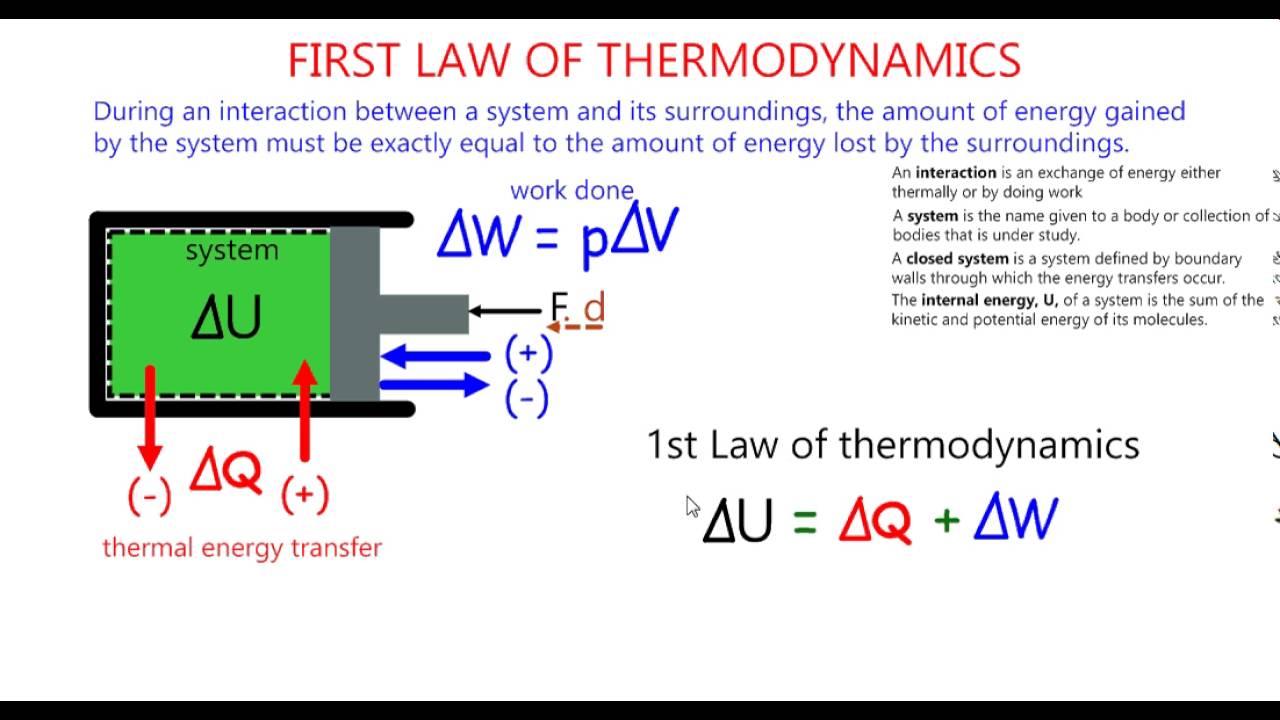
-
Physics/Engineering Convention:
Here, is work done by the system (e.g., a gas expanding). For compression, work is done on the system, so is negative. -
Chemistry (IUPAC) Convention:
Here, is work done on the system. For compression, is positive.
Both conventions are self-consistent because . The key is to understand what the work term represents.
So, how does this relate to calorimetry?
When a gas is compressed and this action heats a surrounding calorimeter, the energy that enters the calorimeter as heat is the work that was done on the gas.
Therefore, the crucial link is:
Regardless of which convention you use to analyze the gas, the heat absorbed by the calorimeter is the positive magnitude of the energy transferred via work.
Why is the sign convention just opposite in thermodynamics, physics and chemistry?
This Quora discussion offers an excellent explanation for why the sign conventions differ and, more importantly, how to confidently translate between them. It directly addresses your concern about this topic.
Read the three selected answers. The first (by Ron Brown, starts 'I think you are asking...') clearly lays out the two equations. The second (by an Assistant bot, starts 'The apparent opposite sign conventions...') gives a practical rule-of-thumb for translating. The third (by an unlisted user, starts 'Physics treats system as the doer...') provides a numerical example showing how both conventions lead to the same result. This will be very helpful.
Test your understanding!
A gas is compressed adiabatically, and the work done on the gas is 500 J. The gas is in a cylinder that is part of a calorimeter. How much heat energy is supplied to the calorimeter?
Show answer
Exactly 500 J. The work done on the gas is the energy transferred to it. Since the process is adiabatic (), this energy increases the gas's internal energy. In this integrated system, this energy is what heats the calorimeter. So, .
If the problem had stated "work done by the gas is -500 J" (the physics convention for the same compression), the heat supplied to the calorimeter would be . The physical result is the same.
3. Integrated Problem-Solving Strategy
Now let's combine these ideas to tackle a complete problem. The structure of these problems usually involves a thermodynamic process providing energy to a calorimetric system.
Here's a systematic approach:
-
Analyze the Thermodynamics:
- Identify the system (the gas) and the process (e.g., adiabatic, isothermal).
- Identify the initial and final states ( and ).
- Calculate the work done during the process. The most direct method is often to use the First Law. For an adiabatic process, , so .
-
Apply Energy Conservation:
- Equate the heat gained by the calorimeter to the work done on the gas: .
-
Analyze the Calorimetry:
- Identify the components of the calorimeter (e.g., water, container).
- Use the calorimetry equation: .
- Solve for the unknown variable, which is usually the final temperature.
Worked Example: Adiabatic Compression Heats a Calorimeter
Problem: A thermally insulated cylinder is fitted with a frictionless piston. It contains 0.1 moles of a monoatomic ideal gas () at an initial temperature of 300 K. The cylinder itself is placed inside a large calorimeter containing 0.5 kg of water at 300 K. The gas is slowly compressed adiabatically until its volume is halved. Calculate the final temperature of the water.
Given:
- Molar specific heat of water,
- Molar gas constant,
Solution:
Step 1: Analyze the Thermodynamics (The Gas)
- The process is adiabatic compression.
- For a monoatomic ideal gas, .
- We need the final temperature of the gas, . For an adiabatic process, .
- Now, calculate the work done on the gas. Since the process is adiabatic, .
Step 2: Apply Energy Conservation
- The work done on the gas is transferred as heat to the water in the calorimeter. We assume the cylinder has negligible heat capacity for simplicity.
Step 3: Analyze the Calorimetry (The Water)
- The heat absorbed by the water causes its temperature to rise.
- The final temperature of the water is:
This example perfectly illustrates the integration of concepts: using adiabatic relations to find state changes, applying the First Law to find work, and connecting that work to a calorimetric calculation.
Conclusion
In this lesson, we established the critical link between mechanical work and heat, a direct application of the First Law of Thermodynamics and the principle of energy conservation.
Key Takeaways:
- Mechanical work and thermal energy are inter-convertible. The energy from work done on a system (like compressing a gas) can be transferred as heat to a surrounding calorimeter.
- The crucial connection is . Mastering this helps navigate the different sign conventions used in physics and chemistry.
- Solving integrated problems requires a clear, multi-step strategy: analyze the thermodynamic process to find the work done, equate this work to the heat absorbed by the calorimeter, and then solve the calorimetry part of the problem.
Preview of the Next Lesson:
We will continue exploring integrated problems. In the next lesson, we will shift our focus from work to heat. We will analyze problems where heat exchanged during a thermodynamic cycle is used to induce temperature or phase changes in another system. This will further strengthen your ability to solve complex, multi-part problems.