Hello! Welcome to the first lesson in our module on Thermodynamics.
In our previous module, we finished our study of gases by examining the behavior of real gases using the van der Waals equation and the compressibility factor, . We saw how mathematical models help us understand and predict the physical world. Now, we transition from the properties of substances to the universal laws governing energy itself.
This lesson introduces the First Law of Thermodynamics. As you specifically highlighted, the sign conventions for heat and work can be a major source of confusion, especially when switching between physics and chemistry contexts. Today, our primary goal is to demystify this. We will break down the two major conventions, understand why they exist, and learn how to apply them correctly. Mastering this is fundamental for nearly every problem in thermodynamics you'll encounter in JEE Advanced.
1. The Building Blocks: Internal Energy, Heat, and Work
The First Law of Thermodynamics is a statement about the conservation of energy. It relates three key quantities:
-
Internal Energy (): This represents the total energy contained within a system. It's the sum of the kinetic energies (from the motion of molecules) and potential energies (from intermolecular forces) of all the particles in the system. For an ideal gas, internal energy depends only on temperature. Importantly, is a state function, meaning its value depends only on the system's current state (e.g., its temperature and pressure), not on how it got there.
-
Heat (): This is the energy transferred between a system and its surroundings due to a temperature difference. It is not energy a system has, but energy in transit. It is a path function, meaning the amount of heat transferred depends on the specific process taken between two states.
-
Work (): This is the energy transferred when a force acts through a distance. In thermodynamics, this often involves a gas expanding and pushing a piston. Like heat, work is energy in transit and is also a path function.
The sign convention for heat () is universally agreed upon in both physics and chemistry.
The First Law of Thermodynamics: Closed Systems
This document, 'The First Law of Thermodynamics: Closed Systems', provides a standard definition for the sign convention of heat. Let's start with this common ground.
Read the section under 'Heat' focusing on the 'Sign convention'.
As the text states:
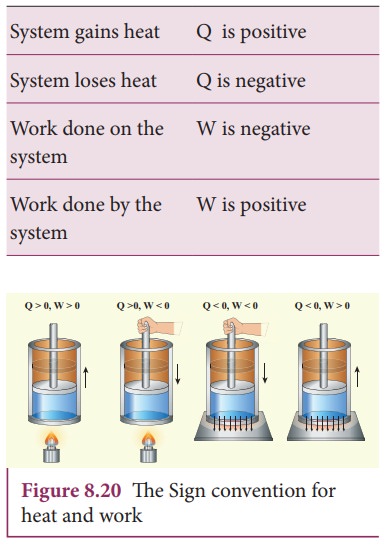
- : Heat is transferred to the system (the system gains energy).
- : Heat is transferred from the system (the system loses energy).
The confusion arises with the sign of work, .
2. The Core of the Convention Difference: What is "Work"?
The entire difference between the physics and chemistry versions of the First Law boils down to the definition of the symbol . Does it stand for work done by the system, or work done on the system?
To get to the bottom of this, let's turn to a foundational explanation from Prof. H.C. Verma, whose work is a cornerstone of JEE preparation.
First Law of Thermodynamics : sign convention for WORK
In his video 'First Law of Thermodynamics : sign convention for WORK', Prof. Verma provides an exceptionally clear explanation. He shows that the fundamental definition of work is universal, and the sign convention is simply a choice of perspective.
Please watch from 00:46 to 08:43. The first part (up to 03:41) establishes that the physical definition of work (W = \int \vec{F} \cdot d\vec{s}) is unambiguous. The second part (from 03:41 onwards) masterfully applies this to a piston, showing how 'work done BY the gas' and 'work done ON the gas' are naturally opposite in sign.
As Prof. Verma explained, the physics is not different, only the focus is. Let's formalize the two viewpoints.
The Physics / Engineering Convention
Physicists and engineers are often interested in creating engines or devices that do useful work on the surroundings. Think of a car engine using expanding gas to turn the wheels. From this perspective, it's natural to define work done BY the system as positive.
- Work done BY the system is positive (). This happens during expansion.
- Work done ON the system is negative (). This happens during compression.
This is the convention we'll see most often in physics problems.
The Chemistry Convention (IUPAC)
Chemists are often interested in the energy changes within the system itself, such as a chemical reaction in a flask. From this perspective, any energy added to the system—whether by heating it or doing work on it—increases its internal energy. It's natural to define work done ON the system as positive.
- Work done ON the system is positive (). This happens during compression.
- Work done BY the system is negative (). This happens during expansion.

The key relationship is simple:
3. Formulating the First Law: Two Sides of the Same Coin
Now we can write the First Law equation using both conventions. The underlying principle is always the same: Change in Internal Energy = Energy In - Energy Out.
Physics Formulation:
Here, the symbol stands for work done BY the system.
- Energy In: Heat added to the system ().
- Energy Out: Work done by the system on its surroundings ().
- The net change in internal energy is therefore:
Chemistry Formulation:
Here, the symbol stands for work done ON the system.
- Energy In: Heat added to the system () AND work done on the system ().
- Energy Out: None in this formulation.
- The net change in internal energy is the sum of all energy inputs:
These are not two different laws. They are two different notations for the exact same physical law. If we take the chemistry equation and substitute , we get , which is the physics equation.
Let's watch a final video that neatly summarizes and contrasts the logic of both viewpoints.
Confusion b/w Physics & Chemistry Thermodynamics | Physics | JEE & NEET | ATP STAR | Shantanu sir
The video 'Confusion b/w Physics & Chemistry Thermodynamics' by ATP STAR directly tackles the question from a JEE prep perspective, explaining the 'why' behind each convention.
Watch from 01:19 to 08:14. The first part explains the physics rationale (energy given is used for \Delta U and work output). The second part explains the chemistry rationale (internal energy is increased by heat input and work input).
Test your understanding!
A gas in a cylinder expands, pushing a piston and doing 500 J of work on the surroundings. During this process, it absorbs 200 J of heat from a flame. What is the change in the internal energy of the gas? Calculate the answer using BOTH conventions to prove you get the same result.
Show answer
Given:
- Heat absorbed by the system: J (This is positive for both conventions).
- Work done by the system: J.
1. Using the Physics Convention ()
Here, represents the work done by the system.
2. Using the Chemistry Convention ()
Here, represents the work done on the system. Since the system did 500 J of work by itself, the work done on it is the negative of that value.
J.
Both conventions give the same result: the internal energy of the gas decreased by 300 J. The energy that left as work (500 J) was greater than the energy that entered as heat (200 J).
4. A Foolproof Strategy for JEE Problems
To avoid errors in an exam, you don't need to memorize both formulas. You need a consistent system.
- Choose Your Convention: Pick one form of the equation and stick with it for all problems. The physics convention () is common in most standard physics textbooks (like H.C. Verma). Let's use it as our default.
- Define Your Terms: Always start by stating what your represents: "Let be the work done by the system."
- Read and Translate: Read the problem statement carefully.
- If it says "the system does 100 J of work," then J.
- If it says "100 J of work is done on the system," then the work by the system is the negative of this, so J.
- If it says "the gas is compressed," you know work is done on the system, so the work by the system, , will be negative.
- Solve: Substitute the translated values into your chosen equation.
Let's see this in action with a numerical example from the provided resources.
Why is the sign convention just opposite in thermodynamics, physics ...
This Quora answer provides an excellent, concise explanation and a perfect numerical example to solidify your understanding.
First, quickly read the sections by 'Ron Brown' and 'Tushar Sharma' for a recap of the 'why'. Then, carefully study the numerical problem at the end of the answer by 'Aryan Mishra'. Notice how he arrives at the same answer (\Delta U = 12.03 kJ) using both conventions.
Conclusion
Congratulations on completing this crucial foundational lesson. The perceived conflict in thermodynamics is not one of physics, but of language and focus.
Key Takeaways:
- The First Law of Thermodynamics is .
- The sign for heat, , is universal: positive for heat in, negative for heat out.
- The two main forms of the law, (Physics) and (Chemistry), differ only in their definition of the symbol .
- In the Physics convention, is work done by the system.
- In the Chemistry convention, is work done on the system.
- You can use either convention as long as you are consistent. The key is to correctly translate the problem statement into the sign of for your chosen formula.
Preview of the Next Lesson:
In our next lesson, we will continue to build on this foundation. We will practice applying these conventions to solve more complex problems, focusing specifically on how to calculate work () from P-V diagrams and for different thermodynamic processes, and then using the First Law to find the other quantities ( or ).