Introduction
Welcome to our next lesson on the inner workings of Java. In our previous sessions, we've pulled back the curtain on how the JVM handles lambda expressions, culminating in our exploration of the invokedynamic instruction and the LambdaMetafactory. We saw how this powerful mechanism allows for the lazy, efficient creation of lambda instances at runtime. This foundation is not just an academic curiosity; it's the very technology that enables modern Java features to be both expressive and performant.
Today, we'll see that machinery in action as we dissect one of Java 8's most significant additions: the Stream API. You've likely used streams to write clean, declarative data processing code, but have you ever wondered how they achieve their apparent "magic"? How can they process vast datasets without loading everything into memory? How does parallelStream() work with just a simple method call? This lesson will answer those questions. Our goal is to explain how Java Streams work internally, focusing on the core principles of lazy evaluation, pipeline construction, and the Spliterator-based execution model.
The Art of Laziness: Intermediate vs. Terminal Operations
The most fundamental concept to grasp about streams is their laziness. Unlike a for loop that executes immediately, a stream pipeline does nothing until it is absolutely forced to. Operations on a stream are divided into two categories:
- Intermediate Operations: These are operations that return a new stream, such as
filter(),map(),sorted(), anddistinct(). They are "lazy" because they don't perform any processing. Instead, they build up a description of the work that needs to be done. - Terminal Operations: These are operations that produce a result or a side-effect, such as
collect(),forEach(),count(), orfindFirst(). When a terminal operation is invoked, and only then, the stream pipeline begins its work.
To see this in action, let's watch a short demonstration that uses a debugger to trace the execution flow.
Java Streams API Explained (with examples)
The video "Java Streams API Explained" provides an excellent visual demonstration of lazy evaluation.
Please watch the segment from this point. The presenter sets a breakpoint inside a filter operation and shows that the breakpoint is only hit after the terminal count() operation is called, proving that the intermediate operations are not executed when they are declared.
As you saw, the intermediate operations merely set up a plan. The terminal operation is the "go" signal that consumes the stream and triggers the execution of that plan. This laziness is the source of many of the Stream API's efficiencies.
Building the Pipeline: A Chain of Stages
So, if intermediate operations don't execute, what do they do? They build a data structure that represents the processing pipeline. Internally, a stream is represented by a linked list of stages, where each stage knows about the previous stage.
The core implementation class is java.util.stream.AbstractPipeline, with ReferencePipeline being the concrete version for streams of objects (Stream<T>). When you call an intermediate operation like map, you are not modifying the existing stream. Instead, you are creating a new pipeline stage object that wraps the previous one.
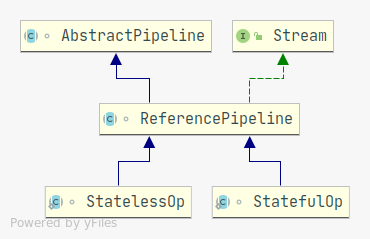
These pipeline stages fall into two main categories:
- Stateless Operations (
StatelessOp): Operations likemapandfilter. They only need to consider one element at a time and have no memory of elements that came before. - Stateful Operations (
StatefulOp): Operations likesortedanddistinct. They need to see either all elements (forsorted) or maintain some state based on past elements (fordistinct) before they can produce a result.
Let's examine how these components form the pipeline structure.
Java streams like never before: Part 1 :: Chermehdi
The article "Java streams like never before: Part 1" by Mehdi Cheracher provides a superb, low-level explanation of the stream internals.
Please read the section titled "Class Hierarchy". It introduces ReferencePipeline, the Head of the stream, and the distinction between StatelessOp and StatefulOp.
Each time you add an operation, you create a new ReferencePipeline object that points to its previousStage, forming a chain that looks something like this for a map().filter() pipeline:
Head <- MapOp <- FilterOp
This chain represents the static structure of the pipeline, ready to be executed.
The Source of It All: The Spliterator
A stream pipeline needs a source of data. This is the role of the Spliterator (a "splittable iterator"). It was introduced in Java 8 as a more powerful alternative to the traditional Iterator. While an Iterator only supports next() and hasNext(), a Spliterator offers richer functionality.
Java streams like never before: Part 1 :: Chermehdi
Let's return to the same article to understand the Spliterator.
Read the section titled "Spliterators". Pay close attention to the three key methods described: tryAdvance, forEachRemaining, and especially trySplit.
The trySplit() method is the crucial innovation. It allows the Spliterator to be partitioned into chunks. This is the fundamental mechanism that enables parallel stream processing. The stream framework can call trySplit() to break the data source into multiple pieces and assign each piece to a different thread in the Fork/Join pool for concurrent processing.
The Execution Model: Sinks and Data Flow
We now have the two main pieces: the static pipeline of operations and the Spliterator data source. How do they work together when a terminal operation is called? This happens through an elegant push-based mechanism using an abstraction called a Sink.
A Sink is an object that receives elements. You can think of it as the implementation of a stage's logic. Each intermediate operation in the pipeline can be converted into a Sink. The execution process unfolds as follows:
-
Sink Chaining: The terminal operation initiates the process. It creates the final
Sink(e.g., aSinkthat adds elements to aListfortoList()). It then asks itspreviousStageto wrap this sink. This process continues backwards up the pipeline, with each stage wrapping theSinkfrom the next stage. This creates a chain ofSinks in the reverse order of the pipeline declaration.Head -> MapOp -> FilterOp -> TerminalOp(Pipeline)MapSink -> FilterSink -> ListSink(Sink Chain) -
Data Traversal: The framework then begins traversing the
Spliteratorfrom the source. For each element, it calls theaccept()method on the firstSinkin the chain (theMapSink). -
Pushing Downstream: The
MapSinkapplies its logic (the mapping function) to the element. If it produces a result, it calls theaccept()method of the next sink in the chain (thedownstreamFilterSink), pushing the result to it. TheFilterSinkapplies its predicate. If the element passes, it callsaccept()on the finalListSink, which adds the element to its internal list.
This "push" model is highly efficient. An element travels vertically through the entire pipeline before the next element is even requested from the source. This is why a short-circuiting operation like findFirst() can stop the entire process after finding just one matching element.
The following diagram provides a fantastic high-level visualization of this entire process, from the Spliterator to the final result.

Let's dive into the code that makes this happen.
Java streams like never before: Part 1 :: Chermehdi
The "The data flow" section of the Chermehdi article is the core of our lesson. It walks through this process with code from the JDK.
Please read the entire section from the beginning to the end. Focus on these key points: The explanation of how the pipeline is "flipped" by the wrapSink method. The implementation of the accept method for the map operation's Sink. Notice how it calls downstream.accept(). The implementation for the filter operation's Sink. See how it conditionally calls downstream.accept().
This wrapSink mechanism and the chain of Sink.accept() calls are the heart of the stream execution engine. It elegantly translates the declarative pipeline you wrote into an efficient, imperative sequence of method calls.
Smart Optimizations: StreamOpFlag
The stream framework includes clever internal optimizations. For example, if you write stream.sorted().filter(...).sorted(), how does Java know not to sort twice?
This is accomplished using a bitmask of flags (StreamOpFlag) that is maintained for each stage of the pipeline. These flags describe the characteristics of the stream at that point, such as SORTED, DISTINCT, or SIZED.
When an operation like sorted() is called, it first checks the flags of the incoming stream. If the SORTED flag is already set, the operation becomes a no-op and simply passes the elements through. If it does perform a sort, it sets the SORTED flag on its resulting output stream, so subsequent operations can use this information.
Java streams like never before: Part 1 :: Chermehdi
The same article has a great section explaining these flags.
Please read the section titled "Flags". It provides excellent code examples from the sorted and distinct operations, showing how they check incoming flags to optimize their behavior and set outgoing flags to inform downstream operations.
These flags are a perfect example of how the internal implementation details of the Stream API work together to provide a performant experience without requiring you to manually optimize the call chain.
Conclusion
Today, we have ventured deep into the internals of the Java Stream API. You've seen that streams are far more than just a convenient syntax; they are a sophisticated data processing engine built on several powerful, interlocking concepts.
Key Takeaways:
- Lazy Evaluation: Intermediate operations (
map,filter, etc.) build a pipeline but do no work. Execution is triggered only by a terminal operation (collect,count, etc.). - Pipeline Construction: Streams are a linked list of pipeline stages (
AbstractPipeline), each wrapping the previous one. They can be stateless (map) or stateful (sorted). - Spliterator: The data source for a stream is a
Spliterator, whosetrySplit()method is the key to enabling parallel processing. - Sink-based Execution: When a terminal operation runs, it builds a chain of
Sinks in reverse. Data is then pulled from theSpliteratorand "pushed" down theSinkchain viaaccept()calls. - Optimization with Flags: The framework uses
StreamOpFlags (SORTED,DISTINCT) to track stream characteristics and avoid redundant work.
With this understanding, you are no longer just a user of the Stream API, but someone who comprehends the engineering behind its power.
In our next lesson, we will look at another feature introduced in Java 8 to support the evolution of the language: default methods in interfaces. You'll see how they were essential for adding methods like stream() and parallelStream() to the existing Collection interface without breaking millions of lines of code.