Introduction
In our last lesson, we began to uncover the mechanics behind Java's lambda expressions. We saw how the compiler "desugars" a lambda's body into a private, synthetic method and uses variable capture to access the surrounding scope. We concluded by identifying the invokedynamic bytecode instruction as the key piece of runtime magic that creates the final lambda object.
This lesson picks up right where we left off, diving deep into the invokedynamic instruction itself. Your goal is to understand the JVM's "inner workings," and invokedynamic is a prime example of the platform's power and flexibility. We will explore why this instruction was introduced, how it operates through a mechanism of bootstrap methods and call sites, and precisely how it is used with LambdaMetafactory to implement lambdas. By the end, you'll have a clear picture of how Java bridges the gap between a static compile-time instruction and dynamic runtime behavior.
The Problem: Four Inflexible Opcodes
Before Java 7, the JVM had four primary method invocation instructions, or opcodes:
invokevirtual: For standard instance method calls.invokeinterface: For interface method calls.invokestatic: For static method calls.invokespecial: For constructors,supercalls, and private methods.
While these cover the core needs of a statically-typed language like Java, they share a common trait: their behavior is fixed and hard-coded into the JVM. The resolution of which method to call is based on strict, predefined rules determined at compile time. This rigidity posed a significant challenge for dynamic languages like JRuby and Jython running on the JVM, which often need to resolve method calls at runtime based on the dynamic types of their arguments. The traditional workaround was to use Java's Reflection API, which is powerful but notoriously slow.
An Introduction to Invoke Dynamic in the JVM | Baeldung
The Baeldung article "An Introduction to Invoke Dynamic in the JVM" provides an excellent overview of this limitation.
Please read the subsection titled "The Problem". This section clearly explains the constraints of the original four invocation types and the inefficient workarounds that developers had to use.
The invokedynamic Solution: Linkage on Demand
Java 7 introduced invokedynamic (or "indy") to solve this exact problem. It's a fifth invocation opcode, but it operates on a completely different principle. Instead of having a fixed linkage logic, invokedynamic delegates the decision of which method to call to the language runtime itself, but only the first time it's encountered.
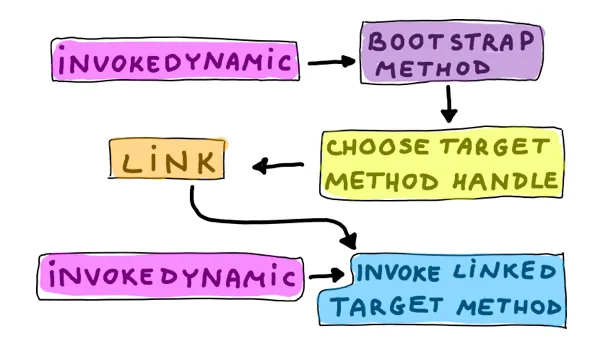
This process works in two stages, which are beautifully illustrated in the following diagram:
-
Bootstrap and Link (The Slow Path): The very first time the JVM executes a specific
invokedynamicinstruction at a particular location in the code (a "call site"), it doesn't know what to do. Instead, it makes a one-time call to a bootstrap method (BSM). The BSM is a static Java method, specified in the class file, containing the language's specific logic for resolving the call. The BSM's job is to figure out the target method and return aCallSiteobject, which "links" that call site to aMethodHandle(a direct, fast reference to the actual target method). -
Direct Invocation (The Fast Path): Once the call site is linked, the JVM caches the result. For every subsequent execution of that same
invokedynamicinstruction, the JVM skips the bootstrap process entirely and directly invokes theMethodHandlestored in theCallSite.
This "call me once to decide, then get out of the way" approach allows for custom, dynamic linkage logic without the performance penalty of reflection on every call.
To hear this explained by the Java Language Architect himself, let's revisit a short segment from Brian Goetz's talk.
Lambdas in Java: A Peek Under the Hood • Brian Goetz • GOTO 2013
In his talk "Lambdas in Java: A Peek Under the Hood," Brian Goetz provides the rationale behind invokedynamic.
Watch the segment from "we turn to another VM feature" where he explains how invokedynamic allows the language runtime and the VM to be "partners" in linkage decisions, enabling dynamic behavior while remaining fast.
The Lambda Recipe: LambdaMetafactory
Now, how does Java use this tool for dynamic languages to implement lambdas in a static language? While the types in Java are static, the code generation strategy for lambdas can be dynamic. The invokedynamic instruction allows the choice of how to create the lambda object to be a runtime decision.
When the Java compiler encounters a lambda, it emits an invokedynamic instruction and provides a "recipe" for creating the lambda instance. This recipe specifies java.lang.invoke.LambdaMetafactory.metafactory as the bootstrap method. The compiler passes arguments to this metafactory so it knows exactly what kind of object to create.
Let's dissect this recipe by looking at the bytecode.
An Introduction to Invoke Dynamic in the JVM | Baeldung
The Baeldung article again provides a clear, annotated javap output.
Read the subsection "Bootstrap Method Table". Focus on the BootstrapMethods attribute. This shows that the bootstrap method is LambdaMetafactory.metafactory and lists the arguments the compiler provides to it.
As you saw in the reading, the compiler provides the LambdaMetafactory with everything it needs:
- Static Arguments (from the constant pool):
- The signature of the functional interface's method (e.g.,
(Ljava/lang/Object;)ZforPredicate.test). - A
MethodHandlepointing to the privatelambda$main$0synthetic method we discussed in the last lesson. - The signature of the lambda implementation itself (e.g.,
(Ljava/lang/String;)Z).
- The signature of the functional interface's method (e.g.,
- Dynamic Arguments (from the stack):
- Any values captured from the local scope. For a non-capturing lambda, this list is empty.
With this recipe, the LambdaMetafactory performs its one-time magic. At runtime, it dynamically generates a class that implements the target functional interface (e.g., Predicate<String>). The test method of this generated class is wired to simply call the provided MethodHandle for our synthetic lambda$main$0 method. It then creates an instance of this new class, wraps it in a ConstantCallSite, and returns it to the JVM to be linked to the invokedynamic call site.
The image below shows what the invokedynamic instruction looks like inside a bytecode viewer. This is the instruction that triggers the call to LambdaMetafactory.

The Trifecta: Metafactory, CallSite, and MethodHandle
To solidify our understanding, let's review the three key components involved in this dynamic invocation.
How Java Lambda Expressions Work Internally
This article from LogJournal gives a concise summary of the three major components.
Read the section from the header "Invocation of Lambda Function" to just before "Creating Demo Lambda Instance Class Using Metafactory". Pay attention to the summary list at the end that defines the roles of the three major components.
In summary:
LambdaMetafactory: The bootstrap method. It's a factory for creating theCallSitethat will produce lambda objects. It uses the "recipe" from the compiler to generate an implementation class on the fly.CallSite: The link between theinvokedynamicinstruction and the target method. For lambdas, this is aConstantCallSite, meaning the target will never change. It holds theMethodHandle.MethodHandle: A direct, fast, and type-safe reference to the underlying method (our syntheticlambda$...method). The JVM can optimize and inline through method handles far more effectively than through reflection.
The Payoff: Flexibility and Performance
This complex machinery provides significant advantages over the "simpler" approach of generating an anonymous inner class for every lambda.
-
Flexibility and Future-Proofing: The
invokedynamicinstruction only specifies the recipe. TheLambdaMetafactoryprovides the implementation. This decouples the binary representation from the implementation strategy. A future version of the JVM could use a completely different, more optimized strategy insideLambdaMetafactorywithout requiring you to recompile a single line of your code. -
Performance via Laziness and Caching:
- The lambda implementation class is only generated and loaded the first time it is needed, reducing application startup overhead.
- For non-capturing lambdas,
LambdaMetafactoryis even smarter. After creating the instance once, it links theConstantCallSiteto return that same singleton instance forever. Theinvokedynamiccall effectively becomes a cheap constant load, completely eliminating allocation overhead on subsequent captures. This is a massive performance win and a key reason why stateless lambdas are preferred.
-
Reduced Deployment Footprint: This approach avoids generating a separate
MyClass$1.classfile for every lambda in your source code, leading to smaller and cleaner application builds.
Conclusion
In this lesson, we've dissected one of the most powerful mechanisms in the modern JVM. You now have a deep understanding of how invokedynamic provides a general-purpose solution for deferred linkage and how it is expertly leveraged to implement Java's lambda expressions.
Key Takeaways:
invokedynamicis the fifth method invocation opcode, designed to allow pluggable linkage semantics at runtime.- It uses a two-phase process: a one-time bootstrap call to a specified bootstrap method, which returns a linked
CallSite. Subsequent calls are fast, direct invocations of the targetMethodHandlein theCallSite. - For lambdas, the compiler uses
LambdaMetafactory.metafactoryas the bootstrap method, providing it with a "recipe" of static and dynamic arguments. LambdaMetafactorydynamically generates an adapter class that implements the functional interface and calls the synthetic lambda body method.- This strategy provides immense flexibility (decoupling representation from implementation) and performance (lazy generation and caching of stateless lambdas).
We have now thoroughly covered the journey from lambda syntax to optimized bytecode execution. This foundation is crucial as we move on to our next topic: Java Streams. You will see that the efficiency of Streams is built directly upon the fast, lightweight lambda instances made possible by the invokedynamic machinery we've just explored.