Welcome to our next lesson. Last time, we focused on being an active listener and asking questions to keep conversations flowing. Now that you have the tools to maintain a great chat, let's learn how to take the next step: using conversation to make plans with friends.
Today's goal is to learn how to make and respond to suggestions and invitations in a friendly, social context. This is a fundamental skill for turning conversations into activities and building stronger relationships, which is one of your key goals. We'll cover how to suggest an idea, how to say "yes" enthusiastically, and, just as importantly, how to say "no" politely without causing offense.
Part 1: How to Make a Suggestion
Making a suggestion is about proposing an idea or activity. English has several common phrases for this, each with a slightly different feel and grammatical structure.
The following infographic provides a clear and well-designed overview of key phrases. Given your background in graphic design, you'll likely appreciate its simple, effective layout.

To hear these phrases in action and understand their structure, we'll watch a short video from Oxford Online English. It breaks down the most common ways to make and accept suggestions.
Making Suggestions in English - Spoken English Lesson
This video, "Making Suggestions in English," clearly explains the core phrases and grammar you need.
Please watch the first part of the video, from the beginning of the lesson. As you watch, pay close attention to the four main structures introduced: Let's... Why don't we...? Shall we...? How about...? Notice the key grammatical difference: How about is followed by a verb in the -ing form (e.g., "How about going to the park?"), while the others are followed by the base verb (e.g., "Let's go to the park.").
You'll also have heard several ways to accept a suggestion, from a simple "Sure, why not?" to a more enthusiastic "Sounds great!".
Part 2: The Art of Politely Saying "No"
Knowing how to decline a suggestion is just as important as making one. This can be a source of anxiety, as the goal is to reject the idea, not the person. The key is to use "softening language" and, often, to provide a brief, polite reason.
Let's continue with the same video, which does an excellent job of contrasting direct, impolite refusals with more tactful alternatives.
Making Suggestions in English - Spoken English Lesson
This next segment of the video focuses on the crucial skill of polite refusal.
Watch from this point in the video. Pay attention to phrases like: "I'd rather not, if you don't mind." "I don't really feel like it, I'm afraid." "Maybe another time." Also, listen for the idiom "Can I take a rain check?". This is a very common and useful North American expression that politely declines an offer while suggesting you'd be open to it in the future. Finally, notice how adding a simple reason (e.g., "I'm a bit tired," "I've got a lot to do") makes the refusal sound much more considerate.
To expand your toolkit, the resource below provides even more phrases for different levels of formality.
1.3.3 MAKING INVITATIONS AND RESPONDING POLITELY | SAT Idiomas
This page from SAT Idiomas offers a rich vocabulary for invitations and suggestions.
Find the section titled "3A. Polite Invitations & Refusals". Look at the table and compare the columns for "Polite Invitations," "Polite Refusals," and "Polite Acceptances." You don't need to memorize them all, but notice the variety. Phrases like "Thanks for thinking of me, but..." or "I really appreciate the invitation, but..." are excellent ways to show gratitude before declining.
Part 3: Intonation - The Unspoken Signal
The words you choose are only half the story. How you say them—your intonation—carries a huge amount of meaning. A flat, monotone "That's a good idea" can sound sarcastic, while an enthusiastic, upward inflection shows you are genuinely pleased. This is especially important when declining, where an apologetic tone can make all the difference.
Making Suggestions in English - Spoken English Lesson
The final part of the video explains the critical role of intonation.
Watch from the section on intonation. Listen to the speaker's examples of accepting with enthusiastic intonation versus flat intonation. Then, listen to how an apologetic tone makes a refusal sound much more polite and friendly.
Part 4: Your Turn to Practice
Now, let's put these skills together.
Activity 1: Making Suggestions
Look at the image below. It presents several situations. For three of them, write a suggestion using one of the phrases we've learned (Let's, How about, Shall we, Why don't we).
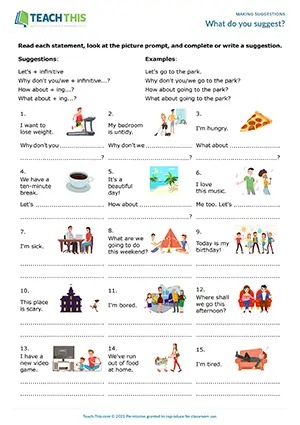
- Look at prompt #3 ("I'm hungry"). Write a suggestion.
- Look at prompt #8 ("What are we going to do this weekend?"). Write a suggestion.
- Look at prompt #11 ("I'm bored."). Write a suggestion.
Activity 2: Responding to Suggestions
Now, imagine a friend makes the following suggestions to you. For each one, write two responses:
a) Accept the suggestion enthusiastically.
b) Decline the suggestion politely, giving a simple reason.
Suggestion 1: "There's a new exhibition at the design museum. Shall we go this Saturday?"
- Your acceptance:
- Your refusal:
Suggestion 2: "I'm exhausted from this project. How about grabbing a coffee after work?"
- Your acceptance:
- Your refusal:
Take your time to write out your responses. Try to use different phrases for each one. This practice is key to making these expressions feel natural and accessible when you're speaking.
Conclusion
In this lesson, you've learned the essential language for proposing activities and responding to others' ideas. This moves you from simply participating in a conversation to actively shaping it, which is a big step toward building connections and feeling more confident in social situations.
Key Takeaways:
- Use varied phrases for suggestions:
Let's,Shall we, andWhy don't weare followed by the base verb, whileHow aboutuses the-ingform. - Decline politely with softening language: Phrases like "I'd love to, but..." or "Maybe another time" reject the suggestion, not the person.
- Give a reason when you say no: A simple explanation ("I'm a bit busy," "I'm not feeling well") makes a refusal feel much less personal.
- Intonation is key: Your tone of voice communicates your enthusiasm or regret, making your words sound sincere.
This lesson concludes our module on everyday conversation. In our next lesson, we will pivot back to your writing goals, beginning a new module: Writing with Structure and Flow. We'll start by learning how to write a topic sentence that clearly states the main idea of a paragraph—the first building block for crafting clear and professional content for your portfolio and social media.