Hello! In our last lesson, you learned how to agree and disagree politely, a key skill for navigating conversations with confidence. We focused on softening your language to express different viewpoints respectfully.
Today, we'll dive into another essential conversational skill: telling a personal anecdote. Your goal is to share experiences with friends and, professionally, to present design work effectively. At their core, both of these activities rely on good storytelling. This lesson will teach you how to structure a short, personal story with a clear beginning, middle, and end, and how to use the correct "narrative tenses" to make your story clear and engaging. This will not only make your conversations more interesting but also build a foundation for explaining the "story" behind your design projects.
Part 1: The Power of a Short Story
What exactly is an anecdote? It's simply a short, interesting story about a real incident or person. Think about a time a friend told you a funny thing that happened to them on the way to work—that was an anecdote. In conversations, we use them all the time.
To understand why they are so powerful, let's look at an article from Grammarly.
Anecdote: Definition, Examples, and Usage
This article explains what an anecdote is and, more importantly, why we use them.
First, read the Key takeaways section at the very top for a concise definition. Then, scroll down to the section titled "Uses of anecdotes" and read through the four main uses described there: Adding humor Simplifying ideas Creating memories Building rapport As you read, think about your work. When you present a design, you simplify a complex process. When you write a social media post, you try to build rapport. Storytelling is a tool for all of these things.
In short, telling a small story makes you more relatable, makes your ideas easier to understand, and helps people remember what you said.
Part 2: The Structure of a Great Story
A good story is more than just a sequence of events. It has a structure that creates interest and leads to a satisfying conclusion. You're familiar with this from design; a good user experience follows a logical flow, not a random collection of screens.
A classic story follows a predictable path, often visualized as an arc.
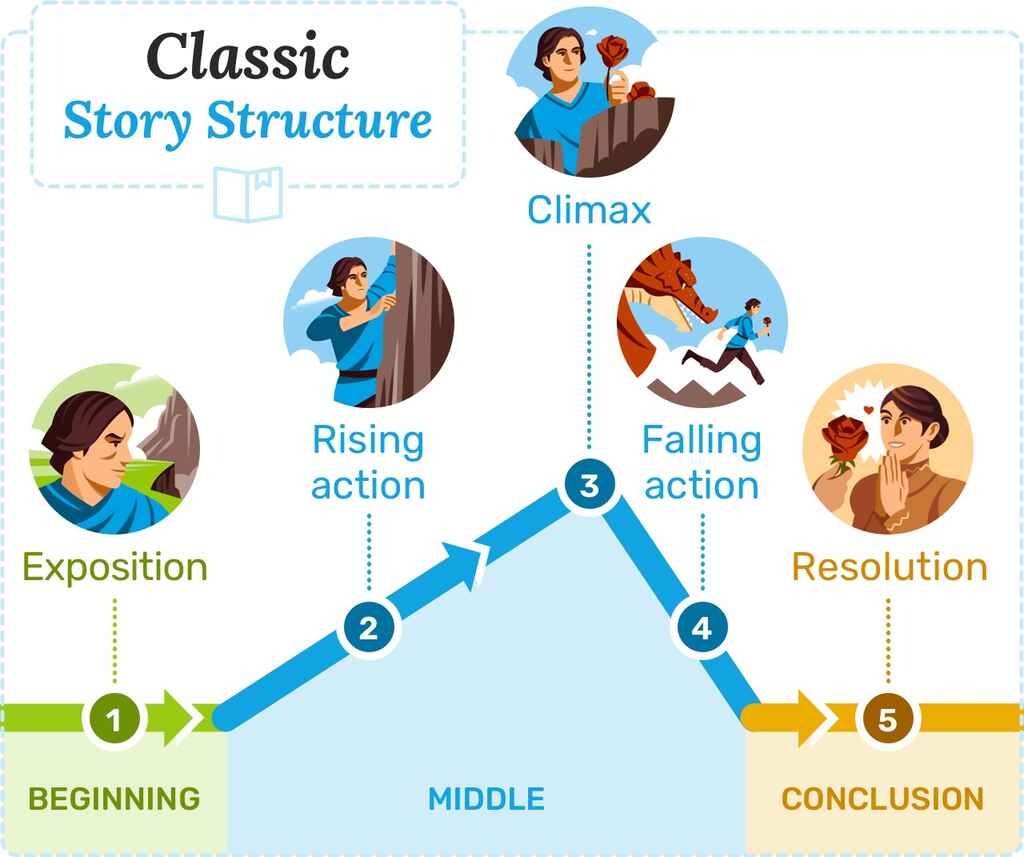
For a short, personal anecdote, we can simplify this into a four-step framework. A fantastic video from Oxford Online English breaks this down perfectly. As you watch, think of a simple story of your own—something funny or surprising that happened to you recently.
How to Tell a Story in English - Using Past Tense
This video, "How to Tell a Story in English," explains a simple, step-by-step structure for building any story.
We will watch it in four parts, corresponding to the four key elements of a story. The Background: This first part explains how to set the scene by answering the questions: who, when, where, and what? The Goal: Next, watch this short segment. Every story needs a goal. The characters must want something. The Tension: Now, watch this section. This is the "problem" or "obstacle" that makes the story interesting. The goal cannot be too easy to reach. The End: Finally, see how to conclude your story by resolving the tension. It's also great to add a "retrospective comment"—a sentence about how you feel looking back now.
So, the simple formula for a great anecdote is:
- Background: Set the scene.
- Goal: What did you want?
- Tension: What went wrong or was difficult?
- Resolution: What happened in the end? (+ How you feel now).
Part 3: The Grammar of Storytelling
Now that you have the structure, let's get the right grammatical tools. These are called narrative tenses, and they are primarily the past tenses. Using them correctly helps your listener understand the timeline of your story.
Here is a quick revision of the two most common past tenses.

To tell a good story, we need to use three tenses together:
- Past Continuous (was/were + -ing): To set the scene and describe background activities.
- Past Simple (verb-ed or irregular form): To describe the main, sequential actions of the story.
- Past Perfect (had + past participle): To talk about something that happened before the main story started.
Let's see how these work together in an actual story.
Storytelling in English: using narrative tenses – The English Coach
This article from The English Coach uses a single story to demonstrate how each narrative tense works.
First, read the example story about a person's disastrous journey to work. You'll find it right under the heading "Here's a story...". Now, read the explanations that follow. They break down the story you just read. Focus on: Setting the Scene: Read how the past continuous is used to describe the background. Describing the Main Action: See how the past simple is used for the main events in order. Referring to an Interrupted Action: Notice how past continuous and past simple work together in sentences like this example. An ongoing action (past continuous) is interrupted by a short event (past simple). Referring to a Past Action: Finally, understand how the past perfect is used to give background information that happened before the story's timeline. For example, the accident had happened before the narrator got stuck in traffic.
Part 4: Your Turn to Tell a Story
You have the structure and the grammar. Now it's time to put it all together.
Before you start, it's helpful to know some common phrases for starting and finishing a story.
EASY ENGLISH CONVERSATION: How to tell a story in English
This video from English with Emma gives some very natural phrases for everyday conversation.
First, watch the section on how to start a story. Phrases like "Did I ever tell you about the time when..." are great signals. Then, skip to the end and watch the section on how to end a story. A simple "Can you believe that?" tells your listener the story is over.
Your Action Plan:
Think of a simple, personal story. It could be about:
- A time you solved a tricky design problem.
- A funny misunderstanding you had with a friend.
- Your first day at a new job.
- A surprising thing that happened on a trip.
Your Task: Write out the story (about 5-8 sentences). Try to follow the structure and include the right grammar.
- Start with a story-opening phrase (e.g., "That reminds me of the time...").
- Set the scene using the past continuous. (e.g., "I was working on a big project, and the deadline was approaching...")
- Describe the main events in order using the past simple. (... "so I opened the file, checked the client's feedback, and started making changes.")
- Include an obstacle/tension. If possible, use the past perfect to explain something that happened before. (e.g., "But when I tried to save, the program crashed! I suddenly realized I hadn't saved the file for over an hour.")
- Explain the resolution using the past simple. (e.g., "Luckily, the software had an auto-recovery feature. I found the backup file and only lost ten minutes of work.")
- End with a concluding phrase or a retrospective comment. (e.g., "I'll never forget that feeling. Now, I save my work every five minutes!")
Take your time with this. The goal is to consciously apply the structure and grammar we've discussed today.
Conclusion
Telling stories is fundamental to how we connect with each other. Today you've learned not just the "what" but the "how": a clear structure to make your stories engaging and the specific grammar to make them easy to follow.
Key Takeaways:
- Anecdote Structure: A good story has a clear Background, Goal, Tension, and Resolution.
- Narrative Tenses:
- Past Continuous sets the scene.
- Past Simple tells the main sequence of events.
- Past Perfect gives background from a time before the story.
- Storytelling is a Skill: It's a powerful tool for both social connection and professional communication, like explaining the process behind a design.
In our next lesson, we'll look at the other side of storytelling: how to be a great listener. You'll learn how to ask natural follow-up questions to demonstrate active listening and keep a conversation going.