Welcome back. In our last lesson, we built a comprehensive "success dashboard" for the photoshoot campaign, defining the quantitative metrics needed to measure everything from audience awareness to return on investment. We also established the importance of guardrail metrics—indicators designed to catch negative side effects, like audience backlash or brand damage.
This lesson transitions our focus to the tour scenario and dives into the qualitative risks that those guardrail metrics are meant to detect. We will move from how you would measure a problem to what the most probable problems are. Your goal is to engineer a successful hotwife experience during the husband's tour; a critical part of that engineering is identifying and understanding the system's potential failure modes.
Today, we will identify the top three emotional risk factors for the tour scenario and their likely triggers. Think of this as a pre-mortem analysis. As a relationship analyst with a background in causal analysis, you're uniquely equipped to dissect the generic label of "jealousy" and break it down into specific, triggerable risk mechanisms.
Deconstructing "Jealousy": A Data-Driven Overview
In statistics, you wouldn't analyze a complex phenomenon using a single, aggregated variable if you could decompose it into its more informative components. The same applies here. "Jealousy" is an umbrella term for a host of distinct emotional states. To manage risk, we must first classify it.
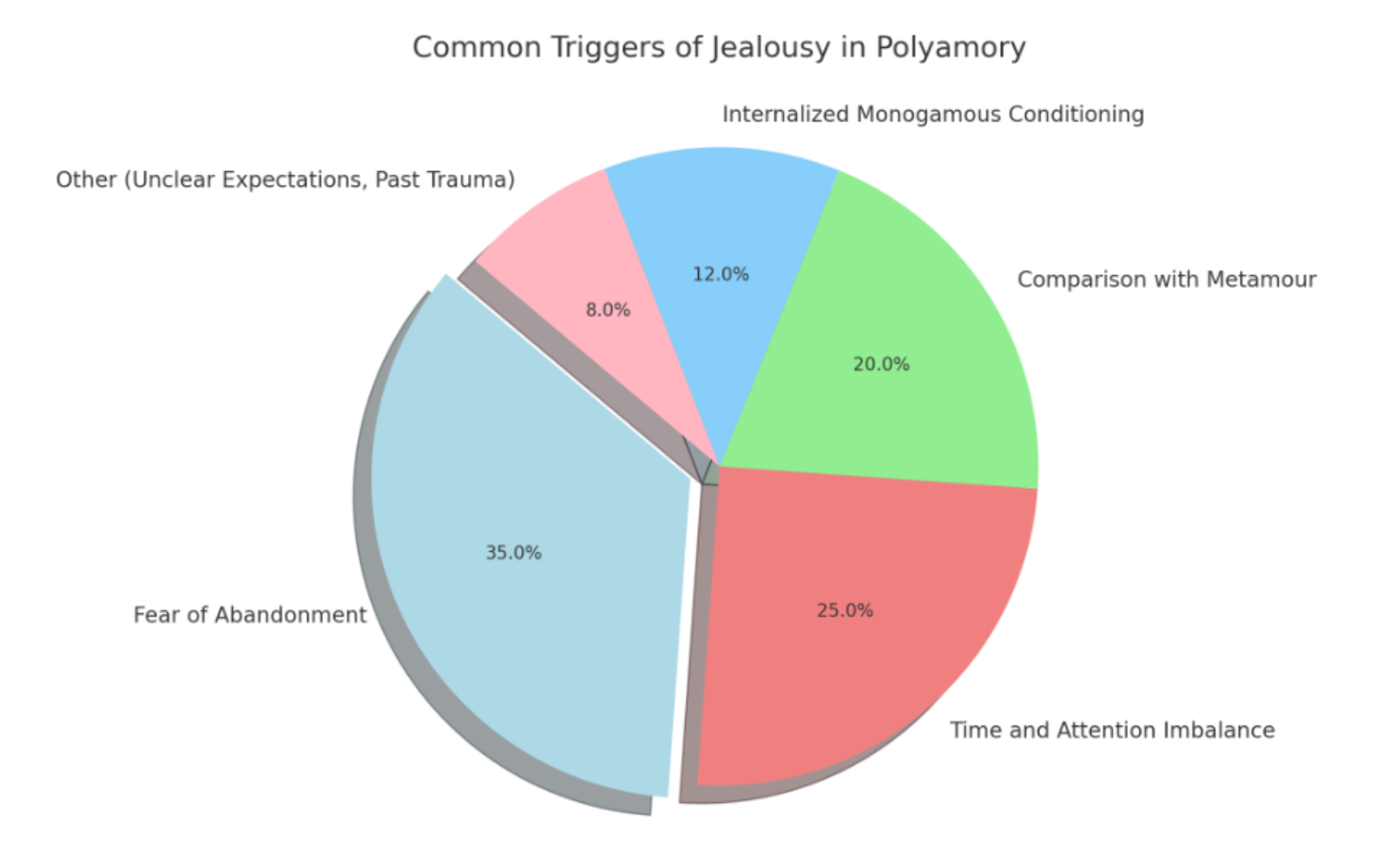
This data aligns with what experts observe: jealousy is often a secondary emotion, a symptom of deeper insecurities and fears. Our task is to identify the most potent of these for your specific scenario.
Risk Factor 1: Insecurity-Driven Jealousy (Husband's Attachment Threat)
The most significant and potentially destructive risk is that the husband experiences a form of jealousy rooted in deep-seated insecurity, not the erotic "excitement-blended" variety that can fuel the dynamic. This type of jealousy is not a feature of the kink, but a bug that can crash the entire system.
The Risk: The husband is overwhelmed by feelings of inadequacy, comparison, and fear of being replaced, leading to an emotional crisis that undermines his trust in both his wife and his best friend.
Likely Triggers:
- Anxious Attachment Activation: The structure of monogamy can often mask an underlying insecure attachment style. The husband's absence removes this structure, potentially exposing a latent anxious attachment that interprets the wife's encounter with the bull not as a shared activity, but as a direct threat to the primary bond.
- The Fantasy-Reality Gap: There is often a significant difference between the controlled, curated fantasy of hotwifing and the more complex, emotionally messy reality. The husband might fantasize about his wife's pleasure but be triggered by an unexpected detail—the specific way she looks at the bull, an intimate conversation he overhears, or simply the long hours of silence where his imagination runs unchecked.
- Negative Self-Comparison: The husband, alone on his tour, may begin to compare himself unfavorably to the bull who is physically present with his wife. This can create a spiral of negative thoughts about his own sexual performance, physical attractiveness, or emotional connection, fueling the fear that he is "not enough."
To understand these triggers better, let's turn to some expert resources.
Attachment, Trauma, and Consensual Nonmonogamy with Jessica Fern
Psychotherapist Jessica Fern, author of Polysecure, is an expert on how attachment theory applies to non-monogamy. This video provides a foundational understanding of how opening a relationship can expose pre-existing insecurities.
Watch the segment from the monogamy structure, where Fern explains how monogamy can create a false sense of security that is removed in non-monogamous dynamics. Then, watch her explanation of the four attachment styles from secure, avoidant, anxious, and disorganized. Pay close attention to the description of the anxious style, as it is the key precondition for this risk factor.
The article "The Hotwife Dynamic" is also very direct about this specific risk.
The Hotwife Dynamic: Her Pleasure His Witness | MoneySexNerd
This article breaks down the common pitfalls of the hotwife dynamic.
Please read two short but critical sections. First, under the heading "Attachment Style Dynamics," read the paragraph describing the Anxious husband. Then, under "Common Pitfalls," read the analysis of the Fantasy ≠ reality. This clearly articulates the triggers we've just discussed.
Risk Factor 2: Attachment Drift (Threat to the Primary Bond)
This risk is more subtle. It's not about a sudden crisis of jealousy, but a gradual "scope creep" of emotional intimacy beyond the agreed-upon boundaries. In systems terms, this is a slow drift away from the desired equilibrium.
The Risk: The wife and/or the bull begin to develop a genuine emotional bond that competes with, rather than complements, the primary couple's relationship. The husband perceives this shift and begins to feel he is becoming secondary.
Likely Triggers:
- Unintentional Intimacy: The bull is not just a sexual partner but the husband's best friend. The pre-existing trust and familiarity, while a key success factor, also create fertile ground for deeper emotional connection to develop between the wife and bull during the prolonged, intimate time they spend together. The dynamic of "caretaker" naturally fosters a supportive, emotionally open environment.
- Perceived Disparity in Connection: The husband, communicating remotely, may feel his connection is becoming logistical ("How was your day?") while the wife and bull are sharing lived experiences. He may start to feel that his wife's bond with the bull is growing stronger and more vibrant than his own, triggering an insecurity that she "means more" to the bull, or vice versa, than is safe for the arrangement.
- Insufficient Reaffirmation Rituals: The "homecoming" or reconnection between the primary couple is a vital part of the hotwife cycle. If communication protocols during the tour fail to consistently reaffirm the primacy of the couple's bond, the husband may feel emotionally abandoned long before he physically returns.
The following resources explore the nuances of these types of insecurities.
A Typology of Insecurities in Non-monogamy - Devon Price - Substack
This article from Dr. Devon Price provides an excellent taxonomy of insecurities that go beyond simple jealousy.
Read the section titled Feeling less worthy, which describes the self-protective impulse to withdraw when you feel you're in competition. Then, read the section Insecurity that a partner means more, which perfectly captures the fear of unreciprocated or imbalanced feelings.
The idea that "outside partners are people" is also a crucial trigger.
The Hotwife Dynamic: Her Pleasure His Witness | MoneySexNerd
Let's return to this article for one more key insight.
Read the section under "Common Pitfalls" titled 'Outside partners are people'. This highlights how treating the bull as a mere 'prop' is unsustainable and that real feelings are an inherent variable in the system.
Risk Factor 3: Performance Pressure & Agency Failure (Wife's Resentment)
The success of the "unmet needs" mechanism is predicated on the wife's genuine desire and enthusiastic consent. If her participation shifts from being an act of self-pleasure to an act of obligation, the entire dynamic becomes corrosive.
The Risk: The wife feels pressured to perform sexually to satisfy the husband's fantasy or to not disappoint the bull. This erodes her agency, replaces desire with duty, and cultivates resentment towards both men, poisoning the relationships.
Likely Triggers:
- Enthusiasm as Coercion: The husband’s excitement about the arrangement can unintentionally become a form of pressure. The wife, not wanting to disappoint him, may agree to encounters even when she is not genuinely in the mood, leading to a feeling of being a performer in his fantasy rather than the protagonist of her own experience.
- Internalized Shame: Society heavily polices female sexuality. The wife may experience "slut-shaming whiplash"—feeling empowered in one moment and ashamed in the next. This internal conflict can interfere with her ability to access genuine desire, making participation feel confusing or even distressing.
- Absence of an "Easy Veto": If the protocols for the wife to cancel or pause an encounter are not explicit, easy, and free of emotional penalty (e.g., guilt-tripping from the husband), her consent is not truly continuous. The lack of a clear, accepted "off-ramp" creates a powerful sense of obligation.
The resources below detail this critical failure mode with precision.
The Hotwife Dynamic: Her Pleasure His Witness | MoneySexNerd
This article provides a stark contrast between empowerment and objectification, which is central to this risk.
Under "Common Pitfalls," please read the section on Her veto power. Then, read the section "The Feminist Question," focusing specifically on the text under the sub-heading Objectifying when. This defines the exact failure state we are trying to avoid.
Conclusion
You have now moved beyond the generic concept of "jealousy" and decomposed it into three distinct, high-impact emotional risks for the tour scenario. By applying an analytical lens, we have defined these failure modes and, more importantly, identified their specific causal triggers.
Key Takeaways:
- Emotional risk is not a monolithic problem. The three primary risks for this scenario are distinct: Insecurity-Driven Jealousy (a threat to the husband's self-worth), Attachment Drift (a threat to the primacy of the main relationship), and Performance Pressure (a threat to the wife's agency and consent).
- Each risk has specific, identifiable triggers rooted in attachment styles, the fantasy-reality gap, unintentional emotional connection, and subtle social pressures.
- Identifying these risks is the foundational step in engineering a resilient system. You cannot mitigate threats you haven't defined.
In our next lesson, we will put this analysis into action. Now that you have identified these three risks and their triggers, we will proceed to the next logical step in your optimization plan: for each risk, we will design a specific contingency response plan, complete with communication protocols and reassurance actions. This is where we begin building the operational safeguards for the tour.