Hello! In our last lesson, we brought together all the pronunciation rules you've learned to practice reading full sentences. We also touched on how the "melody" of your voice, or intonation, can change a sentence's meaning.
Today, we'll zoom in on that idea. The goal of this lesson is to master one of the most fundamental and efficient features of spoken Korean: distinguishing between the falling intonation used for statements and the rising intonation used for yes/no questions. This single skill is crucial for both understanding others and making sure your own questions are understood correctly. It's a simple change that has a huge impact on communication.
The Intonation Switch
In English, to ask a question like "Are you a student?", you have to change the word order from the statement "You are a student." In Korean, for yes/no questions, the structure can be much more streamlined. Often, you can use the exact same words and sentence structure for both a statement and a question. The only difference is the pitch of your voice at the end.
- Statement: The sentence ends with a neutral or slightly falling pitch. ⬇️
- Yes/No Question: The sentence ends with a distinctly rising pitch. ⬆️
Think of it as a binary switch. The words form the command, and the intonation is the flag that tells the listener whether it's an assertion of fact or a request for confirmation.
This image provides a perfect visual summary of the concept.
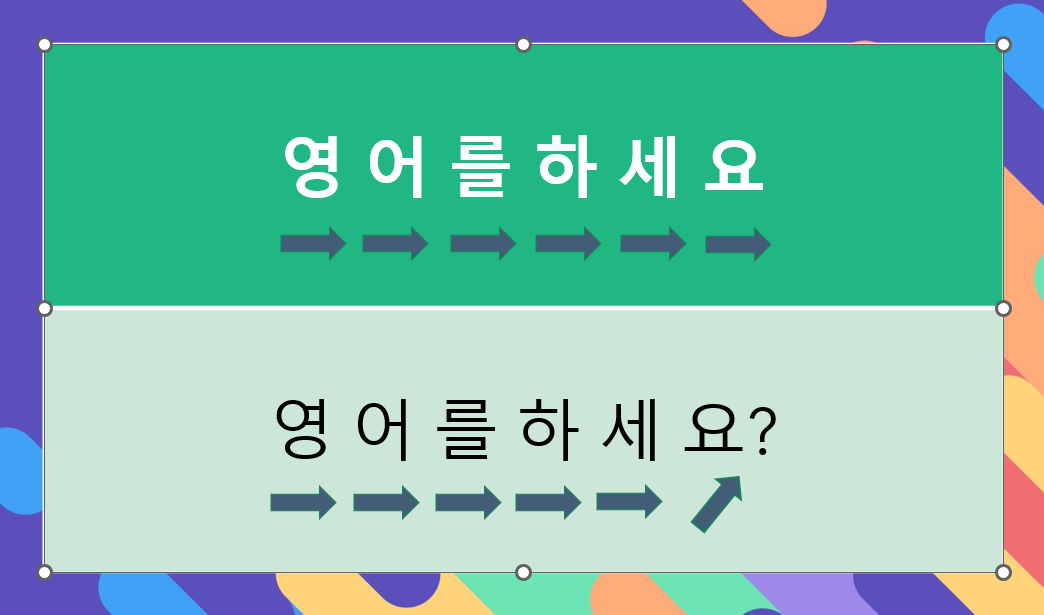
Simple and Efficient Questioning
This ability to form questions with intonation alone is a key feature of the language. Let's explore this idea further with a resource that contrasts this with the way English works.
Lesson 21: Asking Questions in Korean: Why, When, ...
The website HowToStudyKorean.com offers a clear explanation of how simple it is to form yes/no questions in Korean. This will highlight the efficiency of the intonation rule.
Please read the first few paragraphs of the section "Asking Questions in Korean." Focus on how the author contrasts the complexity of English questions (using "do/did/will") with the simplicity of Korean, where you just need to raise your voice at the end.
As you read, you can see that a sentence like 밥을 먹었어 (babeul meogeosseo) can mean "I ate" or "Did you eat?" based entirely on the melody you apply to that final syllable.
Hearing the Difference in Conversation
Now that you understand the rule, let's hear it in a practical context. When you're trying to confirm something, like a person's name, this intonation pattern is essential.
How to Ask Questions in Korean
In this video, Miss Vicky provides excellent, clear examples that directly contrast statements and questions.
First, watch from the introduction, where she explains the basic concept using the sentence "I am from the US" versus "Are you from the US?". Next, watch the series of examples from this section. Pay close attention to how she says: 피곤해 (pigonhae) ⬇️ - I'm tired. 피곤해? (pigonhae) ⬆️ - Are you tired? 배고파 (baegopa) ⬇️ - I'm hungry. 배고파? (baegopa) ⬆️ - Are you hungry? Try repeating these pairs aloud, mimicking her intonation. This is a great way to train your ear and your voice.
This distinction is not just a textbook rule; it's actively used in everyday interactions. The following resource shows this in the context of a dialogue where someone is trying to find the person they're supposed to meet.
This lesson from KoreanClass101.com includes a dialogue and a breakdown that explicitly discuss the role of intonation.
First, read Grammar Point #2, titled "Rising Intonation." It directly explains how saying a name with a rising tone turns it into a question. Then, look at the Lesson Transcript section. Find the part where the host, Keith, explains the line "김수한 씨? (KimSuHan ssi?)." He notes that the rising intonation is what makes it mean "Are you Kim Suhan?" versus simply addressing her.
Time to Practice
Let's try it yourself. Read each pair of sentences below. For the first sentence in each pair, use a falling intonation to make it a statement. For the second, use a rising intonation to make it a question.
-
Statement: 학생이에요. (
haksaeng-ieyo) ⬇️ (I am a student.)
Question: 학생이에요? (haksaeng-ieyo) ⬆️ (Are you a student?) -
Statement: 날씨가 좋아요. (
nalssiga joayo) ⬇️ (The weather is good.)
Question: 날씨가 좋아요? (nalssiga joayo) ⬆️ (Is the weather good?) -
Statement: 이거 재미있어요. (
igeo jaemi-isseoyo) ⬇️ (This is fun.)
Question: 이거 재미있어요? (igeo jaemi-isseoyo) ⬆️ (Is this fun?)
Recording yourself and listening back can be a very effective way to check if your intonation is changing clearly between the statement and the question.
Conclusion
In this lesson, you've sharpened your focus on one of the most important aspects of spoken Korean: using intonation to differentiate statements from yes/no questions. This simple but powerful tool will be invaluable as you start forming your own sentences and engaging in conversation.
Key Takeaways:
- A falling or flat intonation at the end of a sentence signals a statement.
- A rising intonation at the end of a sentence signals a yes/no question.
- For many yes/no questions, the words and grammar are identical to the corresponding statement; only the intonation changes.
You are now at the end of the pronunciation-focused part of our course. You've learned the letters, the sound change rules, and the melody of the language. In our next and final lesson for this module, we will cover a practical technical skill: how to type in Korean on a keyboard. This will equip you with all the foundational tools you need to start writing, reading, and communicating.