Introduction
In our last lesson, we deconstructed the robot into its four core subsystems: actuation, sensing, computation, and power. This gave us a "hardware-up" framework for understanding a robot's inner workings. We noted that actuation—the "muscles"—is a key area for durable technical moats.
This lesson builds directly on that idea by introducing a concept to quantify a robot's physical dexterity: degrees of freedom (DoF). You will learn what DoF means, how it relates to a robot's physical joints, and, most importantly, its profound significance for a robot's capability and cost. For your purposes, understanding DoF is crucial as it's one of the most fundamental specifications you'll encounter when evaluating a robotics company. It's a direct indicator of a robot's intended application, its complexity, and its price point.
What are Degrees of Freedom?
At its core, the concept is straightforward. A robot's degrees of freedom represent the number of independent ways it can move, whether by changing its position or its orientation. Any unconstrained object moving in three-dimensional space has six degrees of freedom:
- Three translational movements: forward/backward (X-axis), left/right (Y-axis), and up/down (Z-axis).
- Three rotational movements: tilting forward/backward (pitch), swiveling left/right (yaw), and twisting side-to-side (roll).
The following short video provides a clear, visual introduction to these concepts, distinguishing between the axes that determine a robot's position and those that determine its orientation.
Robot Axes Explained | Degrees of Freedom, Pitch, Roll and Yaw
Watch the entire video. It's very brief and effectively illustrates the core concepts.
Pay close attention to the distinction it draws between position axes and orientation axes. The aircraft analogy used for pitch, roll, and yaw is particularly helpful for visualizing the three rotational DoF.
As the video explains, a robot's total DoF is determined by its joints. Each joint is a component of the actuation subsystem that enables a specific type of motion while constraining others. A simple hinge, for example, allows one degree of freedom (rotation) but prevents five others (it can't slide up/down, side-to-side, etc.).
The image below shows four common types of robotic joints. Notice how each type allows for a specific number of freedoms by imposing a corresponding number of constraints on movement.

Most industrial robot arms are serial manipulators, meaning they are a chain of links connected by joints. In this common configuration, the total degrees of freedom are simply the sum of the freedoms granted by each joint in the chain. A robot arm with six revolute joints, for example, will have six degrees of freedom.
Why DoF Matters: Capability, Complexity, and Cost
The number of degrees of freedom is not just a technical specification; it's a primary determinant of what a robot can do and, by extension, its commercial viability for a given task. This is a critical concept for your due diligence framework.
The article "What are degrees of freedom in robotics?" from Standard Bots offers an excellent and practical guide. Please read the following sections to understand this connection.
What are degrees of freedom in robotics? Complete guide
This article provides a comprehensive but accessible overview of DoF, linking it directly to robot design and application.
First, read the introductory paragraph to solidify the definition. Next, focus on the section Why DOF matters. This part is key, as it explains how DoF impacts a robot's workspace, its ability to avoid obstacles, and the complexity of tasks it can handle. Finally, read the section Choose the right robot. This section translates the concept of DoF into a practical guide for matching robot capabilities to common industrial tasks.
As you've just read, there is a direct trade-off between DoF, capability, and cost. A higher DoF offers more flexibility but at the price of increased mechanical complexity, more sophisticated control software, and a higher bill of materials.
The infographic below, taken from the article you just read, provides a fantastic at-a-glance summary for an investor.
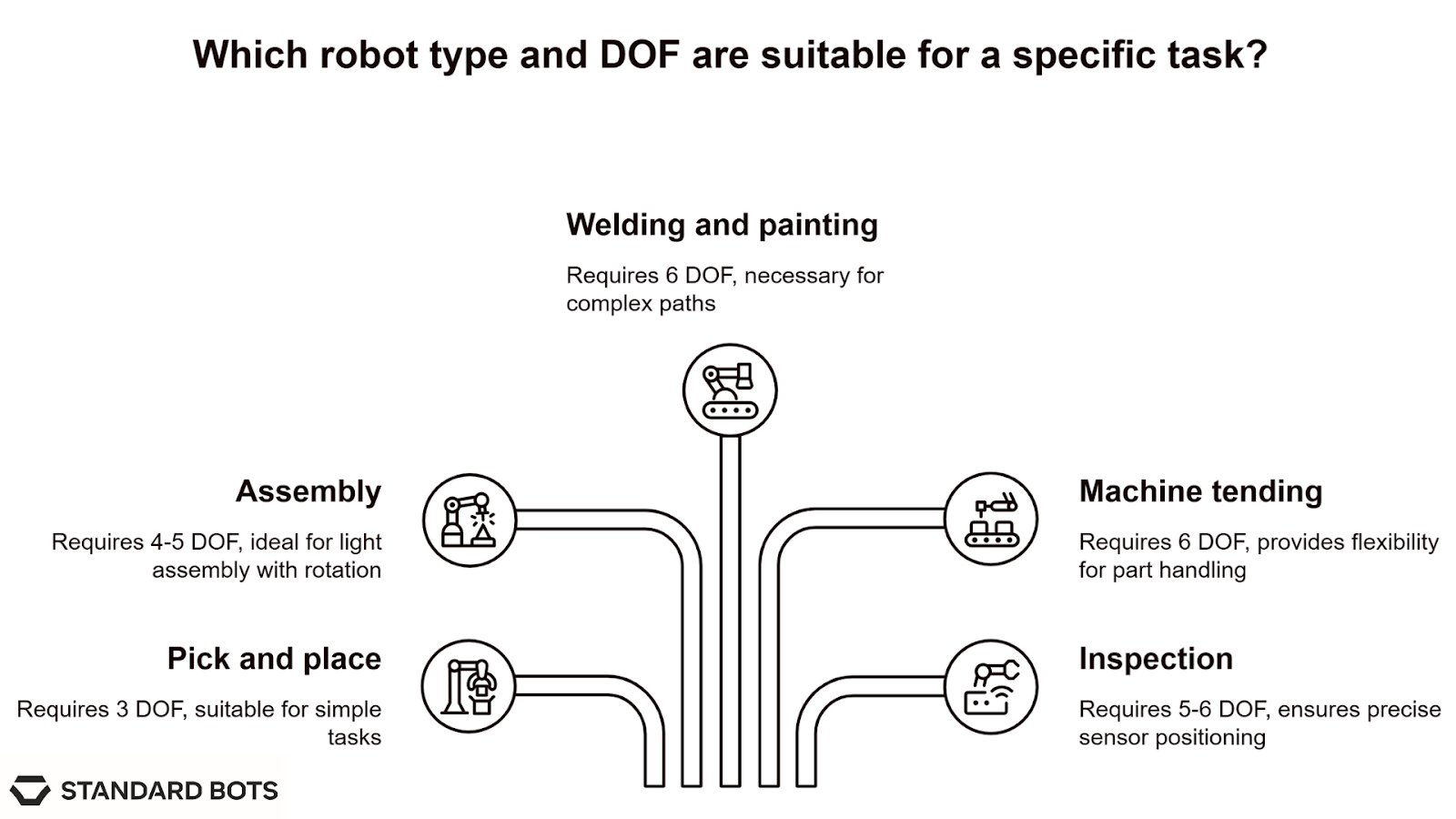
Here’s how to interpret this from an investment perspective:
- 3-4 DoF (e.g., SCARA, Delta, or Cartesian robots): These are specialists. They are optimized for high-speed, repetitive tasks on a flat plane, like circuit board assembly or packaging. A company building a 4-DoF robot for a complex welding application would be a major red flag, as the robot would lack the necessary dexterity.
- 6 DoF: This is the industry standard for general-purpose robotic arms. Having six degrees of freedom allows the robot to place its end-effector (the tool or gripper) at any position (X, Y, Z) and with any orientation (pitch, roll, yaw) within its workspace. This is the minimum required for tasks that involve following complex paths or approaching an object from a specific angle, like welding, painting, or intricate assembly.
- 7+ DoF ("Redundant" Robots): Robots with more than 6 DoF are considered "redundant." This extra joint doesn't expand the theoretical reach but provides immense flexibility in how the robot reaches a point. This is crucial for navigating cluttered environments, as the arm can "snake" around obstacles. This capability is a key enabler for humanoid robots and advanced collaborative robots designed to work alongside people. A company claiming to have a robust solution for obstacle avoidance without redundant DoF would warrant deep skepticism.
The Investor's Bottom Line: DoF and Cost Modeling
Your background in economics and venture capital makes the link between technical specifications and financial models particularly relevant. The number of degrees of freedom is a direct input into the Bill of Materials (BOM) cost of a robot. Each degree of freedom typically requires at least one actuator (motor) and often a corresponding gearbox, controller, and sensors.
A report from the Bank of America Institute on humanoid robots provides a perfect real-world example of this. When estimating the future cost of a humanoid robot, their analysts make explicit assumptions about the DoF of its components.
[PDF] Humanoid robots 101 - Bank of America Institute
This report from Bank of America shows how financial analysts incorporate technical specs like DoF into their cost projections.
First, read the paragraph on Dexterous hands. Note the range of DoF (from 6 to 42) and the comparison to a human hand. Then, review the section From parts to price tags. Pay close attention to the list of assumptions used to calculate the BOM cost. Notice that assumption #4 explicitly states the number of DoF for the hand.
This demonstrates concretely how a technical detail like DoF is not just an engineering concern but a fundamental variable in the economic equation of a robotics company. When a startup pitches a robot, understanding its DoF allows you to immediately benchmark its capabilities against its claimed application and begin to model its underlying cost structure. A company claiming a low-cost, 10-DoF arm is making an extraordinary claim that requires extraordinary evidence for its actuator and manufacturing costs.
Conclusion
In this lesson, we've defined degrees of freedom and established its critical role as a measure of a robot's mobility and dexterity. We've moved from the abstract concept to its direct impact on what a robot can do and what it costs.
Key Takeaways:
- Degrees of Freedom (DoF) represent the number of independent ways a robot can move, with 6 DoF (3 translational, 3 rotational) being the standard for full maneuverability in 3D space.
- DoF dictates capability: The number of DoF determines the complexity of tasks a robot can perform, from simple 3-DoF pick-and-place to complex 6-DoF welding or 7+ DoF obstacle avoidance.
- DoF drives cost and complexity: More degrees of freedom require more actuators, more complex hardware, and more sophisticated software, leading to a higher Bill of Materials and a higher sale price.
- DoF is a key due diligence metric: For an investor, a robot's DoF provides an immediate signal about its intended application, its likely cost bracket, and the validity of a company's technical claims.
In our next lesson, we will explore the spectrum of robot control, from direct human operation (teleoperation) to full autonomy. We'll examine how the physical capabilities defined by DoF are harnessed by different control strategies and what this means for the future of human labor and automation.