In our previous lesson, we established a clear framework for defining and classifying robots, distinguishing them by their level of autonomy and application domain. This provides the first layer of your due diligence toolkit: understanding what a company is building and where it fits in the market.
Now, we will move from the outside in. This lesson addresses the core subsystems that make a robot function, providing the next essential layer for your technical evaluation framework. We will identify the four fundamental components of any robot—computation, sensing, actuation, and power. By the end, you will understand how these parts interact and, more importantly from an investment perspective, how a company's choices in each area can create a technical advantage or a critical dependency.
The Robotic Stack: An Investor's Framework
Before we dissect the hardware, it's useful to adopt a conceptual model used by many investors in this space: the "robotic stack." This framework layers a robot's components from the physical hardware up to the intelligent software, helping to pinpoint where value and defensible moats are created.
The following video provides an excellent, concise overview of this concept from an investment analyst's perspective. It introduces four tiers that map directly to the subsystems we will explore.
The Robot STOCK Boom Wall Street Missed in 2025
Watch this short segment from the channel BWB - Business With Brian. The presenter lays out a clear, four-tiered framework for analyzing robotics companies.
Please watch from this section, where the speaker defines the four tiers of the robotic stack. Pay close attention to the analogies he uses for each layer: muscles, eyes and nerves, and the brain.
The four tiers presented in the video give us a powerful structure for our analysis:
- Tier 1: The Muscles (Actuation): The systems that produce physical motion.
- Tier 2: The Eyes & Nerves (Sensing): The sensors that perceive the environment.
- Tier 3: The Brain (Computation): The computers that process information and make decisions.
- Tier 4: The Operators (Deployment): The companies that integrate these systems to create a competitive advantage. We will explore this tier in later modules on applications and fleet management.
To this stack, we must add one foundational element that enables all the others: Power. Without a power source, the stack is just inert material. Let's now examine each of these subsystems in detail.
Deconstructing the Robot: The Core Subsystems
A helpful way to think about these subsystems is to use the analogy of a living organism. A robot, much like an animal, needs a brain to think, senses to perceive, muscles to move, and a heart to supply energy.
The article "Essential Robot Parts" from Trossen Robotics provides a clear, practical breakdown of these components. We will use it as our guide.
Essential Robot Parts: What You Need & Where to Buy
This article introduces the core components of a robot using the helpful analogy of a "team of specialists." We will read the sections describing each of our four key subsystems.
First, read the brief introductory section, What Are the Essential Parts of a Robot?, which sets the stage. Then, proceed to read the four short sections covering each subsystem: Computation: Read The Controller (The Brain). Actuation: Read Actuators and Motors. Sensing: Read Sensors. Power: Read Power Supply.
Let's synthesize what you've just read and connect it to your investment framework.
1. Computation (The Brain)
As the article explains, the controller is the robot's central processing unit. It executes the software that dictates the robot's behavior.
- Function: It takes in data from the sensors, runs algorithms to interpret that data and decide on an action, and sends commands to the actuators.
- Components: This can range from simple microcontrollers (like an Arduino) for basic tasks to powerful single-board computers (like a Raspberry Pi or an NVIDIA Jetson) for complex AI and computer vision tasks.
- Investment Lens: The "brain" is where the much-hyped intelligence of a robot resides. A company’s strength in software and AI is a critical asset. However, as noted in the article "Robotics Investments: More Than a Brain," software breakthroughs can be copied relatively quickly. A key due diligence question is whether a company's "smarter brain" is truly defensible or if it relies on algorithms and models that will eventually become commoditized.
2. Sensing (The Eyes & Nerves)
Sensors are what connect the robot's brain to the physical world. Without them, the robot is operating blind.
- Function: To gather data about the robot's internal state (e.g., joint position, battery level) and its external environment (e.g., distance to an obstacle, visual identification of an object).
- Components: Common types include cameras (vision), LiDAR (light-based distance measurement), IMUs (orientation and acceleration), and force sensors (touch/pressure).
- Investment Lens: The choice of sensor suite is a major strategic decision that impacts cost, reliability, and capability. A company using expensive, high-end LiDAR might have superior perception in certain conditions, while a company pursuing a vision-only approach (like Tesla) is making a bold bet on the power of its software to interpret camera data. Assessing this trade-off is critical. Does their sensor choice create a performance moat or a cost liability? We will dedicate an entire module to this topic later.
3. Actuation (The Muscles)
Actuators are the components that convert electrical energy into physical motion. They are the workhorses of the robot.
- Function: To move the robot's joints, spin its wheels, or operate its gripper. The precision, speed, and power of its actuators define a robot's physical capabilities.
- Components: The most common are electric motors (servo, stepper, DC), but they can also be hydraulic or pneumatic. These are often paired with mechanical transmissions like gearboxes to modify their speed and torque.
- Investment Lens: This is arguably one of the most fertile grounds for durable technical moats. While software can be fluid, high-performance physical components are difficult to engineer and manufacture at scale. The article "Robotics Investments: More Than a Brain" makes this point compellingly.
Robotics Investments: More Than a Brain | GenInnov
This excerpt from an investment analysis blog highlights why actuation hardware is a critical area for building a competitive advantage.
In the section "Where Durable Moats May Form," please read the paragraph that begins here.
This is a critical insight for due diligence. A startup that has developed a novel, proprietary actuator or a highly dexterous end-effector may have a more defensible long-term advantage than one whose primary innovation is a software algorithm running on off-the-shelf hardware.
4. Power (The Heart)
The power system is the unsung hero of robotics. All the advanced computation, sensing, and actuation is useless without a reliable and sufficient source of energy.
- Function: To store and deliver electrical energy to all other subsystems, often at different required voltage levels.
- Components: This includes batteries (typically Lithium-ion variants for mobile robots), wiring, and power management electronics like voltage regulators.
- Investment Lens: Power is a fundamental constraint. Battery life dictates operational uptime and duty cycles, which directly impacts ROI. The weight and placement of batteries affect a robot's balance, speed, and payload capacity. The following clip from CrashCourse Engineering provides a classic example of this challenge with Boston Dynamics' early Atlas robot.
How Engineering Robots Works: Crash Course Engineering #33
This short clip illustrates the real-world engineering trade-offs involved in powering a mobile robot.
Please watch from this segment, which discusses the transition of the Atlas robot from a tethered power supply to an on-board battery and the engineering challenges that arose.
A Unified System
These subsystems do not work in isolation. They are deeply interconnected, forming a complete system.
The diagram below provides a simple, high-level visualization of how these core parts link together. The "Control system" and "Software" represent Computation, "Sensors" are Sensing, and "Motors and actuators" are Actuation. "Power supply" is the energy source for all.

This diagram illustrates the core interconnected subsystems of a robot. Although it lists seven components, they can be grouped into our four fundamental categories: Computation (Control system, Software), Sensing, Actuation (Motors and actuators), and Power. Other elements like Mechanical structure and End effectors are part of the broader physical system we will explore next.
To see how these abstract subsystems manifest in a real, complex robot, look at the following image of a humanoid robot. It shows the physical placement of various components, clearly illustrating how sensors, control boards (computation), and motors/actuators (actuation) are distributed throughout the robot's body.
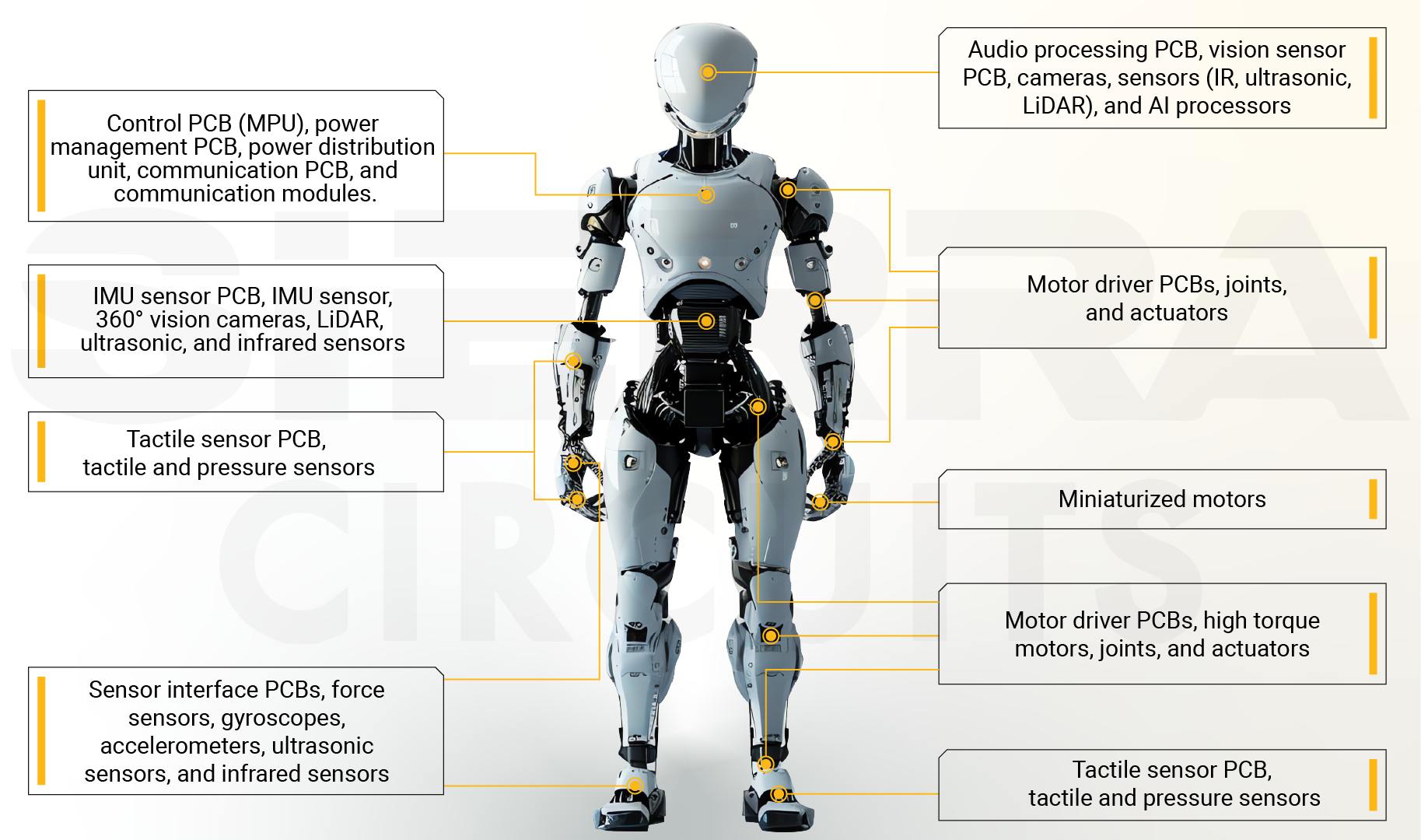
This annotated diagram of a humanoid robot shows the physical location of its core subsystems. Control PCBs (computation) are in the torso, sensor packages (sensing) are in the head, chest, and feet, and motor drivers and actuators (actuation) are located at the joints throughout the body.
Conclusion
In this lesson, we have moved inside the robot to identify its four essential subsystems: computation, sensing, actuation, and power. By understanding the function of each and how they interact, you've added a crucial layer to your due diligence framework. You can now begin to analyze a robotics company not just by what its product does, but by how it achieves that functionality.
Key Takeaways:
- A robot is an integrated system of four core subsystems: Computation (the brain), Sensing (the senses), Actuation (the muscles), and Power (the heart).
- The "robotic stack" is a useful investment framework for analyzing where value is created, from the physical hardware ("muscles") to the intelligent software ("brain").
- Each subsystem presents different opportunities for creating a technical moat. While software and AI (computation) are advancing rapidly, mastery of difficult-to-manufacture hardware like actuators can provide a more durable competitive advantage.
- The choice of components in each subsystem involves critical trade-offs in cost, performance, and reliability that have direct business implications.
In our next lesson, we will build directly on our discussion of actuation. We'll introduce the concept of degrees of freedom (DoF), a fundamental metric that quantifies a robot's mobility. Understanding DoF is key to assessing a robot's capabilities, complexity, and ultimately, its cost.