Welcome back. In our first lesson, we established the principle of backward design, shifting the focus from "what to teach" to "what students should be able to do." You began the crucial process of identifying the broad, high-level goals for your entire 10-hour film sound workshop.
Now, we will sharpen that focus. This lesson drills down into the next level of precision required by the backward design process. We will translate your big-picture goals into the specific, actionable learning objectives that will form the backbone of each of your five workshop sessions. To do this, we'll use a widely recognized and powerful framework known as SMART.
By the end of this lesson, you will be able to write specific, measurable, achievable, relevant, and time-bound (SMART) learning objectives for each of your workshop sessions. These objectives will serve as your blueprint, ensuring every demonstration, exercise, and piece of theory you include has a clear and deliberate purpose.
From Broad Goals to Specific Objectives
In the last lesson, you drafted some "enduring understanding" goals for your workshop. A goal might be, "Students will be able to plan for and capture clean, usable dialogue." This is an excellent starting point, but it's too broad for a single two-hour session. To make it useful for session planning, we need to break it down.
This is the distinction between course-level goals and session-level (or module-level) objectives. The resource below explains this hierarchy.
Writing Learning Objectives: Measurable and Mighty | Teaching Resources
This article clearly distinguishes between the broad goals for a whole course and the specific objectives for individual units or modules within it. This concept is central to organizing your 10-hour workshop into five distinct sessions.
Please read the section titled "Course and Module Objectives". Pay close attention to the example provided, which shows how a single broad course outcome is broken down into smaller, more focused module-level objectives.
Another way to think about this is in terms of "terminal" and "enabling" objectives. The terminal objective is the main goal (e.g., capture clean dialogue), while the enabling objectives are the smaller, scaffolded skills needed to get there (e.g., identify mic types, demonstrate proper boom handling, set recording levels).
The video below explains this distinction and introduces the core components of a well-formed objective.
How to Write Learning Objectives with Bloom's Taxonomy
This video from The eLearning Designer's Academy provides a clear breakdown of terminal vs. enabling objectives, which directly maps to the course vs. session structure of your workshop.
Watch the segment from "Terminal versus enabling learning objectives". This will help you see how to break down your overarching workshop goals into manageable steps for each session.
To see what a final list of objectives might look like in a syllabus for a practical filmmaking course, examine the image below. Notice how each objective starts with an action verb (Perform, Critique, Plan, etc.), describing something the student will do.

The SMART Framework
To ensure our objectives are clear, practical, and useful, we use the SMART framework. This acronym is a checklist to test the quality of each objective you write.
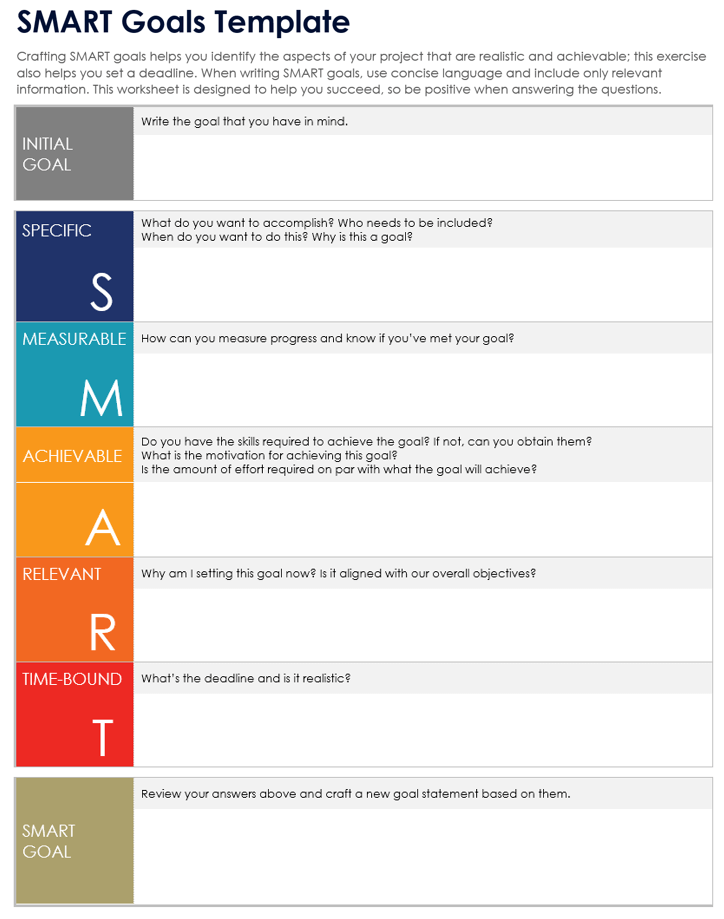
Let's break down each component.
S: Specific
An objective must state precisely what the learner will be able to do. "Learn about microphones" is vague. "Identify the three most common types of microphones used in film production" is specific.
M: Measurable
This is the most critical part of an effective objective. You must be able to observe and assess whether the student has achieved it. This hinges on using the right verbs. Verbs like "know" or "understand" are not directly measurable. How do you see someone "understanding"? Instead, use action verbs that describe an observable behavior.
The following video provides an excellent explanation of why measurability is so important and which verbs to use and avoid. It also contains a short, practical quiz to test your understanding.
How to Write Learning Objectives with Blooms Taxonomy
This video by Devlin Peck focuses on the practical application of writing measurable objectives using Bloom's Taxonomy and the Performance-Condition-Criteria model.
Please watch these key segments: Bloom's Taxonomy: This section introduces the concept of using a hierarchy of action verbs. Measurable and Meaningful: This is the core of our discussion. It explains why verbs like "understand" are weak and how to make objectives both measurable and relevant. Performance, Condition, and Criteria: This introduces a formal structure for writing objectives, which we will detail next. Quiz Time: Work through these examples to solidify your understanding of what makes a good objective.
A: Achievable
Is the objective realistic for your target audience (film students, not professionals) within the given timeframe (a 2-hour session)? An objective like "Master the art of sound design" is not achievable in two hours. "Apply basic equalization and reverb to a dialogue track" is.
R: Relevant
Does the objective contribute to the main goals of the workshop? Will this skill be useful for a film student in their own projects? Every objective should have a clear "why" that connects back to the practical realities of filmmaking.
T: Time-bound
This criterion is naturally built into your workshop structure. The objective should be achievable "by the end of this session" or "by the end of the workshop."
A Structure for Writing: The ABCD Method
While SMART provides the criteria, the ABCD model gives you a grammatical structure to build your objectives.
5 Steps to Writing Clear and Measurable Learning Objectives
This article from The Bob Pike Group provides a step-by-step guide to writing objectives, including a valuable list of action verbs and a clear explanation of the ABCD model.
First, read the section "Check Your Objective", which details the A, B, C, D's of this method. Then, review the lists of action verbs in the section titled "Select an Action Verb". These verbs are your toolkit for writing measurable objectives.
As the article explains, the four components are:
- Audience: Who is doing the learning? (e.g., "The student...")
- Behavior: What will they do? This is your measurable action verb. (e.g., "...will be able to record...")
- Condition: Under what circumstances or with what tools? (e.g., "...using a boom microphone and field recorder...")
- Degree: To what standard of performance? (e.g., "...with peak audio levels between -12dB and -6dB.")
Putting It All Together: A Worked Example
Let's take a broad goal: "Students will understand how to set up for a basic dialogue recording."
- Weak Objective: "By the end of the session, students will understand how to set up a boom mic." (Uses "understand," not measurable, lacks detail).
Now let's rebuild it using the ABCD method to make it a SMART objective for one of your Production sound sessions.
- A (Audience): The student...
- B (Behavior): ...will be able to assemble and connect a boom pole, shock mount, microphone, and XLR cable...
- C (Condition): ...given all the necessary components...
- D (Degree): ...correctly and in under two minutes.
The final SMART objective: "Given all necessary components, the student will be able to assemble and connect a boom pole, shock mount, microphone, and XLR cable correctly and in under two minutes."
This objective is:
- Specific: It lists the exact equipment and action.
- Measurable: You can watch them do it and time them. "Correctly" implies all connections are secure and functional.
- Achievable: For a film student in a hands-on session, this is a reasonable task.
- Relevant: This is a fundamental, required skill for anyone recording sound on a film set.
- Time-bound: It's designed to be achieved within a single session.
Your Turn: Draft Your Objectives
Now it's time to apply this to your own workshop plan. Take one of the broad "Important to Know and Do" goals you drafted at the end of the last lesson. Your task is to break it down into 2-3 specific, session-level learning objectives.
Exercise (15 minutes):
- Choose one of your broad workshop goals.
- Imagine you are planning the specific session where you will teach the skills related to that goal.
- Write 2-3 SMART learning objectives for that session. Use the ABCD structure to guide your writing.
- Audience: The student...
- Behavior: ...will be able to [ACTION VERB]...
- Condition: ...given [TOOLS/CONTEXT]...
- Degree: ...with/to [STANDARD OF SUCCESS].
- Jot down your drafted objectives. We will build on them in future lessons.
Conclusion
In this lesson, we moved from broad goals to the level of precision needed for effective session planning. You've learned how to formulate learning objectives that are not just lists of topics, but clear, actionable statements about student performance.
Key Takeaways:
- Effective workshop design requires breaking down broad course goals into specific, session-level learning objectives.
- The SMART framework (Specific, Measurable, Achievable, Relevant, Time-bound) is your quality-check for each objective.
- Measurability is key; always use strong action verbs and avoid vague terms like "understand" or "know."
- The ABCD model (Audience, Behavior, Condition, Degree) provides a reliable structure for writing complete and unambiguous objectives.
These objectives are the foundation of Stage 1 of backward design. Now that you can define exactly what you want your students to be able to do, you are ready for the next step. In our next lesson, we will address a crucial constraint for any workshop leader: time. We'll explore how to distinguish essential from supplementary content to ensure you can meet your new, well-defined objectives within your 10-hour workshop schedule.