Introduction
Welcome to the final lesson in our portfolio module! In our last session, you designed the most critical page of your portfolio: the case study, turning a project into a persuasive story of your problem-solving abilities. Now, it's time to introduce the creator behind that work. A potential client who is impressed by your case study will inevitably ask, "Who is the person who made this?" Your 'About Me' page is the answer to that question.
Today, we will focus on writing a concise and compelling 'About Me' page that does more than just list your history. It will craft a narrative that strategically highlights your unique background, weaving your experience in finance and creative entrepreneurship into a powerful value proposition for your freelance UI/UX career. For a freelancer, this page is not just a bio—it's a tool for building trust and connection, turning a potential client's curiosity into a conversation.
1. The Foundation: Your Personal Brand Statement
Before writing a full page, you need a core message. This is your personal brand statement—a concise, 1-2 sentence declaration of who you help, what problem you solve, and what makes you unique. It's the headline of your professional story.
Given your transition into design, the goal is not to downplay your past but to frame it as a unique strength. Your background in finance provides analytical rigor, and your entrepreneurial experience provides creative and client-centric intuition. The fusion of these two worlds is your superpower.
To start crystallizing this, it helps to do a quick self-reflection.

Now, let's translate that reflection into a sharp, effective statement.
27 Personal Brand Statement Examples That Actually Get You Hired ...
This article from SocialRails provides excellent, actionable templates for crafting a brand statement. It's perfect for moving from abstract ideas to concrete copy.
Your task is to draft your core statement. To do this, focus on three key parts of the article: First, read the section "For Career Changers." This template is tailor-made for your situation and provides a solid structure. Next, review the "How to Write Your Personal Brand Statement (Step-by-Step)" section. The 7 questions and the drafting structure will guide you in filling out the career-changer template with your specific details. Finally, read the section "Optimize Your Personal Brand Statement for Different Goals," specifically the part on "For Freelancing/Consulting." This will help you ensure your statement speaks directly to potential clients and their business needs.
2. Weaving Your Narrative: From Finance to Figma
With your core message defined, you can now build the full 'About Me' page around it. The most effective 'About Me' pages tell a story. Your story is about the convergence of two distinct worlds: the analytical precision of finance and the empathetic creativity of your bespoke gifting business.
This journey is not something to explain away; it's a narrative that builds a unique and compelling case for why a client should hire you. You're not just a designer; you're a designer who understands business logic, return on investment, and what truly delights a customer.
To see a real-world example of this, let's look at another professional who made a similar transition.
Is UX Design A Good Career? - From Accountancy To UX at 37
This article tells the story of Ivy, who transitioned from finance (PWC, Barclays) to UX design. Her journey will likely feel very familiar and provides a fantastic model for how to frame your own background.
As you read about Ivy's story, pay close attention to two key phrases: She "prides herself as someone who is able to offer a unique blend of UX and Design skills coupled with commercial understanding and analytical ability." She describes UX design as a field that "marries logic and creativity." These phrases are powerful because they don't apologize for a non-traditional background; they celebrate it as a unique advantage. This is exactly the tone and angle you should aim for.
3. Structuring Your 'About Me' Page
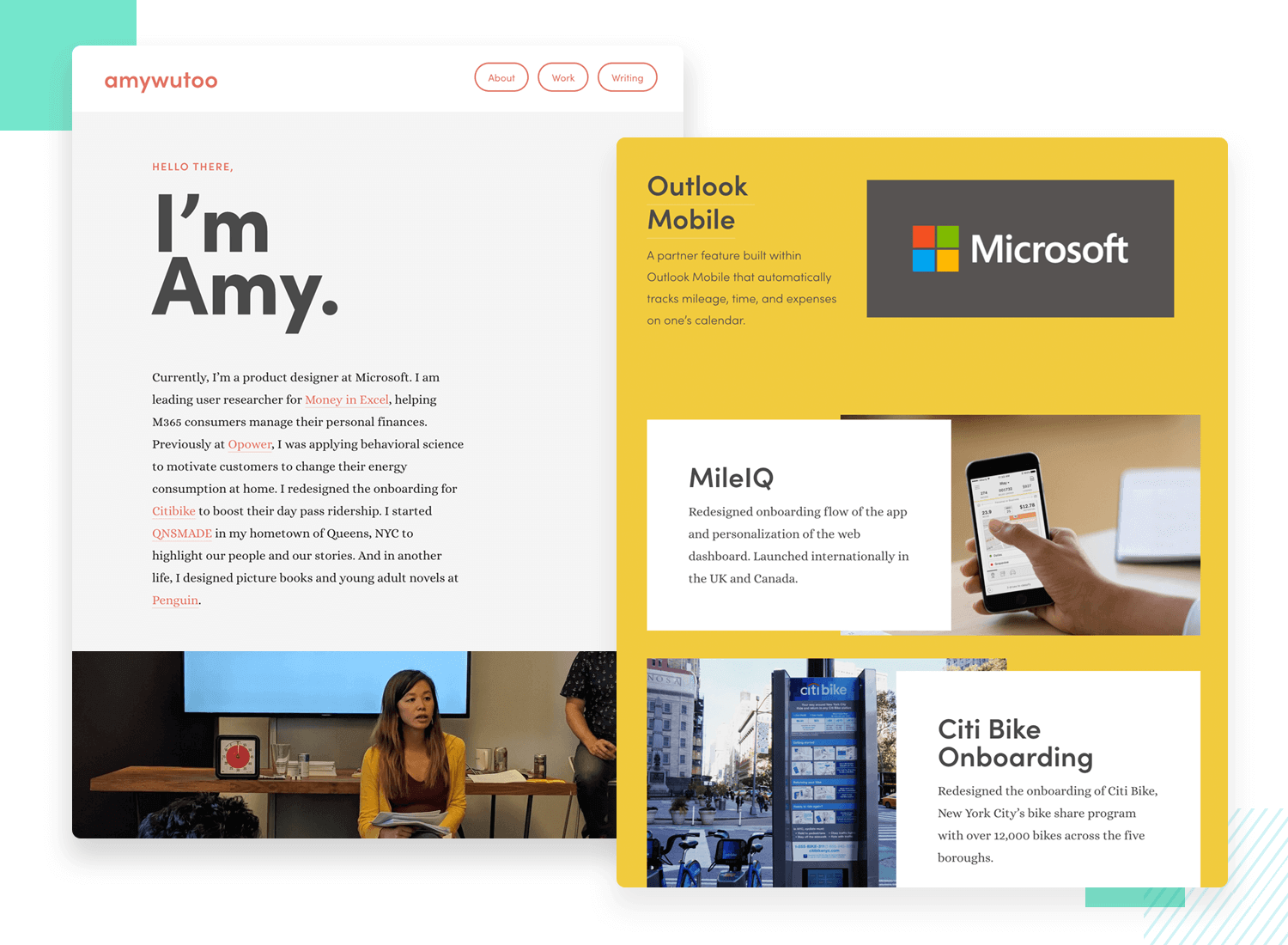
A good story needs a good structure. A jumble of facts won't connect with a reader. We'll use a proven formula for a personal brand 'About Me' page that guides the reader from interest to action.
How To Write A Memorable About Us Page (With Copywriting Tips, Examples & Formulas)
In this video, copywriting expert Alex Cattoni breaks down the essential components of a memorable 'About' page. We will use her formula as the blueprint for your page content.
Watch the segment from the 'About page formula'. The presenter outlines six key elements. We will adapt these for your freelance portfolio page:
Here are the six elements, adapted for your specific context:
- Headline: Your Personal Brand Statement. This should be the first thing a visitor reads.
- Intro/Mission: A short paragraph expanding on your headline. This is where you introduce your core belief—for example, that great design should be both beautiful and business-savvy, marrying logic and creativity.
- The Story: This is the heart of your page. In 2-3 short paragraphs, you'll narrate your journey.
- Paragraph 1: The Analytical Foundation. Briefly mention your background in finance/audit and the skills it gave you: attention to detail, data-driven thinking, and understanding business structures.
- Paragraph 2: The Creative Spark. Talk about your entrepreneurial venture. This shows your passion for aesthetics, client psychology, and creating delightful experiences.
- Paragraph 3: The Convergence. Explain how you're now channeling both sets of skills into UI/UX design to create digital experiences that are not only visually engaging but also strategically sound.
- Authority/Credibility: This section provides proof. You can frame your experience as credibility boosters.
- Finance & Audit: "My background in audit and CA has trained me to be meticulously detail-oriented and to approach every project with analytical rigor."
- Entrepreneurship: "Running my own creative business taught me how to manage client relationships from start to finish and the importance of delivering a final product that exceeds expectations."
- A Personal Touch (Optional but Recommended): A single sentence about your interests outside of work (e.g., your love for crafting, a favorite book) makes you more relatable.
- Call-to-Action (CTA): End the page by telling the visitor what to do next. This should be clear and direct. Examples:
- "Have a project in mind? Let's connect." (Links to your contact page or email).
- "View my work to see my process in action." (Links back to your portfolio/case studies).
4. Writing Exercise: Draft Your 'About Me' Content
Now it's time to write. Using the structure above, draft the text for your 'About Me' page. Don't worry about perfect wording yet; focus on getting the ideas down.
Your Action Items:
- Draft Your Headline: Use the personal brand statement you created in the first step.
- Write Your Story: Follow the three-paragraph structure (Analysis -> Creativity -> Convergence). Use the insights from Ivy's story and the NNgroup video below to frame your skills effectively.
- Quantify Where Possible: Remember the advice on reframing past roles. Your finance experience isn't just "attention to detail"; it's experience in a world where small errors have big consequences.
Awesome Resumes for UX Career Changers
This short video from NNgroup, though focused on resumes, offers a powerful method for articulating the value of your past experiences.
Watch these two key clips: Reframing old jobs: The speaker explains how to connect past roles to transferable UX skills. Think about how your "data analysis" in finance translates to analyzing user data, or how "client management" in your business translates to stakeholder interviews. Structuring achievements: The "Verb + quantitative achievement + context" formula is a powerful tool. While you may not have UX metrics yet, you can use this to describe your business success (e.g., "Delivered over 100 bespoke client projects, translating unique personal stories into tangible creative products").
Conclusion
You have now crafted the final, crucial piece of your portfolio's core narrative. Your 'About Me' page is more than a formality; it's a strategic asset that builds trust and sets you apart. By embracing your unique journey from finance and entrepreneurship, you've created a story that positions you not as a typical junior designer, but as a design professional with a rare combination of analytical depth and creative intuition.
Key Takeaways:
- Your 'About Me' page should tell a story that frames your unique background as a competitive advantage.
- Start with a strong, client-focused personal brand statement that serves as your headline.
- Structure your narrative logically: introduce your mission, tell your story of convergence (analysis + creativity), provide credibility, and end with a clear call-to-action.
- Use inspiring examples like Ivy's journey to see how a non-traditional path can be your greatest strength.
- Reframe skills from your past career to show their direct relevance and value in a UI/UX context.
Preview of the Next Module:
With your portfolio's foundation firmly in place—complete with compelling case studies and a unique 'About Me' page—you are now ready to engage with the market. In our next module, we transition from building your assets to running your business. Our first lesson will focus on the very beginning of a client engagement: creating a client kickoff questionnaire to ensure every project starts with clarity, alignment, and a solid foundation for success.