Hello! Welcome to your eighth and final lesson in our first module, "The Chemical Foundation of Life."
In our previous lessons, we've explored three of the four major classes of biological macromolecules: carbohydrates, lipids, and proteins. We saw how simple monomers can be assembled into complex polymers with diverse functions. You learned how the precise sequence of amino acids in a polypeptide (its primary structure) dictates its final 3D shape and, ultimately, its function.
Today, we will dive into the fourth and final class of macromolecules: nucleic acids. These molecules hold the very blueprint for life itself. This lesson directly addresses the learning outcome: Describe the structure of nucleotides and their polymerization into nucleic acids (DNA and RNA). We will explore the building blocks of genetic material and see how they are assembled into the long chains that encode all the information needed to build and operate a cell—including the primary structure of every protein we just discussed.
The Building Blocks of Information: Nucleotides
Nucleic acids are polymers, and their corresponding monomers are called nucleotides. There are two main types of nucleic acids:
- Deoxyribonucleic acid (DNA): The master blueprint. It stores an organism's genetic information in the nucleus of eukaryotic cells.
- Ribonucleic acid (RNA): A versatile molecule that acts as a messenger, carrying instructions from DNA to the cell's protein-making machinery, and also plays structural and catalytic roles.
Every nucleotide, whether for DNA or RNA, consists of three core components. Let's watch a video that introduces these components and highlights the key differences between the nucleotides found in DNA versus RNA.
Nucleic Acids - RNA and DNA Structure - Biochemistry
This video from The Organic Chemistry Tutor provides an excellent introduction to nucleic acids. It defines nucleotides and clearly explains their three components, pointing out the structural differences that distinguish DNA from RNA.
Watch the video from the beginning to 05:23. Pay close attention to: The three parts of a nucleotide. The difference between the sugars (ribose vs. deoxyribose). The different sets of nitrogenous bases used in DNA and RNA.
As the video explained, the three components of a nucleotide are:
-
A Pentose (5-carbon) Sugar: This forms the core of the nucleotide.
- In RNA, the sugar is ribose.
- In DNA, the sugar is deoxyribose. The "deoxy-" prefix indicates that it is missing an oxygen atom on its second carbon (written as the 2' carbon) compared to ribose.
-
A Nitrogenous Base: This is the information-carrying part of the nucleotide. The bases come in two chemical families:
- Purines (two rings): Adenine (A) and Guanine (G).
- Pyrimidines (one ring): Cytosine (C), Thymine (T), and Uracil (U).
- DNA uses A, G, C, and T.
- RNA uses A, G, C, and U.
-
A Phosphate Group: This is attached to the 5' carbon of the sugar. The phosphate group is acidic and carries a negative charge, which gives nucleic acids their overall negative charge and name.
This image provides a clear, simplified diagram of a DNA nucleotide's structure.
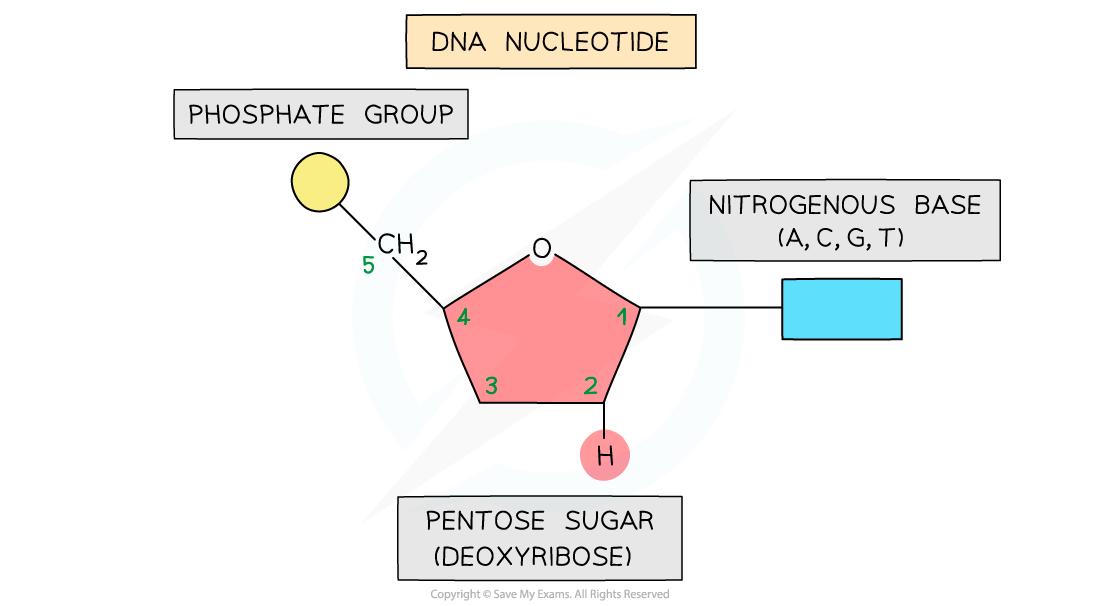
It's also useful to distinguish between a nucleoside and a nucleotide. A nucleoside is just the sugar and the base, without the phosphate group. Adding one or more phosphate groups turns a nucleoside into a nucleotide.
Test your understanding!
A scientist analyzes a nucleotide and finds that it contains a ribose sugar and a uracil base.
- Is this nucleotide from DNA or RNA?
- Is the nitrogenous base a purine or a pyrimidine?
Show answer
- This nucleotide is from RNA. The presence of both ribose sugar and the base uracil are hallmarks of RNA. DNA would have deoxyribose sugar and thymine instead of uracil.
- The base, uracil, is a pyrimidine because it has a single-ring structure. The purines are adenine and guanine.
Polymerization: Building a Nucleic Acid Chain
Now that we understand the monomer, how do these nucleotides link together to form a polymer, or a polynucleotide?
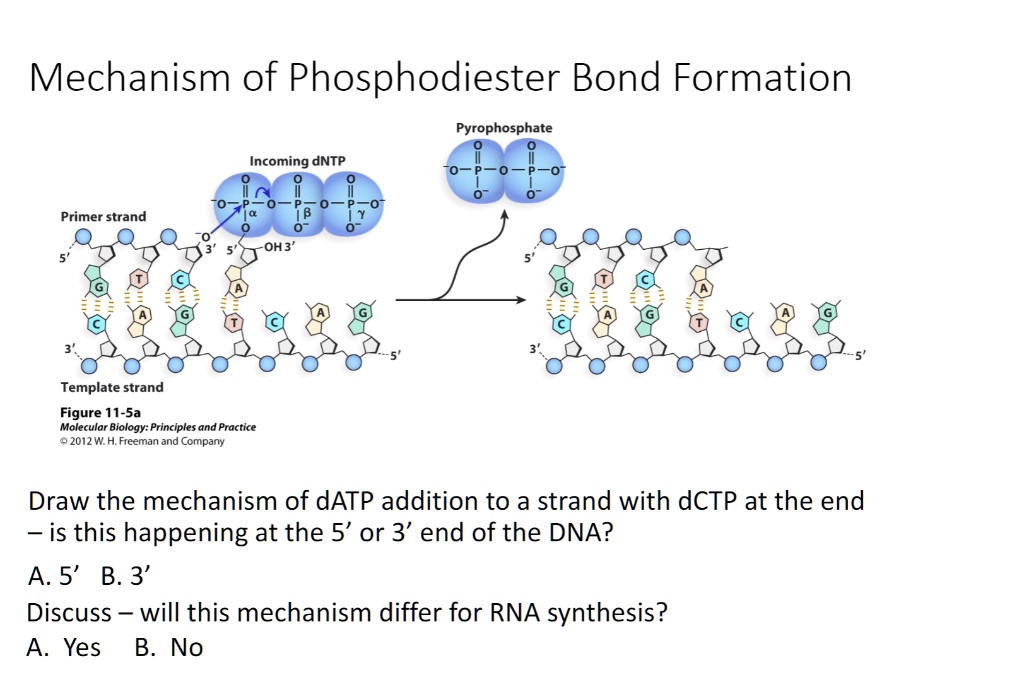
Nucleotides are joined by a phosphodiester bond. This is a strong covalent bond formed in a condensation reaction. Specifically, the phosphate group attached to the 5' carbon of one nucleotide forms a bond with the hydroxyl (-OH) group on the 3' carbon of the next nucleotide.
This repeated linking process creates a sugar-phosphate backbone, which is the structural framework of a nucleic acid strand. The nitrogenous bases are not part of the backbone; they project outwards from it, like teeth on a comb.
This process creates a strand with directionality. One end has a free phosphate group on the 5' carbon (the 5' end), and the other end has a free hydroxyl group on the 3' carbon (the 3' end). By convention, we always read and write a nucleic acid sequence from the 5' end to the 3' end.
Let's look at the chemistry of this reaction.
Now, let's watch a video that animates this process and introduces some key features of the resulting DNA molecule.
Cell Biology | DNA Structure & Organization 🧬
This segment from Ninja Nerd clearly illustrates how phosphodiester bonds link nucleotides together to form the sugar-phosphate backbone. It also introduces the crucial concepts of complementarity and the anti-parallel nature of DNA strands.
Watch from 29:27 to 36:08. Focus on: The concept of base complementarity (A with T, G with C). How the 5' and 3' ends of nucleotides form a phosphodiester bond. The meaning of 'anti-parallel' arrangement in DNA.
The Structure of DNA and RNA
With an understanding of how polynucleotide chains are built, we can now look at the final structures of DNA and RNA.
DNA: The Double Helix
As you just saw, DNA is not a single strand. It consists of two polynucleotide strands that wind around each other to form a double helix. Think of it as a twisted ladder.
- The sugar-phosphate backbones form the two side rails of the ladder.
- The nitrogenous bases, paired in the middle, form the rungs.
Key features of the DNA double helix:
- Antiparallel Strands: The two strands run in opposite directions. If one strand runs 5' to 3', its partner strand runs 3' to 5'.
- Complementary Base Pairing: The bases pair in a specific way, held together by hydrogen bonds.
- Adenine (A) always pairs with Thymine (T), forming two hydrogen bonds.
- Guanine (G) always pairs with Cytosine (C), forming three hydrogen bonds.
- This rule ensures a purine always pairs with a pyrimidine, maintaining a constant diameter for the helix. The sequence of one strand dictates the sequence of the other.
RNA: A Versatile Single Strand
The structure of RNA is simpler but more varied.
- Single-Stranded: RNA is typically a single polynucleotide chain.
- Sugar and Base: It uses ribose as its sugar and uracil (U) in place of thymine.
- Folding: Although single-stranded, an RNA molecule can fold back on itself, with stretches of complementary bases (A with U, G with C) forming hydrogen bonds. This allows RNA to form complex and specific three-dimensional shapes, which are crucial for its diverse functions (e.g., in tRNA and rRNA).
To solidify these concepts, let's review a short, comprehensive text with helpful diagrams.
This resource from the OpenStax 'Biology 2e' textbook provides a concise summary of the structures of nucleotides, DNA, and RNA. The diagrams are very clear.
Read the sections 'DNA and RNA' (starting from the paragraph defining nucleotides), 'DNA Double-Helix Structure', and 'RNA'. The table at the end provides a great summary.
Test your understanding!
A segment of one strand of a DNA molecule has the sequence:
5' - A T G C C G T A C - 3'
What is the sequence of the complementary strand? Remember to label the 5' and 3' ends correctly.
Show answer
The complementary sequence is:
3' - T A C G G C A T G - 5'
Or, written in the conventional 5'-to-3' direction:
5' - G T A C G G C A T - 3'
This is because A pairs with T, and G pairs with C. The strands must also be antiparallel.
Conclusion
Congratulations on completing the first module! We have now explored all four major classes of biological macromolecules. Today, we delved into nucleic acids, the molecules of heredity.
Key Takeaways:
- Nucleic acids (DNA and RNA) are polymers made of nucleotide monomers.
- Each nucleotide has three parts: a phosphate group, a pentose sugar (deoxyribose in DNA, ribose in RNA), and a nitrogenous base (A, G, C, T in DNA; A, G, C, U in RNA).
- Nucleotides polymerize via phosphodiester bonds, linking the 5' carbon of one sugar to the 3' carbon of the next, creating a sugar-phosphate backbone with 5' and 3' ends.
- DNA is a double helix with two antiparallel strands linked by hydrogen bonds between complementary bases: A pairs with T, and G pairs with C.
- RNA is typically single-stranded and can fold into complex shapes essential for its function.
Preview of the next lesson:
Having built a strong foundation in the chemical components of life, we are now ready to see how they are organized into a living unit. In our next lesson, we will begin Module 2: "A Tour of the Cell." We will start by comparing the fundamental structures and features of the two major types of cells: prokaryotic and eukaryotic cells.