Hello! Welcome to the first lesson of your university-level biology course. We're kicking things off with the most fundamental substance for life as we know it: water.
This lesson is designed to address the first learning outcome in our "Chemical Foundation of Life" module: Explain the properties of water that make it essential for life, including polarity, hydrogen bonding, and its role as a solvent.
We will start by examining the structure of a single water molecule to understand its polarity. From there, we'll see how this polarity allows water molecules to form hydrogen bonds with each other. These hydrogen bonds are the key to understanding all of water's remarkable "emergent properties"—cohesion, adhesion, its ability to moderate temperature, its role as a universal solvent, and the strange fact that ice floats. By the end of this lesson, you'll have a clear picture of why the search for life elsewhere in the universe always begins with a search for water.
Given your comfort with basic chemistry, we'll dive right into the molecular details that explain these large-scale biological phenomena. Let's begin.
1. The Root of It All: Water's Polarity and Hydrogen Bonds
Everything special about water begins with its molecular structure. A water molecule () consists of one oxygen atom covalently bonded to two hydrogen atoms. However, these bonds are not ordinary; they are polar covalent bonds.
This polarity arises because oxygen is highly electronegative, meaning it has a strong attraction for electrons. As a result, the shared electrons in the H-O bonds spend more time orbiting the oxygen nucleus than the hydrogen nuclei. This unequal sharing of electrons creates:
- A partial negative charge () on the oxygen atom.
- Partial positive charges () on the hydrogen atoms.
Because it has oppositely charged ends, the water molecule is polar. This polarity is the single most important concept for understanding water's behavior.
This charge difference allows water molecules to attract each other. The partially positive hydrogen () of one molecule is attracted to the partially negative oxygen () of a nearby molecule. This attraction is called a hydrogen bond.

It's crucial to remember that hydrogen bonds are much weaker than covalent bonds. They are constantly breaking and reforming, especially in liquid water. However, the cumulative effect of billions of these bonds gives water its unique, life-sustaining properties.
To see a clear animation of this, please watch the first part of the following video.
Properties of Water | Hydrogen Bonding in Water | Biology | Biochemistry
The video 'Properties of Water' by Socratica provides an excellent visual explanation of water's structure and the formation of hydrogen bonds.
Watch from the beginning until timestamp 02:27. Focus on how the electronegativity of oxygen creates partial charges and how these lead to hydrogen bonding between molecules.
Test your understanding!
Methane () is a simple molecule with covalent bonds, much like water. However, it is a gas at room temperature and does not form hydrogen bonds. Based on what you've learned about polarity, why can't methane form hydrogen bonds?
Show answer
The covalent bonds in methane are nonpolar. Carbon and hydrogen have very similar electronegativities, so they share electrons almost equally. This means there are no significant partial positive or negative charges on the molecule. Without these partial charges, there is no basis for the electrostatic attraction that defines a hydrogen bond.
2. The Universal Solvent
Water's polarity makes it an exceptional solvent, especially for other polar molecules and ionic compounds. This is why the cytoplasm of every cell is a water-based solution.
- Hydrophilic (water-loving) substances are those that readily dissolve in water. These include ionic compounds (like salt) and polar molecules (like sugar).
- Hydrophobic (water-fearing) substances are nonpolar and do not dissolve in water. Oils and fats are classic examples.
When an ionic compound like table salt (NaCl) is placed in water, the polar water molecules surround the individual ions ( and ). The partial negative oxygens are attracted to the positive sodium ion, while the partial positive hydrogens are attracted to the negative chloride ion. This forms a "hydration shell" around each ion, effectively separating them and dissolving the salt.
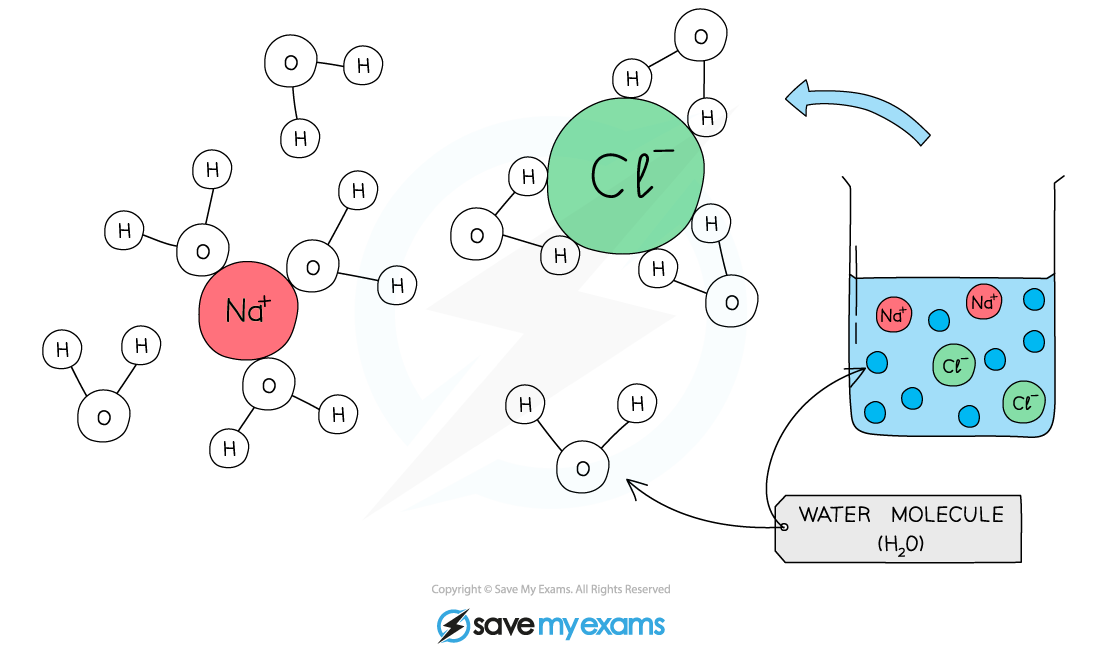
This solvent property is vital for life. It allows for the transport of nutrients in blood (which is mostly water), facilitates the chemical reactions inside cells, and allows waste products to be carried away.
For a more detailed explanation, please consult the following reading.
2.2 Water - Biology for AP® Courses
The OpenStax resource 'Biology for AP® Courses' clearly explains water's solvent properties.
Read the section titled 'Water’s Solvent Properties'. Pay attention to the definitions of solvent, sphere of hydration, and dissociation.
3. Cohesion, Adhesion, and Surface Tension
Hydrogen bonds cause water molecules to "stick together," a property called cohesion. This is why water forms droplets. At the surface of a body of water, the cohesion between molecules is especially strong, creating surface tension—a sort of invisible film that can support the weight of small insects like water striders.
Adhesion is the clinging of one substance to another. Since water is polar, it adheres to other polar or charged surfaces. You can see this when water "climbs" up the sides of a glass tube, forming a meniscus.
The combination of cohesion and adhesion is responsible for capillary action, which is critical for plants. As water evaporates from the leaves (transpiration), adhesion to the walls of the plant's xylem tubes and cohesion between water molecules pull more water up from the roots, sometimes over distances of more than 100 meters in the tallest trees.
Properties of Water | Hydrogen Bonding in Water | Biology | Biochemistry
Let's return to the Socratica video to see visualizations of cohesion, adhesion, and surface tension.
Watch the segment from 02:27 to 04:40. Notice the real-world biological examples provided for these properties, such as transpiration in plants and water striders.
4. Moderation of Temperature
Water plays a crucial role in regulating temperature, both in the environment and within organisms. This is due to its high specific heat capacity and high heat of vaporization, both of which are direct results of hydrogen bonding.
High Specific Heat
Specific heat is the amount of heat that must be absorbed or lost for 1 gram of a substance to change its temperature by 1°C. Water's specific heat is unusually high.
When heat is added to water, much of the energy is used to break hydrogen bonds before the molecules themselves can start moving faster (which is what an increase in temperature is). Conversely, when water cools, it releases a lot of heat as new hydrogen bonds form.
Biological Significance:
- Large bodies of water, like oceans and lakes, can absorb and store huge amounts of heat from the sun, which stabilizes coastal climates.
- Since organisms are mostly water, this property helps them resist changes in their own body temperature, contributing to homeostasis.
High Heat of Vaporization
Water also has a high heat of vaporization. This means it takes a large amount of heat to convert liquid water into a gas (water vapor). Again, this is because the hydrogen bonds must be broken before the molecules can escape as a gas.
Biological Significance:
- This property leads to evaporative cooling. As water evaporates from a surface (like your skin when you sweat or a dog's tongue when it pants), it takes a large amount of heat with it, cooling the organism. This is another vital mechanism for maintaining temperature homeostasis.
Properties of Water | Hydrogen Bonding in Water | Biology | Biochemistry
The next segment of the Socratica video covers these thermal properties.
Watch from 04:40 to 07:57. Focus on how hydrogen bonds explain both high specific heat and high heat of vaporization, and understand the biological importance of each.
Test your understanding!
Many coastal cities, like Istanbul, experience milder climates (cooler summers and warmer winters) than inland cities at the same latitude. How do the properties of water you've just learned about explain this phenomenon?
Show answer
This is due to water's high specific heat capacity. In the summer, the nearby sea absorbs a large amount of solar heat, which keeps the coastal air cooler than it would be inland. In the winter, the sea slowly releases this stored heat, which warms the coastal air and prevents temperatures from dropping as low as they do inland. The water acts as a massive heat buffer.
5. The Anomaly of Ice Floating
In most substances, the solid state is denser than the liquid state. Water is a notable exception. When water freezes, its molecules don't pack closer together. Instead, the hydrogen bonds become stable, locking the molecules into a crystalline lattice that holds them farther apart than in liquid water.
This makes ice about 10% less dense than liquid water, which is why ice cubes and icebergs float.
Biological Significance:
- This property is crucial for aquatic life. In winter, a layer of ice forms on the surface of lakes and ponds, which insulates the liquid water below, preventing it from freezing solid. This allows fish and other organisms to survive the winter.
- If ice were denser than water, it would sink. Lakes and oceans would freeze from the bottom up, eventually becoming solid blocks of ice, which would be devastating for life.
Properties of Water | Hydrogen Bonding in Water | Biology | Biochemistry
The final segment of the video explains this unique property of ice.
Watch from 09:30 to the end (12:09). Pay close attention to the structure of the ice lattice and why its insulating effect is so important for aquatic ecosystems.
Conclusion
In this lesson, we have explored the fundamental properties of water that make it indispensable for life. We've seen that all of these properties are emergent, meaning they arise from the interactions between water molecules, which are governed by a single, simple fact: the water molecule is polar.
Here are the key takeaways:
- Polarity: Unequal sharing of electrons in creates partial positive and negative charges.
- Hydrogen Bonding: The polarity of water molecules leads to weak attractions called hydrogen bonds between them.
- Cohesion & Adhesion: Hydrogen bonds make water molecules stick to each other and to other polar surfaces, enabling transport in plants.
- Excellent Solvent: Water's polarity allows it to dissolve other polar and ionic substances, making it the medium for life's chemical reactions.
- Temperature Moderation: Due to its high specific heat and heat of vaporization, water resists temperature changes and is effective for cooling, both crucial for homeostasis.
- Floating Ice: The crystalline structure of ice is less dense than liquid water, which insulates aquatic environments in winter.
Understanding water's role provides the essential chemical context for all the biological processes we will study next.
Preview of the next lesson: Now that we've established the aqueous environment of the cell, we will turn to the large molecules that make up life's structures and carry out its functions. In the next lesson, we will explore the relationship between monomers and polymers, the building blocks of life, and the chemical reactions—dehydration synthesis and hydrolysis—that assemble and disassemble them.