Hello! Welcome to your second lesson.
In our first lesson, we explored why water is the perfect stage for the drama of life, thanks to its unique properties like polarity and hydrogen bonding. We established that all of life's essential chemical reactions happen in an aqueous (water-based) solution inside cells.
Now, we'll turn our attention to the actors on that stage: the large biological molecules (macromolecules) that make up living things. This lesson addresses the learning outcome: Describe the relationship between monomers and polymers, and the processes of dehydration synthesis and hydrolysis.
We will discover that nature, like a good engineer, uses a simple and elegant strategy: building vast and complex structures from small, repeating units. We'll define these units (monomers) and the chains they form (polymers). Most importantly, we'll learn the two fundamental chemical reactions that life uses to build these chains up and break them back down. These two processes are central to everything from how your body grows to how it digests food.
1. The Building Blocks of Life: Monomers and Polymers
Think of a complex structure, like a long train or a necklace made of beads. The entire structure is the polymer ("poly-" means many), and each individual train car or bead is a monomer ("mono-" means one). Biological macromolecules are built on this same principle. They are long chains composed of smaller, repeating molecular units.
There are four major classes of large biological molecules, and three of them are true polymers:
- Carbohydrates: Their monomers are called monosaccharides (simple sugars). Their polymers are called polysaccharides.
- Proteins: Their monomers are amino acids. Their polymers are called polypeptides.
- Nucleic Acids (like DNA and RNA): Their monomers are nucleotides. Their polymers are called polynucleotides.
The fourth class, lipids (fats and oils), are also essential large molecules, but they are not considered true polymers because they aren't built from a repeating chain of identical or similar monomers. We'll discuss them in a future lesson.
To get a clear picture of these concepts, the following video provides an excellent introduction.
Introduction to Biological Molecules: Monomers & Polymers | A-level Biology | OCR, AQA, Edexcel
This video from Launchpad Learning uses a helpful analogy to explain the monomer-polymer relationship and introduces the specific terminology for each major class of biological molecules.
Watch from 06:48 to 10:44. Focus on the definition of a monomer as a building block and a polymer as a chain of monomers. Pay attention to the specific names for monomers and polymers in carbohydrates, proteins, and nucleic acids, and note why lipids are considered a special case.
2. Building Up and Breaking Down
Now for the central question: how does a cell link monomers together to build a polymer, and how does it break a polymer apart to get back to the monomers? The answer lies in two opposing reactions that involve the addition or removal of water.
The names of the reactions themselves give you a strong clue about what they do:
- Dehydration Synthesis: Dehydration means to lose water. Synthesis means to make something. This is the reaction that builds polymers.
- Hydrolysis: Hydro means water. Lysis means to split or break. This is the reaction that breaks down polymers.
Let's watch a short, focused video that illustrates the general mechanism of both reactions.
Hydrolysis and Dehydration Synthesis Reactions
This clip from The Organic Chemistry Tutor provides a very clear, step-by-step walkthrough of both dehydration synthesis and hydrolysis.
Watch from the beginning to 02:52. The video first explains the meaning of the terms. Then, it illustrates the general mechanism for how monomers join and polymers split, showing the role of water in each process.
3. A Closer Look at the Chemistry
As you saw in the video, these two reactions are mirror images of each other. Let's formalize what happens.
Dehydration Synthesis (or Condensation)
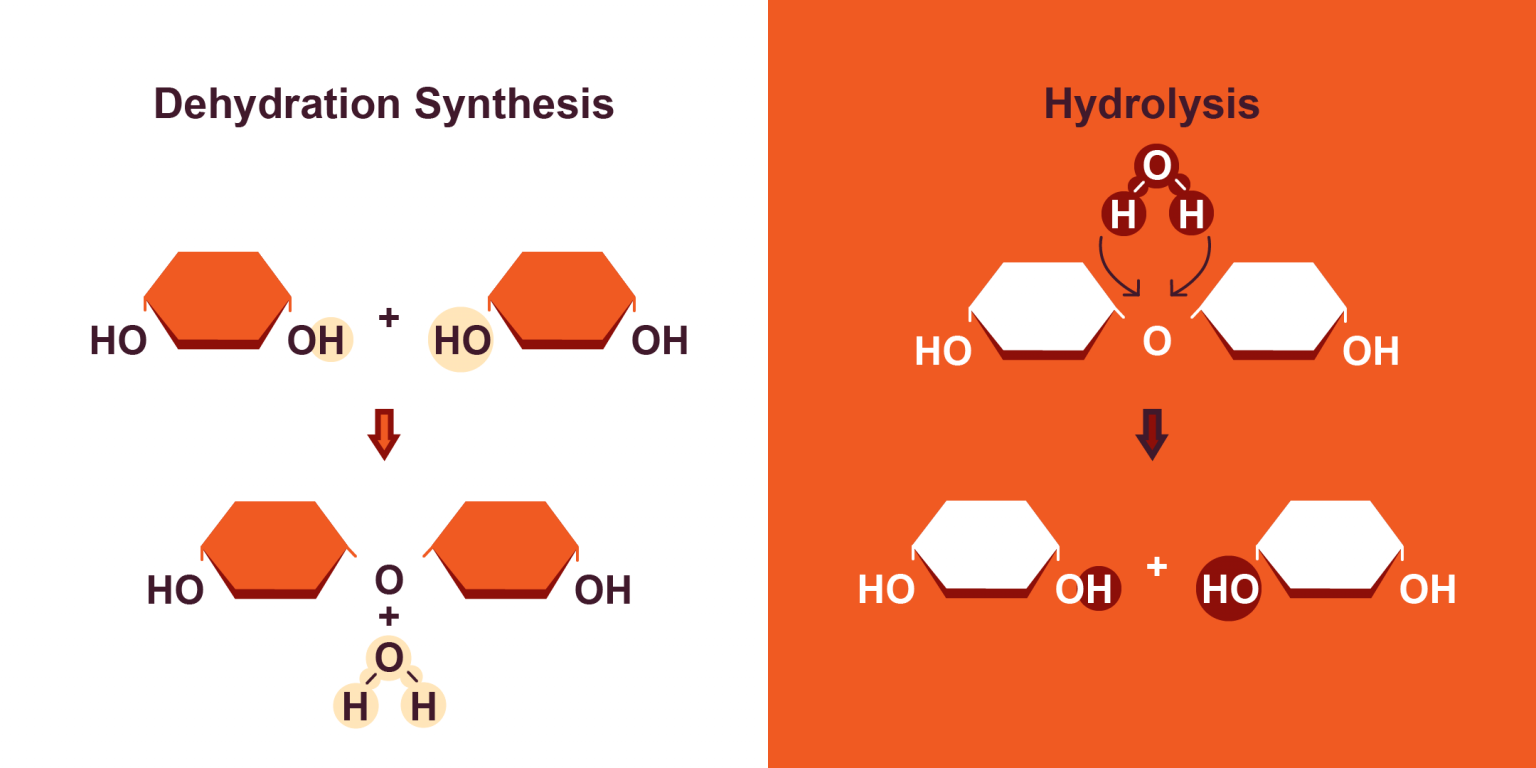
To join two monomers, a covalent bond must be formed between them. This is achieved when one monomer loses a hydroxyl group () and the other loses a hydrogen atom (). These two combine to form a water molecule (), which is released. The "gap" left on each monomer allows them to form a stable covalent bond.
This process is repeated to add more monomers to the chain, extending the polymer. Because it involves building new bonds, dehydration synthesis requires energy and the help of specific biological catalysts called enzymes.
Hydrolysis
To break a polymer down, the process is reversed. A water molecule is added across the covalent bond linking two monomers. The water molecule splits into and . The attaches to one monomer, and the attaches to the other, breaking the bond between them.
This process is fundamental to digestion. Your body uses hydrolysis to break down the polymers in your food (like starch and protein) into monomers (like simple sugars and amino acids) that are small enough to be absorbed by your cells. Hydrolysis releases energy and also requires specific enzymes.
For a detailed explanation and to see these reactions in context, please read the following sections from the OpenStax 'Biology 2e' textbook.
Synthesis of Biological Macromolecules
This text provides a formal description and clear diagrams of both reactions.
Read the sections titled 'Dehydration Synthesis' and 'Hydrolysis'. Pay close attention to the diagrams showing the involvement of water and the formation/breaking of covalent bonds. Also, note the mention of enzymes and the real-world example of digestion.
The diagram below provides a simple, powerful visual summary of these two opposing processes.
Test your understanding!
Imagine a small protein (a polypeptide) is being built in a cell. The final protein is a chain consisting of 50 amino acid monomers linked together.
- How many covalent bonds were formed to create this polymer?
- How many water molecules were produced during its synthesis?
- If your body were to digest this protein completely back into its 50 individual amino acids, how many water molecules would be needed for the hydrolysis reactions?
Show answer
- To link 50 monomers in a chain, you need to form 49 bonds (one less than the number of monomers).
- Since one water molecule is produced for every bond formed, 49 water molecules were produced.
- To break all 49 bonds, you would need 49 water molecules, as hydrolysis consumes one water molecule per bond broken.
Conclusion
In this lesson, we have established the fundamental principle of how life's large molecules are constructed. This theme of building polymers from monomers via dehydration synthesis, and breaking them down via hydrolysis, will recur throughout our study of biochemistry.
Here are the key takeaways:
- Monomers are the individual building blocks of large biological molecules.
- Polymers are long chains of monomers linked by covalent bonds.
- Dehydration Synthesis is an anabolic process (it builds molecules) that joins monomers, releases a water molecule, and requires energy.
- Hydrolysis is a catabolic process (it breaks down molecules) that splits polymers, consumes a water molecule, and releases energy.
These two reactions provide the cell with a simple, reversible mechanism for assembling and disassembling all the major macromolecules it needs to function.
Preview of the next lesson: With this foundational knowledge in place, we are ready to explore the first major class of biological macromolecules: carbohydrates. We will start by examining the structure of monosaccharides (simple sugars) and then see how dehydration synthesis links them to form disaccharides and polysaccharides, the polymers that serve as fuel and structural components in organisms.