Welcome to your first lesson in the Atomic Habits course. We'll begin by exploring the foundational principle of the entire philosophy: the surprising power of small, consistent changes. Your goal for this lesson is to analyze how these seemingly minor daily actions compound over time to produce remarkable results.
As a business analyst with an engineering background, you're familiar with how small inputs can lead to significant outputs in complex systems. We'll apply a similar lens to personal and professional development, examining the underlying mathematics and real-world evidence of this powerful concept. This first step will provide the "why" behind the practical strategies we will build in the lessons to come.
The Mathematics of Marginal Gains
We often convince ourselves that meaningful change requires massive, disruptive action. While big efforts can sometimes yield big results, they are often unsustainable. James Clear argues that the more reliable path to improvement is through small, "atomic" habits that compound.
The effect of these small changes can be startling when projected over time. Imagine improving by just 1% each day. The daily difference is negligible, but the long-term impact is enormous.
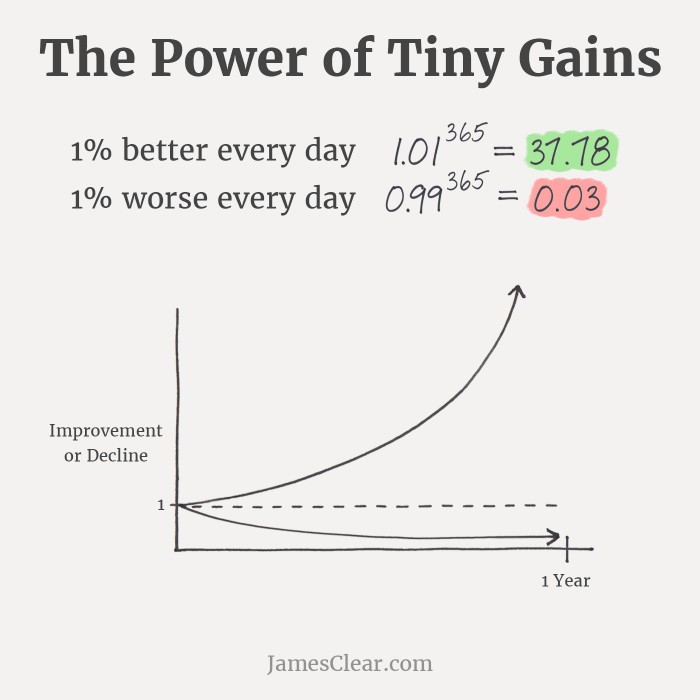
The math is simple but profound:
- 1% better every day: . You end up nearly 38 times better.
- 1% worse every day: . You decline nearly to zero.
This is the principle of compound interest applied to self-improvement. Just as money multiplies with compound interest, the effects of your habits multiply as you repeat them.
To see a powerful analogy for this effect, watch the beginning of this short video.
How to become 37.78 times better at anything | Atomic Habits summary (by James Clear)
This video summary of Atomic Habits from the Escaping Ordinary channel opens with a fantastic analogy that illustrates how a tiny change in trajectory can lead to a completely different destination.
Watch the section from the start, which uses the example of an airplane's flight path to explain how small deviations compound over distance and time. Pay close attention to how this connects to the 1% rule.
The key insight is that your habits are steering your life's trajectory. A small, consistent course correction today can lead you to a vastly different destination a year or a decade from now.
The Aggregation of Marginal Gains: A Case Study
This idea isn't just theoretical. It has been used to achieve extraordinary results in the highly competitive world of professional sports. The story of the British Cycling team provides a compelling case study.
Before 2003, the team had a century-long record of mediocrity. Then, they hired Performance Director Dave Brailsford, who introduced a philosophy he called "the aggregation of marginal gains." His approach was to break down every single aspect of cycling and improve it by 1%.
Marginal Gains: This Coach Improved Every Tiny Thing by 1 Percent
In this article, James Clear details how Dave Brailsford transformed the British Cycling team from perennial underperformers into a global powerhouse. This story is a powerful illustration of our core concept in action.
Read the first part of the article. As you read, notice the kinds of "1 percent improvements" the team made. They ranged from the obvious (redesigning bike seats) to the overlooked (testing massage gels and teaching proper hand-washing).
This case study is a perfect example of systems thinking applied to performance, something that should resonate with your work in business analysis. Brailsford didn't search for a single, magical solution. Instead, he optimized hundreds of small, interconnected variables, and their cumulative effect was transformative. The results—multiple Tour de France victories and dozens of Olympic gold medals—speak for themselves.
Why We Overlook Small Habits
If the 1% rule is so powerful, why do we so often ignore it? The problem lies in our perception of progress. We tend to focus on outcomes and defining moments, underestimating the value of daily process.
How to Master the Art of Continuous Improvement
This article explains the psychology behind why we dismiss small improvements and how their compounding nature works over the long run.
Please read the section titled "How Does Continuous Improvement Work?". This section directly addresses the gap between our expectations and the reality of how meaningful change occurs.
This leads to a crucial mental shift: focusing on your trajectory rather than your current position. Your weight, your bank balance, or your quarterly business metrics are lagging measures of your past habits. They are your position. Your trajectory, on the other hand, is whether you are getting 1% better or 1% worse each day. If your trajectory is positive, time becomes your greatest ally.
James Clear explains this distinction clearly in the following clip.
James Clear Explains How to Build Habits That Stick With One Simple Planning Trick || MasterClass
In this clip from a MasterClass session, James Clear himself discusses how small improvements multiply and the importance of focusing on your trajectory.
Watch from this segment. Pay attention to his distinction between "position" and "trajectory."
Actionable Frameworks for Continuous Improvement
Understanding the theory is the first step. Now, let's translate this into a few practical, analytical approaches you can use, much like a business analyst would diagnose a system. These are not about starting a massive new project, but about finding those 1% improvements.
How to Master the Art of Continuous Improvement
Now, let's return to the same article to look at a few actionable starting points for applying the principle of continuous improvement.
In the section "Continuous Improvement Tools," read about these three strategies: Do more of what already works: Identify effective behaviors you already have and increase their consistency. Avoid tiny losses: Focus on improvement by subtraction—eliminating small, recurring mistakes or inefficiencies. Measure backward: Base your next small step on your actual recent performance, not a distant future goal. As you read, think of one personal or professional area where you could apply one of these analytical frameworks. For example, in "avoiding tiny losses," what is a small, recurring error or time-waster in your weekly workflow that, if eliminated, would compound positively over a year?
Conclusion
In this lesson, we've unpacked the fundamental law of behavior change: the compounding effect of small habits. You now have the analytical tools to understand why and how this principle works.
Here are the key takeaways:
- The 1% Rule: Small, daily improvements or declines compound into massive differences over time.
- Habits as Compound Interest: Your habits are the "compound interest of self-improvement." The effects of your actions multiply.
- Process Over Events: Success is the product of consistent daily habits, not singular, transformative events.
- Trajectory Over Position: Focus on the direction you are heading (getting 1% better) rather than getting fixated on your current results.
We've established the power of consistent habits. In our next lesson, we will explore what kind of habits have the most leverage. We'll differentiate between outcome-based goals and identity-based habits, and you will learn how to reframe your goals to create changes that are more deeply integrated and sustainable.