In our first lesson, we explored the foundational principle of Atomic Habits: the remarkable power of small, consistent changes compounding over time. You saw how improving by just 1% each day can lead to extraordinary long-term results, a concept familiar from systems analysis in both engineering and business.
Now that we've established why small habits are so potent, we will turn to what kind of habits create the most lasting change. This lesson addresses a critical strategic shift from focusing on what you want to achieve (outcomes) to who you wish to become (identity). Your goal is to learn how to reframe a personal objective as an identity-based habit, which is the key to making new behaviors stick.
The Three Layers of Behavior Change
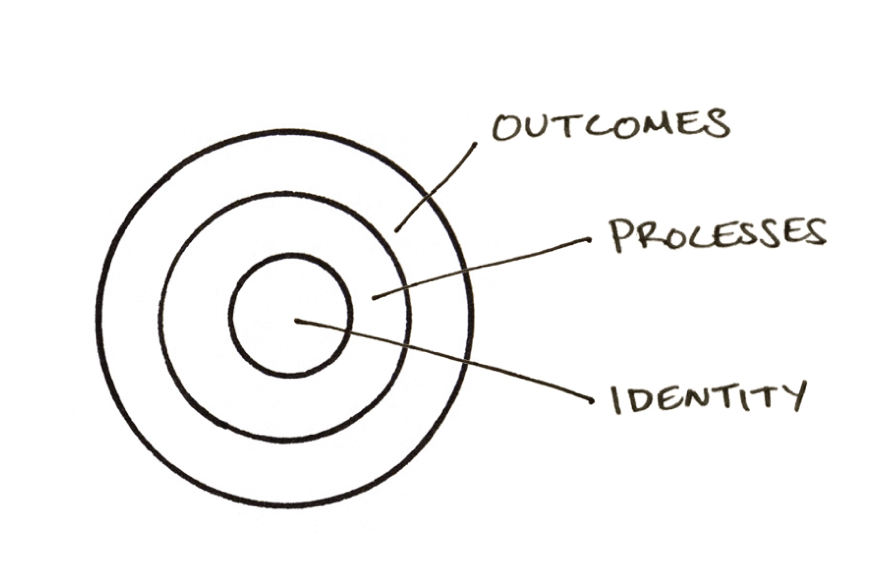
When we think about change, we typically focus on the results we want. James Clear suggests that there are three layers to behavior change, which we can visualize as an onion.
To understand this model, let's read a short excerpt that defines these layers.
Identity-Based Habits: How to Actually Stick to Your Goals ...
This article from James Clear introduces the three layers of behavior change and explains why the direction of change matters.
Start from the heading "Identity-Based Habits" and read down to the end of the section, just before the heading "The Recipe for Sustained Success." Pay close attention to the definitions of the three layers and the explanation of why the direction of change is the crucial factor.
As the article explains:
- Outcomes are about what you get (e.g., losing 20 pounds, winning a championship).
- Processes are about what you do (e.g., your gym routine, your writing schedule).
- Identity is about what you believe (e.g., "I am a healthy person," "I am a writer").
The common, but often flawed, approach is to start from the outside in: we set an outcome-based goal ("I want to write a book") and then try to force a process to achieve it. The problem is that this approach often conflicts with our underlying identity. If you don't see yourself as a writer, you'll constantly be fighting an internal battle to maintain the habit of writing.
Identity-Based Habits: Changing from the Inside Out
The more sustainable approach is to work from the inside out. You start by focusing on the person you want to become.

When you adopt an identity, your behaviors start to align naturally. You aren't just "doing a habit"; you are acting in accordance with who you believe you are. Each action you take then reinforces that identity.
James Clear discusses this powerful feedback loop in the following clip.
HABITS FORM YOUR IDENTITY - James Clear | London Real
In this interview on London Real, James Clear explains how our actions serve as "votes" for our identity, making the process of change feel more natural.
Watch the segment from this clip. The key ideas to listen for are that every action is a "vote" for the person you want to become, and the goal is not the outcome (running a marathon) but the identity (becoming a runner).
The concept of each action being a "vote" is a practical way to think about the 1% improvements we discussed in the last lesson. A single workout won't transform your body, but it casts a vote for "I am a healthy person." Writing one paragraph casts a vote for "I am a writer." These small wins accumulate and build evidence for your new identity.
A Practical Framework for Building Your New Identity
This brings us to the core action for this lesson. Changing your identity sounds abstract, but James Clear provides a simple, two-step process that aligns perfectly with your preference for practical frameworks.
- Decide the type of person you want to be.
- Prove it to yourself with small wins.
You can start with the result you want and work backward. Ask yourself, "Who is the type of person that could get the outcome I want?"
For example:
- Goal: Get a promotion at work.
- Identity: Who gets promoted? Someone who is reliable, proactive, and a leader. So, you decide: "I am the type of person who is a dependable leader."
- Small Wins (Votes): Arrive 5 minutes early for every meeting. Finish a weekly report a day ahead of schedule. Proactively offer to help a junior colleague.
Let's watch a short clip where James Clear provides precise language for framing these identity statements.
Atomic Habits Author James Clear on How to Set Your Mission and Identity Statement
In this conversation with Tim Ferriss, James Clear offers actionable phrasing to define and reinforce a new identity.
Watch the clip from the beginning for specific ways to phrase your identity statement, such as "I'm the type of person who..." or asking "What would a [healthy/productive] person do?". Then, continue watching until the end to see how this connects back to proving your identity with small wins.
Your Turn: Reframe Your Goal
Now it's time to apply this framework. You're going to use a simple guide from James Clear to take a personal or professional goal and reframe it using this identity-based approach. As a business analyst, you're skilled at translating high-level objectives into specific requirements; this process follows a similar logic.
[PDF] QuickStart Guide to Identity-Based Habits | James Clear
This PDF provides a concise summary and a practical worksheet to apply the concept of identity-based habits.
First, read the initial explanation to solidify the concept. Next, review the examples provided. Notice how each outcome-oriented goal is translated into an identity, and then into a "small win" or first step. Finally, mentally work through the three steps of the Identity-Based Habits QuickStart worksheet on the last page. Step 1: Pick one goal you have. It could be professional (e.g., "master a new analytics tool") or personal (e.g., "read more books"). Step 2: Define the identity. Who is the person that achieves this? (e.g., "I am a lifelong learner," "I am a reader"). Use the phrasing "I am the type of person who..." Step 3: Brainstorm one to three "small wins"—tiny, easy actions you could take today to cast a vote for that new identity (e.g., "spend 15 minutes in the tool's tutorial," "read two pages of a book before bed").
The purpose of this exercise isn't to achieve the big goal overnight. It's to prove to yourself, through small, concrete actions, that you are becoming the kind of person who can achieve it. The goal is to build evidence for your new identity.
Conclusion
In this lesson, you've moved from the "why" of small habits to the "who" that drives them. By shifting your focus from outcomes to identity, you create a powerful system for lasting change where your behaviors and beliefs reinforce each other.
Here are the key takeaways:
- Three Layers of Change: Change can occur at the level of Outcomes, Processes, or Identity. The most effective change starts with Identity.
- Outcome vs. Identity: Outcome-based goals focus on what you want to get. Identity-based habits focus on who you want to become.
- Every Action is a Vote: Each small habit you perform is a piece of evidence that reinforces your desired identity.
- The Two-Step Process: The practical way to change your identity is to (1) decide who you want to be and (2) prove it to yourself with small wins.
You now have a powerful new lens through which to view your goals. In our next lesson, we will get even more tactical by exploring the mechanics of how habits function. We'll break down the four-stage Habit Loop—cue, craving, response, and reward—which forms the backbone of every habit you have, good or bad.