Hello! In our last lesson, we established how to determine if a function is one-to-one, a necessary condition for it to have an "undo" button. Now, we're going to build that button.
Today's lesson focuses on finding the inverse of a one-to-one function and stating its domain and range. You will learn the algebraic steps to derive an inverse function's formula and, crucially, understand the intimate relationship between the domain and range of a function and its inverse. This connection is a powerful tool for problem-solving.
The Essence of an Inverse Function
In our previous session, we confirmed that only one-to-one functions can be inverted. This is because for an inverse to be a function itself, every output must trace back to a single, unique input.
An inverse function, denoted as , essentially reverses the mapping of the original function . If takes an input and produces an output , then takes the input and returns the original input .
- If , then .
This reversal has a direct and vital consequence for the domains and ranges:
- The domain of becomes the range of .
- The range of becomes the domain of .
This swapping of roles is the central concept you should hold onto throughout this lesson.
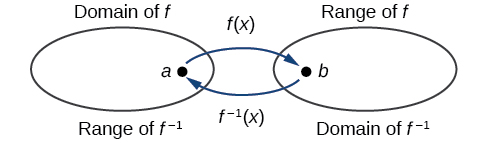
Because the functions "undo" each other, applying a function and its inverse in sequence brings you back to your starting point. This is expressed through function composition:
- for all in the domain of .
- for all in the domain of .
This property provides a way to algebraically verify if two functions are indeed inverses of each other.
Finding the Inverse: The Algebraic Procedure
Now, let's move from the concept to the mechanics. How do we find the formula for an inverse function? The most common method taught involves a three-step process.
The following video provides a concise demonstration of this standard procedure. Pay close attention to the steps of replacing with , swapping the variables and , and then solving for the new .
Understanding One-to-One and Inverse Functions
Watch the section of the video from Textbook Tactics that explains how to find the equation of an inverse function.
Focus on the part starting at this segment. The narrator clearly lays out the three-step "swap and solve" method using the example f(x) = 5x + 1.
This "swap and solve" method is a reliable algorithm that will produce the correct formula. However, since your goal is to build strong intuition, it's worth knowing that this procedure can sometimes obscure why it works. The act of swapping and is a procedural shortcut that can feel abstract.
For a deeper understanding, let's explore a more conceptually-grounded approach.
Inverse Functions: We’re Teaching It All Wrong! |
This article from the American Mathematical Society blog, titled "Inverse Functions: We’re Teaching It All Wrong!", critiques the "swap and solve" method and proposes an alternative that keeps the meaning of the variables intact.
Please read the sections that highlight the issue with the standard method and present the alternative. Start by reading Problematic Conception #1, which uses a real-world tuition example to show how "swap and solve" can lead to confusion. Then, read the following section, The confusion is easily remedied, which introduces the "solve for the dependent variable" method. Notice how this approach is just about rearranging the original equation to express the original input in terms of the original output.
To summarize the more intuitive method:
- Start with your function, .
- Your goal is to find the inverse, which expresses the input in terms of the output . So, simply solve the equation for .
- You will end up with an equation of the form . This function is your inverse function, so . Therefore, .
At the very end, we often switch the variable from back to (e.g., writing ) simply by convention, because we are used to seeing as the input variable for functions. The key is understanding that the procedure is fundamentally about solving for the original input.
Finding the Domain and Range of an Inverse Function
This is where the conceptual understanding pays off. As we established, the domain of the inverse function is the range of the original function .
This is a powerful problem-solving trick. Instead of finding the inverse first and then analyzing its domain, you can often find the range of the original function to determine the domain of its inverse .
The following video is excellent for seeing this principle in action with common function types you'll encounter in calculus.
How To Find The Domain of an Inverse Function | Precalculus
This video from The Organic Chemistry Tutor provides practical examples of finding the domain of an inverse function by first analyzing the domain and range of the original function.
Watch the following examples: A quadratic function: Notice how the domain of f(x)=x^2-3 must first be restricted to make it one-to-one. This restriction directly impacts the domain and range. A radical function: Here, the range of the original square root function, [0, \infty), immediately tells you the domain of its inverse. A rational function: This example shows how the horizontal asymptote of the original function (a value excluded from the range) corresponds to a value excluded from the domain of the inverse.
The Graphical Connection
Finally, let's visualize the relationship between a function and its inverse. If you have a point on the graph of , it means . For the inverse, this means , which corresponds to the point .
When you swap the coordinates of every point on a graph, the new graph is a reflection of the old one across the diagonal line .
The section on graphs in the LibreTexts resource provides a clear visual and explanation of this reflection property.
Please read the section titled Finding Inverse Functions and Their Graphs. Pay attention to the graph showing f(x)=x^2 and its inverse f^{-1}(x)=\sqrt{x} reflected across the line y=x.
This graphical property provides a useful sanity check when you are working with inverse functions.
Conclusion
You have now completed your tour of the essential properties of functions that form the bedrock of calculus. Finding an inverse is the final piece of this foundational module.
Here are the key takeaways from today's lesson:
- An inverse function reverses the action of a one-to-one function .
- The domain of is the range of , and the range of is the domain of . This is the most crucial relationship to remember.
- To find the formula for an inverse, you can use the "swap and solve" method, but it is conceptually clearer to think of it as solving the original equation for the input variable .
- Graphically, the graph of is a reflection of the graph of across the line .
With this, our first module is complete. You are now equipped with a solid understanding of how functions work, how they are classified, and how they can be manipulated. In our next lesson, we will begin our journey into calculus proper by exploring the concept of limits, which allow us to analyze what a function is doing at and around a particular point.