Hello! In our last lesson, we explored how to combine functions through composition. We're now going to investigate a crucial property that determines whether a function can be "undone" or "reversed."
Today's lesson focuses on determining if a function is one-to-one using graphical and algebraic methods. A function being "one-to-one" is the essential condition it must meet for an inverse function to exist. Understanding this concept is the gateway to finding and working with inverse functions, which we'll tackle in our next session. We will cover two key techniques: the intuitive Horizontal Line Test for graphs and a more formal algebraic test.
What is a One-to-One Function?
In simple terms, a function is a rule where each input has exactly one output. A one-to-one function is more specific: each input has a unique output that is not shared by any other input.
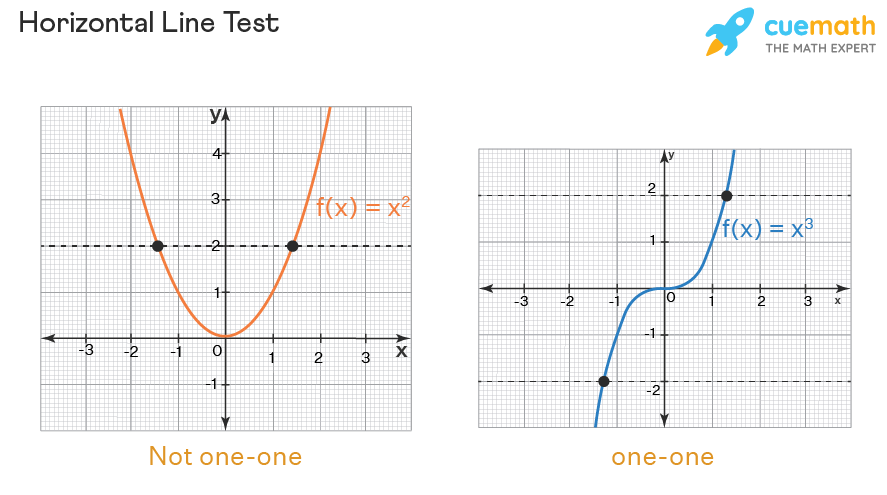
For example, the function is not one-to-one. Why? Because different inputs can lead to the same output: both and give the output . On the other hand, a function like is one-to-one, because you will never find two different numbers that, when cubed, give you the same result.
The following video by Professor Leonard provides an excellent introduction to this idea. He explains the concept using a practical analogy and lays out why this property is so fundamental for our upcoming topics.
One to One Functions (Precalculus - College Algebra 50)
Watch the beginning of the video "One to One Functions" to build a solid intuition for the concept.
Please watch from the start until the professor finishes discussing the ordered pairs example at the introduction. Pay close attention to the employee ID analogy—it perfectly illustrates the idea of a relationship being "mappable" in both directions, which is the core of being one-to-one.
The Graphical Method: The Horizontal Line Test
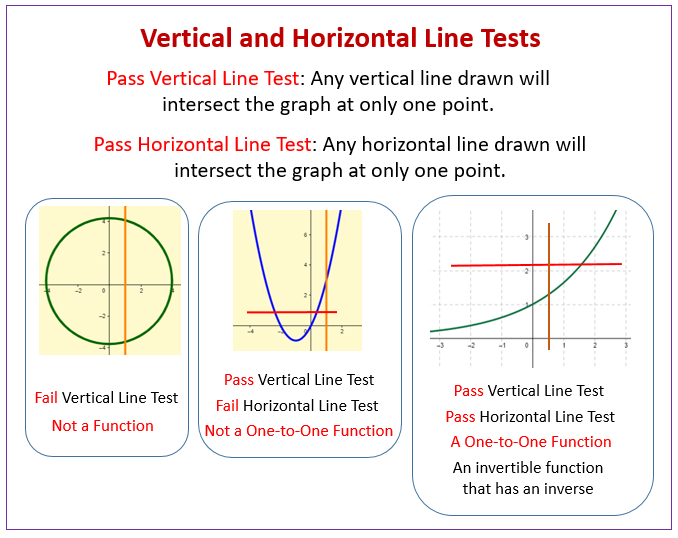
The most intuitive way to check if a function is one-to-one is by looking at its graph. This is done using the Horizontal Line Test.
The rule is simple: If any horizontal line can be drawn that intersects the graph of a function more than once, then the function is NOT one-to-one.
If a horizontal line hits the graph at two points, it means that two different x-values (inputs) are producing the same y-value (output), which violates the definition of a one-to-one function.
This is the visual counterpart to the Vertical Line Test, which you may recall:
- Vertical Line Test: Checks if a graph represents a function. If a vertical line hits the graph more than once, it's not a function.
- Horizontal Line Test: Checks if a function is one-to-one. If a horizontal line hits the graph more than once, it's not one-to-one.
The image below clearly illustrates both tests.
Now, let's look at a direct comparison of a function that is not one-to-one with one that is.
To solidify this graphical method, please read the following brief article.
One-to-one functions and the horizontal line test
This text provides a concise explanation of the Horizontal Line Test, reinforcing the concepts we've just discussed with more examples.
Please read the section titled this section. Focus on how the test is applied to different families of functions, like linear and quadratic functions.
The Algebraic Method
While the graphical method is intuitive, we also need a formal algebraic way to prove whether a function is one-to-one. This method is essential when we don't have a graph or when we need a more rigorous proof.
The algebraic definition is as follows:
A function is one-to-one if, for any two values and in its domain, if , then it must follow that .
To use this test, you follow these steps:
- Set up the equation .
- Substitute the function's expression for and .
- Use algebraic manipulation to solve for .
- If the only possible conclusion is , the function is one-to-one. If you find that could be something other than (like ), the function is not one-to-one.
Let's see this in action.
Example 1:
- Assume .
- Subtract 5 from both sides:
- Divide by 3:
Since the only possible result is , the function is one-to-one.
Example 2:
- Assume .
- Add 1 to both sides:
- Take the square root of both sides:
Since could be equal to or , we cannot conclude that is the only solution. For instance, if , could be 3 or -3. Because we found a case where but , the function is not one-to-one.
The following resource provides more worked-out examples of this algebraic technique.
One-to-one functions and the horizontal line test
This part of the article demonstrates the algebraic test with several examples, including one that proves a function is one-to-one and another that shows a function is not.
Start reading at the section titled the algebraic method and continue through the examples in the next section, ending just before the "Get access" banner after the example for g(x) = x^2.
Summary of Methods
To bring everything together, let's review the two methods for determining if a function is one-to-one. The following resource provides a compact summary and some useful properties.
One to One Function - Graph, Examples, Definition
This article section neatly summarizes the graphical and algebraic tests.
Please read the sections titled How to Determine if a Function is One to One? and the short FAQ answer for How Do You Check if a Function is One to One?. You'll notice a third method mentioned involving derivatives; since you're rusty on derivatives, you can just note its existence for now—we will revisit these connections later in the course.
Conclusion
In this lesson, we established the concept of a one-to-one function, which is a critical stepping stone in our study of calculus. A function that is one-to-one has a unique output for every input, ensuring it can be unambiguously "reversed."
Here are the main takeaways:
- A function is one-to-one if every output value corresponds to exactly one input value.
- The Horizontal Line Test is the graphical method: if any horizontal line intersects the graph more than once, the function is not one-to-one.
- The algebraic test provides a formal proof: a function is one-to-one if the condition necessarily implies that .
Now that we have the tools to verify if a function is one-to-one, we are ready for the next logical step. In our next lesson, we will learn how to find the inverse of a one-to-one function, which is the mathematical process of "reversing" it.