Welcome to your first lesson in art history. Your journey to becoming a polymath—someone who sees the connections between art, history, and culture—begins here. Before we can explore the grand narratives of empires, religions, and revolutions through art, we first need to build a fundamental skill: the ability to speak the language of art itself. This lesson is designed to give you that vocabulary.
Our goal is to identify the basic visual elements that artists use to create their work. Think of these elements as the alphabet of a visual language or the ingredients in a recipe. They are the raw materials from which every drawing, painting, and sculpture is made. We will focus on line, shape, color, texture, and space, and also touch upon the closely related concepts of form and value. By the end of this lesson, you will be able to look at an artwork and deconstruct it into these essential components, the first crucial step in understanding what an artist is doing and why.
The Building Blocks of Art: A Visual Introduction
Let's begin by getting a feel for what these elements are. An artwork is not a random collection of marks; it is a carefully constructed image where each component plays a role. The image below provides a clean visual summary of the seven elements we will discuss.

To get a dynamic sense of how these elements function, let's watch a short video that introduces them with clear examples from famous artworks. It provides an excellent animated overview before we dig into each element more methodically.
The 7 Elements of Art Explained: A Fun and Easy Guide for Kids! 🎨
This video from Miss Teresa Art, titled "The 7 Elements of Art Explained," offers a fun and accessible introduction to each concept.
Watch the video from the beginning to the end. As you watch, pay attention to how each element is defined and how the video connects it to a specific artwork. Notice the distinction between: Line and how it creates movement in Van Gogh's work. Shape and how it forms the basis of Cubism. Form, the three-dimensional sibling of shape. Color and its emotional power. Value, which creates light and shadow. Texture, whether real or implied. Space, both positive and negative.
A Deeper Look at the Elements
Now that you have a general overview, we'll examine each element more closely. We'll use a combination of readings to solidify the definitions and then look at specific examples to see them in action.
Our main guide will be the article "7 Elements of Art" from Online Art Lessons. It's a clear, concise reference that we'll return to for each element.
First, let's read the introduction to this resource. It frames the elements as the "essential components, or building blocks, of any artwork."
Read the short introductory section, starting from the beginning down to the list of the seven elements.
Now, let's break them down one by one.
1. Line
A line is the most basic element, the path of a moving point. But its simplicity is deceptive. The character of a line—whether it's thick, thin, straight, curved, or jagged—can convey a wide range of feelings and ideas, from stability and calm to energy and chaos.
The "Online Art Lessons" article provides a great breakdown of the different types of lines and their expressive qualities.
Read the section titled "Element 1 - Line". Focus on the different descriptions, such as how horizontal lines suggest calm while diagonal lines create dynamism.
Lines can also be implied—not physically drawn, but created by the arrangement of objects in the painting. Your eye connects the dots, and this implied line can be used to guide your gaze and create structure. For a powerful example, let's turn to a more academic resource that connects this concept to a famous historical painting.
[PDF] Elements and Principles - Digital Commons@ETSU
This document from East Tennessee State University uses Théodore Géricault’s masterpiece, The Raft of the Medusa, to show how implied lines create drama and narrative.
In this PDF, find the section "Elements of Art: Line". Skim past the definitions of contour lines and read the part on implied lines. Notice how the arms and bodies of the figures create a strong diagonal line, leading your eye from the despair at the bottom left to the hope at the top right.
2. Shape and Form
When a line encloses a space, it creates a shape. Shapes are two-dimensional, having only height and width. They can be geometric (circles, squares, triangles) or organic (irregular, like a leaf or a cloud).
Form is the three-dimensional version of shape. It has height, width, and depth. A circle is a shape; a sphere is a form. In a two-dimensional artwork like a painting, form is an illusion created through techniques like shading.
Let's return to our primary guide to distinguish between these two related elements.
Read the sections "Element 2 - Shape" and "Element 3 - Form". Pay close attention to the distinction between 2D shape and 3D form.
3. Space
Space refers to the area around, between, and within objects. Artists creating on a flat surface must use various tricks to create the illusion of three-dimensional space. This includes techniques like overlapping, varying size, and perspective.
A key concept here is the difference between positive space (the area occupied by the main subjects) and negative space (the area around them). A skilled artist pays just as much attention to the negative space as the positive.
This next section details the techniques artists use to fool our eyes into seeing depth where there is none.
Read the section titled "Element 4 - Space". Note the different methods listed, such as placement, size, and detail, for creating the illusion of distance.
4. Texture
Texture is the surface quality of an object—how it feels, or how it looks like it would feel. In art, we distinguish between:
- Actual texture: The real surface quality, which you can feel in a sculpture or a painting with thick paint (known as impasto).
- Implied or simulated texture: The illusion of texture created on a flat surface, like a painter meticulously rendering the look of soft fur or rough stone.
This section explains the difference between actual and implied texture.
Read the section "Element 7 - Texture". Notice how the artist uses value and specific marks to create the illusion of a particular texture.
For a fascinating example of texture, consider Meret Oppenheim's surrealist sculpture Object, a teacup covered in fur. The "Elements and Principles" PDF discusses this work, highlighting how its actual texture is key to its unsettling effect. You can find this example under the heading "Elements of Art: Texture" in that resource.
5. Value and Color
Value is the lightness or darkness of a color. It is one of the most powerful tools for creating the illusion of form and light. A full range of values, from bright highlights to dark shadows, makes an object look three-dimensional.
Color is the element that most directly affects our emotions. It has three main properties:
- Hue: The name of the color (e.g., red, blue, green).
- Value: The lightness or darkness of the hue.
- Saturation (or Chroma): The intensity or purity of the color.
Finally, let's explore value and color. Getting the values right is often more important than the specific colors for creating a believable image.
Read the sections "Element 5 - Value" and "Element 6 - Colour". Focus on how value creates form and contrast, and how color is described by hue, saturation, and value.
Color can be used to create a mood. In the "Elements and Principles" PDF, the discussion of Picasso's The Old Guitarist shows how a monochromatic (single color) scheme of blues creates a profound sense of sadness. This is an excellent example of an artist choosing an element to serve a specific emotional purpose.
Putting It All Together: A Case Study
Now, let's practice identifying these elements. Look at the abstract painting below by the Dutch artist Piet Mondrian.
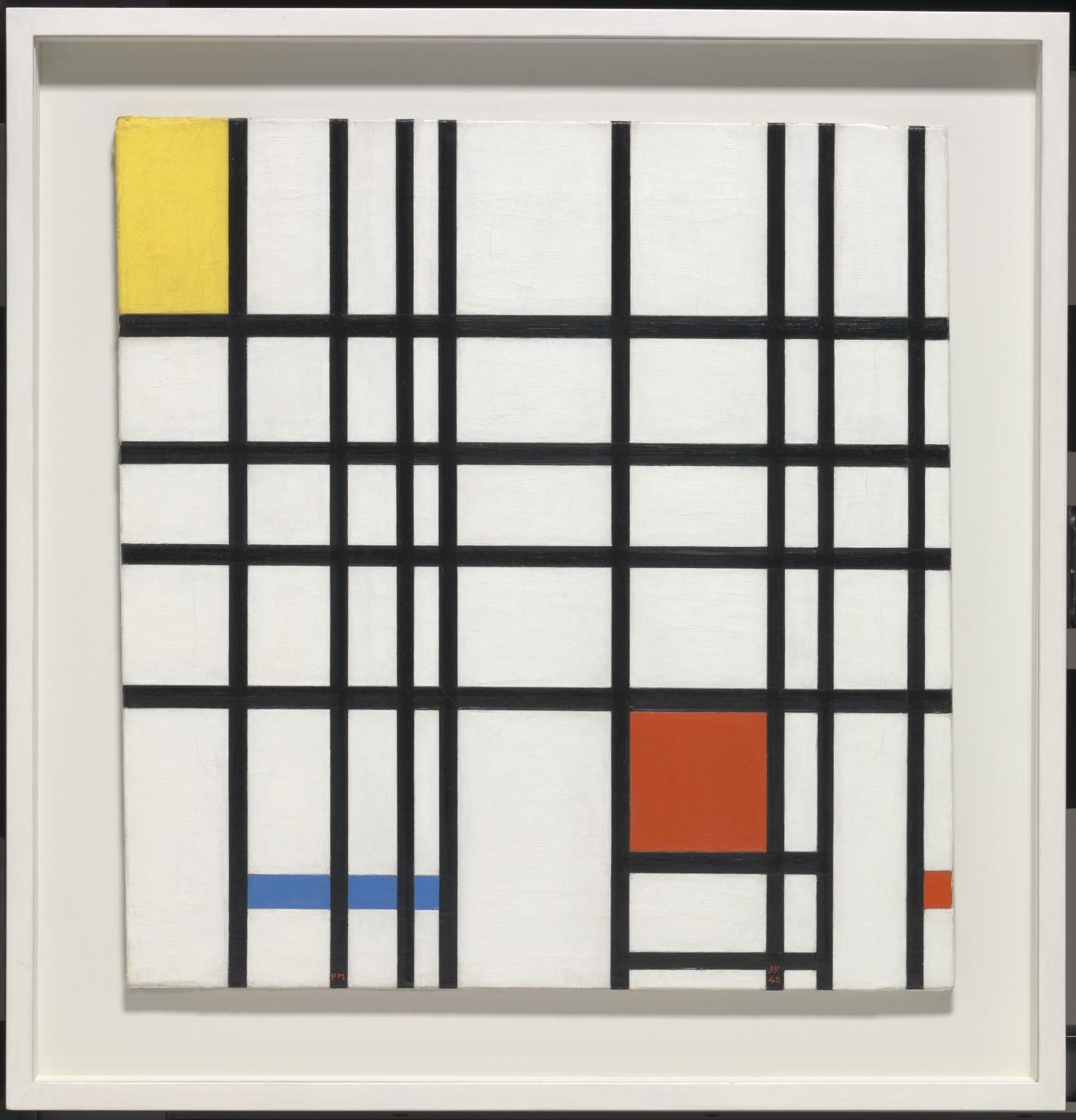
Take a moment to analyze it using the vocabulary we've just learned. What elements do you see? How are they being used?
- Line: The painting is dominated by a grid of straight, black lines, both vertical and horizontal. They create a sense of order, structure, and stability. There are no curved or diagonal lines, giving the work a very rigid feel.
- Shape: The lines create a series of geometric shapes, mostly rectangles and squares of various sizes.
- Color: Mondrian has restricted his palette to the three primary colors (red, yellow, blue) plus the non-colors white and black. The colors are pure and highly saturated. They are placed asymmetrically, creating a visual balance despite the lack of symmetry.
- Texture: The texture is not a prominent element. The surface appears flat and smooth, with no attempt to create an illusion of texture. The focus is purely on line, shape, and color.
- Space: The painting is very flat. Mondrian has deliberately avoided all the traditional techniques for creating an illusion of depth. There is no overlapping or shading. The shapes sit on the same plane, emphasizing the two-dimensional surface of the canvas.
In this single work, you can see how an artist makes deliberate choices about which elements to use and which to ignore to achieve a specific effect—in this case, one of pure, abstract harmony.
Conclusion
In this foundational lesson, we have defined and identified the essential building blocks that all artists use: line, shape, form, space, texture, value, and color. You have learned not only what they are but also how they can be manipulated to guide the viewer's eye, create illusions of depth and texture, and evoke powerful emotions. This vocabulary is the first tool you need to confidently look at a work of art and begin to understand it on a deeper level.
You are now equipped to start describing what you see. In our next lesson, we will build on this foundation. We'll move from the "ingredients" (the elements) to the "recipe" by exploring the Principles of Art. These are the rules or guidelines that artists use to arrange the elements—concepts like balance, contrast, and rhythm. This will take us one step closer to your goal of being able to "read" any artwork you encounter.