In our last lesson, we focused on identifying the fundamental "ingredients" of art—the visual elements like line, color, and texture. Now that you have this basic vocabulary, we can move on to the "recipe": how artists arrange these ingredients to create a coherent and impactful whole. This arrangement is known as composition.
This lesson will equip you to describe the composition of an artwork, a core skill for art analysis. We will focus specifically on how artists create an illusion of depth using foreground and background, and how they achieve visual stability and interest through balance and symmetry. By the end of this lesson, you'll be able to look at a painting not just as a collection of objects, but as a deliberately constructed space designed to guide your eye and evoke a particular response.
What is Composition?
At its heart, composition is the structure of an artwork. It's the way an artist organizes the visual elements to lead the viewer through the work and communicate their message. Is the arrangement calm and orderly, or chaotic and energetic? Answering this question is the first step in analyzing composition.
To get a quick overview of what composition entails, the following video offers a concise introduction.
How to Analyze Art (Composition)
This video, "How to Analyze Art (Composition)" from the Let’s Learn About Art channel, breaks down the concept into simple, actionable questions.
Watch the very beginning of the video, from the initial definition, to understand the core questions we ask when looking at composition.
As the video suggests, composition involves conscious choices. Two of the most important choices relate to creating a sense of space and establishing visual equilibrium. Let's explore these now.
Creating Depth: Foreground, Middle Ground, and Background
One of the great challenges for an artist working on a flat surface is creating a convincing illusion of three-dimensional space. In the last lesson, we touched on this when discussing the element of space. Now, we'll look at the primary structural tool artists use to achieve this: dividing the picture into distinct planes.
These planes are typically called the foreground, middle ground, and background.
- Foreground: The part of the scene that appears closest to the viewer.
- Middle ground: The area between the foreground and the background, often where the main action or subject is located.
- Background: The part of the scene that appears farthest away, often serving as the setting.
A wonderful way to understand this is to think of a theater stage. The following video explains this analogy beautifully.
How to Use Foreground, Midground and Background to Clarify Depth
In this video, painter Ian Roberts explains how these three grounds work together to create depth and direct the viewer's attention.
Watch the section from his explanation of the stage set analogy. Pay close attention to how he describes the function of each area: the foreground as an entrance, the middle ground as the focus of the action, and the background as a simple "foil." Then, continue watching his analysis of a student's painting to see how adjusting these grounds can dramatically improve a composition.
By clearly defining these layers, an artist can lead your eye from the front to the back of the scene, creating a journey through the pictorial space. Overlapping objects, decreasing size, and atmospheric effects (where distant objects become paler and less detailed) all help to reinforce this illusion of depth.
Establishing Equilibrium: Balance
Once an artist has structured the space, they must arrange the elements within it. Balance refers to the distribution of visual weight in a composition. A balanced composition feels stable and complete, while an unbalanced one can create a sense of unease or tension.
There are several types of balance an artist can employ. The image below shows four common types. We will focus on the first three: symmetrical, asymmetrical, and radial.
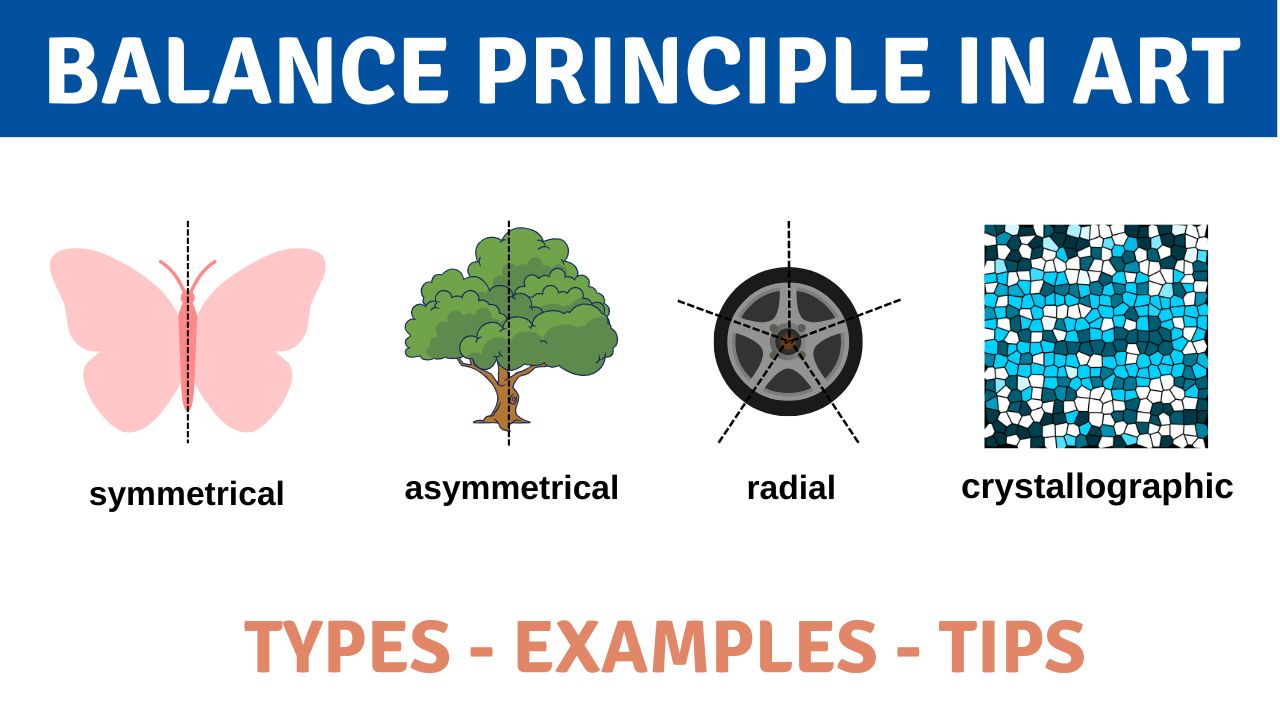
Now, let's explore these types in more detail using some classic examples.
Balance, symmetry, and emphasis (article) | Khan Academy
This article from Khan Academy provides clear definitions and excellent examples for understanding the different types of balance.
First, read the section on Bilateral symmetry. This is the most formal and intuitive type of balance. Next, read about asymmetrical balance, which is more complex and dynamic. Notice how the artist balances different elements against each other rather than simply mirroring them. Finally, read the section on radial symmetry, where elements are arranged around a central point, often used to create a strong sense of unity or spiritual focus.
To see symmetrical balance in action, look at this famous fresco from the Sistine Chapel.

If you were to draw a vertical line down the center of this painting, the two halves would be nearly mirror images. The figures on the left are balanced by the figures on the right. The two grand arches in the background mirror each other, flanking the central temple. This symmetry gives the scene a profound sense of order, stability, and classical calm, which was highly valued during the Renaissance. Asymmetrical and radial balance, by contrast, can create feelings of movement, energy, or spiritual radiation.
Case Study: A Formal Analysis
You now have the key terms for describing composition: foreground, background, and the different types of balance. Let's see how these concepts (along with the elements from our last lesson) are used by art historians to perform a visual (or formal) analysis. This is the process of describing and interpreting an artwork based solely on what you can see.
The following resource provides a transcript of two experts analyzing Giovanni Bellini's Madonna of the Meadow. It's a perfect example of how to put your new vocabulary to work.
How to do visual (formal) analysis in art history - Khan Academy
This Khan Academy resource demonstrates how art historians use the language of visual analysis to deconstruct a painting.
Read the section where the speakers discuss the composition. Pay attention to how they describe the main figure forming a stable "pyramid" shape and how the landscape is arranged in horizontal bands that serve as foreground, middle ground, and background. Then, read the next section on pictorial space. This reinforces the concepts of overlapping and perspective that help create the illusion of depth we discussed earlier.
This analysis shows how the terms we've learned are not just labels, but tools for understanding how a painting achieves its effect. The pyramidal composition creates stability, while the clear division of pictorial space gives the landscape a sense of serene depth.
Conclusion
In this lesson, we transitioned from the "ingredients" of art to the "recipe" of composition. You've learned how artists structure their work to create specific effects.
Here are the key takeaways:
- Composition is the overall arrangement of visual elements in an artwork.
- Artists create an illusion of depth by organizing space into a foreground, middle ground, and background.
- Balance refers to the distribution of visual weight. Major types include:
- Symmetrical balance: Creates formal, stable compositions through mirroring.
- Asymmetrical balance: Creates dynamic equilibrium by balancing dissimilar elements.
- Radial balance: Creates unity and focus by arranging elements around a central point.
You are now able to describe not just what is in a painting, but how it is organized. This is a significant step toward your goal of confidently reading and discussing art.
In our next lesson, we will shift our focus from the abstract language of art to its physical reality. We will explore the different artistic media, distinguishing between major forms like drawing, painting, sculpture, and architecture. This will add another layer to your understanding of how art is made and experienced.