Welcome to our third lesson. In our last session, we crafted your program's "from-to" transformation statement, which acts as the North Star for your client's journey. It defines the ultimate destination. Now, it's time to chart the course by identifying the major landmarks along the way.
Today, we will identify 3-4 key client milestones that will form the structural backbone of your "From Grief to Gratitude" program. These milestones are not individual sessions, but significant stages of progress and accomplishment for your client. They break the overwhelming journey of grief into a manageable, structured path, providing both you and your client with a clear sense of direction and achievement.
1. Visualizing the Journey: From Disruption to Meaning
Before we dive into specific frameworks, let's look at a high-level model of the grief process. Many contemporary approaches to grief, moving beyond linear stages, focus on the process of "meaning reconstruction." This is the journey of making sense of a world that has been irrevocably changed by loss.
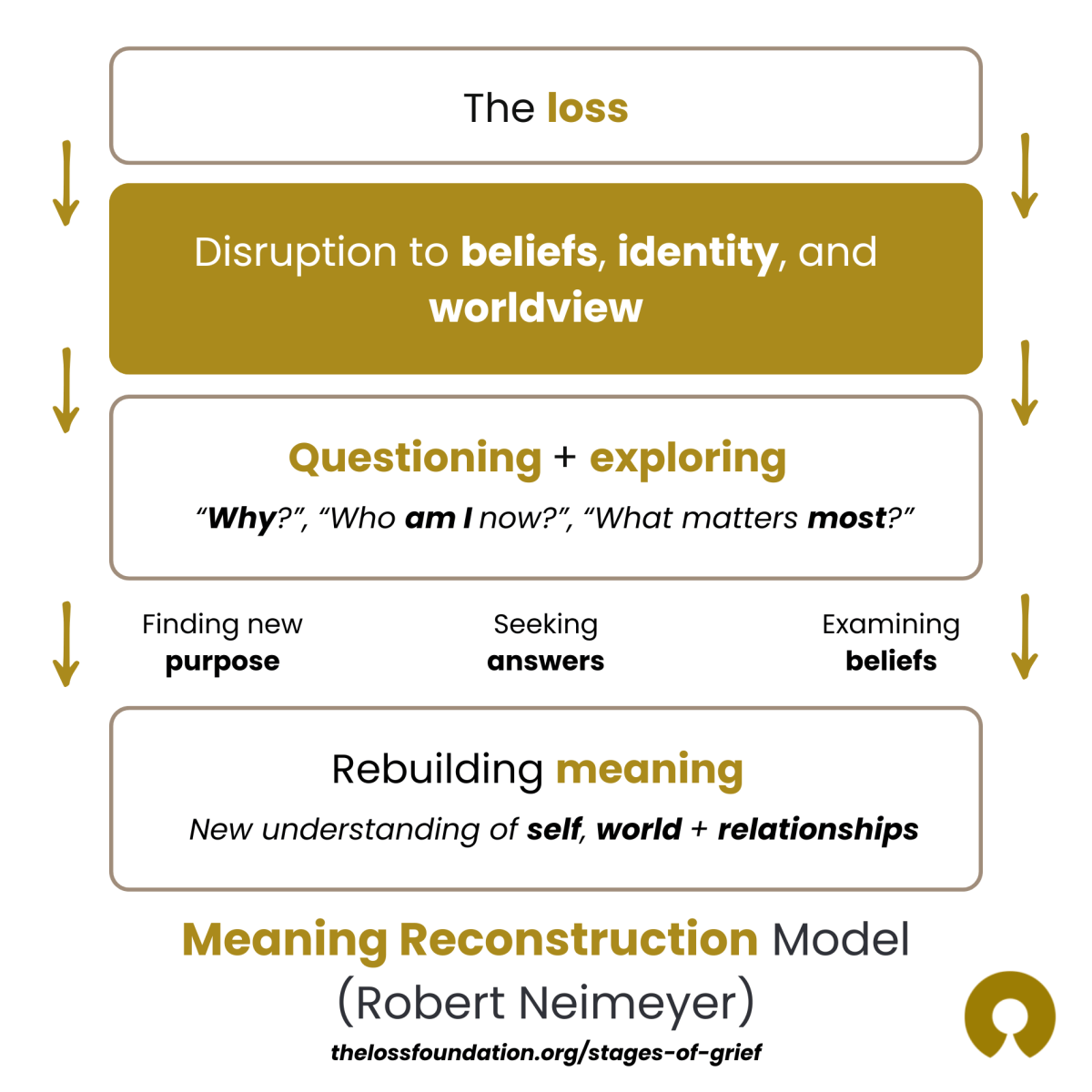
This visual captures the essence of the journey you facilitate. A client arrives with their world disrupted. Your program guides them through the questioning and exploring, leading them toward finding new purpose and rebuilding meaning. The milestones we define today will serve as the core phases of this reconstruction process.
2. Building on Your Foundation: The "From Grief to Gratitude" Model
Your certification in the "From Grief to Gratitude" program gives you a powerful and familiar starting point. This model already contains a structured path that we can adapt into distinct client milestones.
From Grief to Gratitude Coach Certification Program
Let's revisit the core methodology of your training. As you read, think about how each of these five steps represents a major shift for a client—a milestone they achieve.
In the article, locate the section titled "FROM GRIEF TO GRATITUDE COACHING MODEL." Read the descriptions of the five steps of the model.
These five steps provide an excellent, ready-made sequence for your program's milestones:
- Giving Yourself Permission to Grieve: Acknowledging the unique and personal nature of the grief experience.
- Remembering to Honor the Life and Legacy: Shifting focus to the essence and memory of the loved one.
- Incorporating New Traditions into Old Traditions: Releasing painful emotions and adapting to a new reality.
- Embracing Meaning and Purpose Going Forward: Seeing change as natural and creating one's own legacy.
- Finding Gratitude in the Gift of Now: Moving beyond grief to a new chapter, while holding treasured memories.
You can choose to use these as your core milestones, or perhaps group them. For instance, steps 1 and 2 could be part of a larger "Processing the Loss" milestone.
3. Reinforcing with a Classic Framework: Worden's Tasks of Mourning
To add another layer of depth to your program design, it's helpful to be familiar with other foundational models in the field. J. William Worden's "Four Tasks of Mourning" is one of the most respected frameworks in grief counseling. It complements your existing training by framing the process as a series of active tasks for the bereaved.
10 Grief Counseling Therapy Techniques & Interventions
This article from Positive Psychology provides a concise overview of Worden's influential model. Notice the active, task-oriented nature of this framework.
Read the section under the heading "The goals of grief counseling." Focus on the four bulleted tasks of mourning and the four numbered subgoals that align with them.
Worden's Four Tasks offer a slightly different but compatible lens:
- Task 1: Accept the reality of the loss. The cognitive and emotional acceptance that the person is gone.
- Task 2: Process the pain of grief. Allowing oneself to feel the wide range of emotions that come with loss.
- Task 3: Adjust to a world without the deceased. This involves external (daily tasks), internal (identity), and spiritual adjustments.
- Task 4: Find an enduring connection with the deceased while embarking on a new life. This is about moving forward without forgetting, finding a new place for the deceased in one's life.
You can see the clear parallels between this model and your "Grief to Gratitude" framework. For example, Worden's Task 1 and 2 align with "Giving Yourself Permission to Grieve," while Task 4 aligns with "Remembering to Honor" and "Finding Gratitude."
4. The Final Milestone: A Deeper Dive into Meaning
The culmination of the grief journey, as suggested by both Neimeyer's model and your own certification, is the discovery of new meaning and purpose. Grief expert David Kessler, who co-authored a book on the five stages with Elisabeth Kübler-Ross, later proposed "Meaning" as a sixth stage, drawing from his own profound personal loss. This concept is the heart of your program's promise.
David Kessler Finding Meaning The Sixth Stage of Grief
In this video, David Kessler explains the evolution of his thinking and what it truly means to find meaning after loss.
Watch the following key segments: First, understand the background and why he felt "acceptance" wasn't enough, leading him to meaning, from acceptance was not enough. Next, listen to the crucial distinction he makes about where meaning is found, from meaning is our response. This is a vital point for your coaching. Finally, listen as he reads the seven guidelines for meaning from his book. These are principles you can directly weave into your program.
Kessler's insights are incredibly valuable for shaping the final milestone of your program. The key takeaways are:
- Meaning is not found in the death itself, but in our response to the loss.
- It's not about the loss being a "gift" or a "lesson."
- Meaning can be found in small moments, in changed perspectives, in honoring a loved one, or in creating something for others.
- It is a deeply personal and unique discovery.
This final milestone is about helping your client build a life that honors their loved one and their grief, rather than being defined by it. It’s the transition from "grief" to "gratitude"—gratitude for the time they had, and gratitude for the new life they are building.
5. Practical Exercise: Defining Your Program Milestones
Now it's time to synthesize these ideas and define the core milestones for your own signature program. Based on the frameworks we've explored, a 4-milestone structure is a robust and popular choice.
Your Task:
Define 3-4 key milestones for your program. For each milestone, give it a clear, client-centric name and write 1-2 sentences describing the shift or accomplishment the client achieves.
Here is a sample structure you can adapt. It integrates the concepts from your certification, Worden's tasks, and Kessler's work on meaning.
- Milestone 1: Acknowledgment & Permission
- Description: The client moves from the initial shock or numbness to fully acknowledging the reality of their loss. They learn to give themselves unconditional permission to experience their unique grief without judgment or comparison.
- Milestone 2: Honoring & Remembering
- Description: The client actively processes their memories—both cherished and complex. They find ways to memorialize their loved one, creating an enduring connection that shifts from one of painful absence to one of loving remembrance.
- Milestone 3: Readjusting & Rebuilding
- Description: The client begins to navigate the practical, emotional, and identity shifts required in a world without their loved one. They start to build new routines, redefine their sense of self, and regain confidence in handling daily life.
- Milestone 4: Meaning & Integration
- Description: The client integrates the loss into their life story as a part of who they are, not the entirety of who they are. They discover a renewed sense of purpose and find gratitude, allowing them to step into a future that honors their past while embracing new possibilities.
Take 15-20 minutes to work on your own version. You can use this template, adapt the "Grief to Gratitude" steps directly, or create a hybrid that feels most authentic to you and your coaching style. This work will become the high-level outline for your entire program.
Conclusion
Today we have built the primary pillars that will support your entire coaching program. By establishing 3-4 clear milestones, you've translated the abstract "from-to" transformation into a tangible, navigable path. This structure provides clarity for your clients, demonstrating that there is a way through the fog of grief, and gives you a powerful framework for designing your sessions.
Key Takeaways:
- Milestones are major stages of client progress, not single sessions.
- Your "From Grief to Gratitude" certification provides a strong foundation for these milestones.
- Frameworks like Worden's Tasks of Mourning and David Kessler's work on Meaning provide additional depth and validation for your program structure.
- The ultimate milestone in a grief-to-gratitude journey is the client's personal discovery of meaning.
Now that we have the destination (Transformation Statement) and the major landmarks (Milestones), our next step is to start drawing the map itself. In our next lesson, we will group these milestones into distinct program phases and begin outlining the objectives for each phase, bringing your program architecture into even sharper focus.