Hello! In our last lesson, you were introduced to the formal definition of a Nondeterministic Finite Automaton (NFA) and saw how its computation works, particularly with the inclusion of epsilon (ε) transitions and the concept of the epsilon-closure. We focused on the mechanics of how an NFA processes a string.
Today, we shift our focus from analysis to synthesis. The learning outcome for this lesson is to design an NFA to recognize a given language. You'll discover that the "guessing" power of nondeterminism and the flexibility of ε-transitions are not just theoretical curiosities; they are powerful design tools. We will explore key strategies that make constructing NFAs often far more intuitive and straightforward than designing their deterministic counterparts, a skill that is fundamental to your study of automata theory.
The "Guessing" Paradigm in NFA Design
Recall from our previous lesson that an NFA accepts a string if there exists at least one valid computational path to an accept state. When designing an NFA, you can adopt a powerful mindset: the machine can "guess" which path to take. This simplifies the design process for many languages, especially those involving searching for patterns.
There are two helpful ways to visualize this, as outlined in the "Computation and Acceptance" section of the notes from the University of Illinois.
- Parallel Computation View: The NFA exists in a set of all possible current states at once. After reading each symbol, it forks new threads for each possible transition.
- Guessing View: The NFA magically guesses the correct sequence of transitions that will lead to an accepting state, if such a sequence exists.
For design purposes, the Guessing View is particularly useful. Let's consider a language .
To design a DFA for this, you would need states to track how much of the "ababb" prefix you've seen, with transitions to handle cases where the pattern breaks (e.g., you've seen aba and the next symbol is a). This gets complex quickly.
With an NFA, the logic is much simpler:
- Stay in an initial state and read any characters.
- At some point, guess that the substring
ababbis about to begin. - Transition to a new path that sequentially verifies each character of
ababb. - If the path successfully reads
ababb, move to a final state and stay there, regardless of any subsequent characters.
The following resource provides a clear example of this "search" pattern.
[PDF] Nondeterministic Finite Automata
These lecture slides provide several excellent examples of NFA design. We will focus on one that embodies the "guessing" strategy.
Find "Example 4" in the slides. Please study the NFA for the language of strings containing ababb. You can find it by looking for the heading and the corresponding diagram on the next slide. Notice how the initial state q_0 (implicit, to the left) allows the machine to "wait" for the pattern, and then a transition on a represents the "guess" that the substring is starting.
This design elegantly captures the essence of the problem without the complex state management a DFA would require. The machine doesn't need to know when the substring will appear; it just needs the ability to follow the correct path when it does.
Compositional Design: Building NFAs from Parts
Many complex languages are constructed from simpler ones using the regular operations: union, concatenation, and Kleene star. A major advantage of ε-NFAs is that they allow us to build machines for these simpler parts and then "glue" them together compositionally.
Let's say we have NFAs for language and for language .
1. Union ()
To build an NFA for the union, we need a machine that can choose to run either or .
Strategy: Create a new start state and add ε-transitions from it to the original start states of and . All final states from both and remain final.

2. Concatenation ()
For concatenation, we need to first process a string from and then a string from .
Strategy: Connect every final state of to the start state of using ε-transitions. The final states of are no longer final; only the final states of are final for the combined machine.
3. Kleene Star ()
The star operation requires accepting the empty string (ε) or one or more concatenations of strings from .
Strategy:
- Create a new start state that is also a final state. This handles the empty string.
- Add an ε-transition from the new start state to the original start state of the NFA for .
- Add ε-transitions from the original final states back to the original start state. This allows for repetition.
The following image provides a schematic for these three constructions.
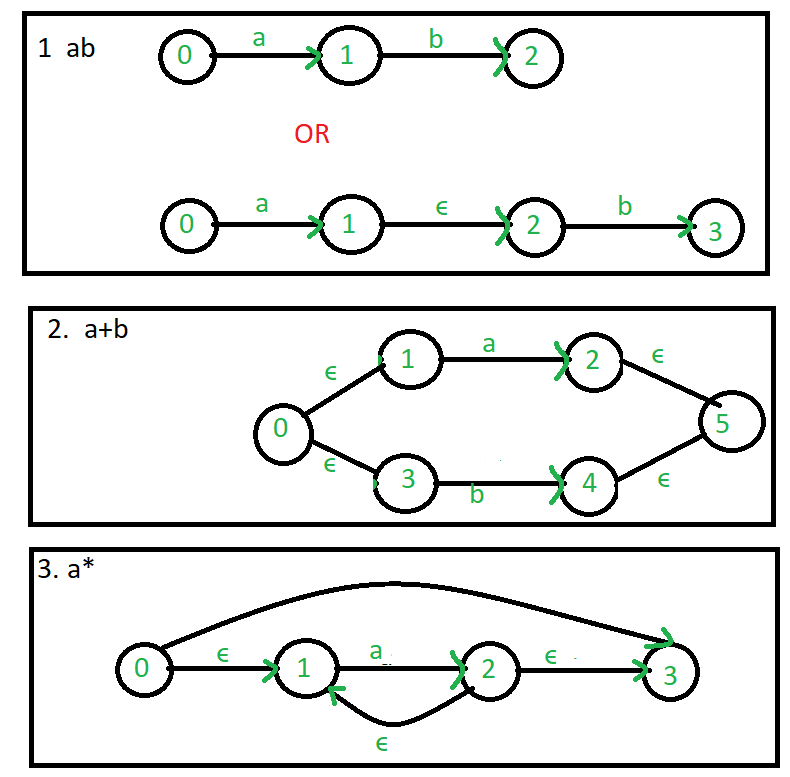
The next video demonstrates these constructions in action. While the video's context is converting regular expressions to NFAs (a topic we will formalize in the next module), the techniques for handling union, concatenation, and star are precisely the general design patterns we are discussing.
Regex to NFA Conversion Isn't Hard! (Sipser 1.28a)
This video from Easy Theory walks through building a complex NFA from smaller pieces. Focus on the how for each operation.
Please watch the following segments demonstrating the construction for each regular operation: Concatenation: Watch how the NFAs for a and b are combined to create an NFA for ab from this section. Kleene Star: See how an NFA for (abb)* is built around the NFA for abb from this part. Union: Observe the final step, where a new start state with ε-transitions is used to combine two machines for the union operation, from this final segment.
Applying the Design Strategies
Now let's practice applying these principles to design NFAs for a few languages. For each, think about whether a "guessing" or a "compositional" approach (or a mix) is more suitable.
Example 1: Strings Ending with Specific Patterns
Consider the language .
This is a union of three languages: strings ending in ab, strings ending in bc, and strings ending in ca. The "guessing" approach is perfect here. The machine can nondeterministically "guess" that the end of the string is approaching and try to match one of the three patterns.
[PDF] Nondeterministic Finite Automata
This document contains an elegant NFA for the language described above.
Find "Example 1" in the slides by looking for the heading An NFA. Examine the diagram on the next slide. Notice how the start state q_0 has a self-loop on all characters, allowing it to consume any prefix. It also has ε-transitions (implied by the arrows without labels, though some might interpret them as starting multiple paths) to the beginnings of three "checker" paths for ab, bc, and ca. This is a compact way to represent the "guessing" of which pattern will appear at the end. The same slide deck shows the equivalent DFA, highlighting how much simpler the NFA is.
Example 2: Modulo Arithmetic
Consider the language .
This is a clear case for a compositional approach using the union construction. We can design three simple NFAs (which happen to also be DFAs) and then join them.
- : A 3-state cycle that counts
a's modulo 3. - : A 3-state cycle that counts
b's modulo 3. - : A 3-state cycle that counts
c's modulo 3.
The final NFA would have a new start state with ε-transitions to the start states of , , and . The resource below shows the completed construction.
[PDF] Nondeterministic Finite Automata
This example demonstrates a clever application of the union principle.
Find "Example 3" in the slides by looking for the heading An NFA. Study the diagram on the following slide. This NFA uses a single start state with ε-transitions to three sub-machines, each responsible for checking the count of one character modulo 3.
Conclusion
In this lesson, you have learned the fundamental strategies for designing Nondeterministic Finite Automata. By moving beyond just understanding their mechanics, you can now leverage their unique features to create elegant and simple solutions for recognizing regular languages.
Here are the main takeaways on NFA design:
- Embrace the "Guessing" Mindset: For languages involving searching for substrings or patterns in specific positions (like "k-th from the end"), design your NFA to nondeterministically guess when to start verifying the pattern.
- Think Compositionally: For languages defined by union, concatenation, or Kleene star, build smaller NFAs for the component parts and then combine them using the standard ε-transition constructions.
- Simplicity is Key: The primary advantage of NFAs in design is their ability to express complex language rules with simpler state diagrams compared to DFAs.
You have now seen that NFAs are often easier to design than DFAs. This might lead you to wonder if they are more powerful. In our next lesson, we will answer this question definitively. We will explore the subset construction algorithm, a formal method for converting any NFA into an equivalent DFA. This will prove that both models recognize the exact same class of languages—the regular languages.