Welcome back! In our previous lesson, we explored the different ways viewers discover content on YouTube, distinguishing between the high-intent "pull" of Search traffic and the discovery-oriented "push" of Browse and Suggested videos. You now understand that when a viewer uses the search bar, they are actively looking for an answer or a specific piece of content.
This lesson builds directly on that understanding. If Search is how motivated viewers find solutions, your goal is to be the best solution they find. To do that, you need to understand how YouTube's search algorithm decides which videos to rank at the top. By the end of this lesson, you will be able to identify the key ranking factors for YouTube search results, giving you a foundational checklist for optimizing your tech and AI edutainment videos.
The Two Halves of YouTube SEO
At its core, ranking in YouTube search is a two-part challenge. First, you must clearly signal to YouTube's algorithm what your video is about. Second, you must prove to the algorithm that your video is a satisfying and high-quality answer to the viewer's query.
This gives us two broad categories of ranking factors:
- Relevance Signals: These are the pieces of information you provide directly to YouTube. This is how you tell the algorithm, "This video is about AI diffusion models."
- Performance Signals: These are the data points YouTube gathers from viewer behavior. This is how your audience tells the algorithm, "Yes, this video about AI diffusion models was excellent and answered my question."
A successful YouTube SEO strategy requires mastering both. Let's look at a high-level map of these factors before we break them down.
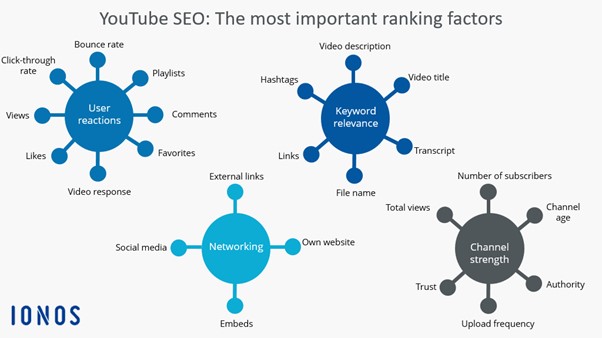
To start, let's get a clear definition of YouTube SEO and clarify the modern role of keywords versus tags. The following video from Think Media provides an excellent introduction.
How to Rank in YouTube Search (SEO Beginners Guide)
Watch the beginning of the video "How to Rank in YouTube Search" to get a foundational definition of YouTube SEO.
Watch the segment from the introduction, which defines SEO and explains the crucial difference between keywords (which are vital) and tags (which have minimal impact today). Pay close attention to where keywords matter most: the title, the description, and what you say in your script.
As you just saw, keywords are the vocabulary you use to communicate your video's topic to the algorithm. Now, let's explore exactly where and how to use that vocabulary.
Part 1: Relevance Signals (Telling YouTube What Your Video Is About)
These are the factors you have the most direct control over before you even publish. They are the SEO "blocking and tackling" that makes your video discoverable in the first place.
Keyword Relevance in your Metadata
Metadata is simply the text-based information that accompanies your video. YouTube's crawlers analyze this text to understand its subject matter. The most important pieces of metadata for search ranking are your title, description, and tags, in that order of importance.
Building a Search-First YouTube Content Strategy: SEO Tips for 2026
This article provides an excellent breakdown of how YouTube's algorithm uses the information you provide to rank your videos. Focus on the sections that explain the role of metadata.
Please read the first three major sections of the article: Start at the beginning of Part 1, which introduces the two main categories of signals. Continue to Part 3, which details best practices for video titles. Notice the emphasis on placing your primary keyword early. Finally, read Part 4, focusing on the section about the "Anatomy of a High-Impact Description." This reinforces how the first few lines of your description are weighted most heavily.
To summarize the key takeaways:
- Title: This is your single most important piece of SEO real estate. Including your target keyword here, preferably near the beginning, is critical.
- Description: The first 2-3 lines are paramount, as they appear before the "Show more" link and are given more weight. This is the place to elaborate on your title and include your primary keyword in a natural sentence.
- Tags: While far less important than they once were, tags can still be useful for capturing common misspellings or alternative phrases related to your topic. They should be considered a low-priority-but-still-useful tool.
Spoken Keywords and Transcripts
Here is a factor that has become increasingly important and one that ties directly into your interest in scripting: YouTube doesn't just read your metadata; it listens to your video. The platform automatically transcribes your video's audio, and the words you say become a powerful relevance signal.
If your video is about "fine-tuning a large language model," and you say that exact phrase multiple times in your script, you are sending a strong, authentic signal to the algorithm about your video's topic. This is much more powerful than simply stuffing keywords into a description box.
Building a Search-First YouTube Content Strategy: SEO Tips for 2026
Let's return to the article on Search-First strategy to explore this concept.
Read the section on captions and spoken keywords. Focus on how accurate, creator-provided captions and naturally spoken keywords reinforce your topic's relevance to both the algorithm and newer AI systems.
This is great news for an edutainment channel. By scripting your videos to be clear and precise in your language, you are simultaneously improving the viewer experience and optimizing your content for search.
Part 2: Performance Signals (Proving Your Video Is a Good Answer)
Having strong relevance signals will get your video considered by the algorithm. But to rank high and stay there, your video must perform well. Performance signals are all about viewer satisfaction.
Watch Time and Audience Retention
This is the undisputed king of ranking factors. Watch Time is the total amount of time viewers have spent watching your video. Audience Retention is the percentage of your video that viewers watch, on average.
A high audience retention tells YouTube that viewers who clicked on your video found it engaging and valuable. It signals that your video is a satisfying answer to their search query. A video that is 10 minutes long but has an average watch time of 7 minutes (70% retention) will almost always outrank a 10-minute video with an average watch time of 2 minutes (20% retention), even if the second video has more views.
Click-Through Rate (CTR)
CTR is the percentage of people who see your video's thumbnail and title (an "impression") and decide to click on it. A high CTR tells YouTube that your video's "packaging"—its title and thumbnail—is compelling and relevant to the search query.
CTR and Watch Time work together. A high CTR gets viewers in the door, and high Watch Time keeps them there. You need both to succeed.
We will explore Watch Time, Retention, and CTR in much greater detail in our next two lessons, as they are the most critical metrics for channel growth.
Engagement Signals
Likes, comments, and shares are also ranking factors, though they are considered less important than Watch Time and CTR. Think of them as positive tie-breakers. If two videos have similar relevance and watch time, the one with more comments and likes is likely to be seen as more engaging by the algorithm and may get a slight ranking boost. A lively comment section is a strong indicator of a video that has sparked a conversation and resonated with its audience.
Avoiding Outdated Tactics
As YouTube's algorithm has become more sophisticated, many old SEO "tricks" have become ineffective or even counterproductive. It's just as important to know what not to do.
The Think Media video you watched earlier has an excellent segment debunking these common myths.
How to Rank in YouTube Search (SEO Beginners Guide)
Let's return to the "How to Rank in YouTube Search" video to learn about common mistakes to avoid and to get a final summary of the key ranking factors.
Please watch two segments from this video: First, watch the section on outdated tactics. This will save you from wasting time on things like keyword stuffing, renaming video files, or trying to copy competitor tags. Then, watch the final summary, which provides a concise checklist of the 10 ranking factors that truly matter today. This is a perfect recap of our lesson.
Conclusion
You now have a comprehensive overview of the factors that determine whether your video succeeds or languishes in YouTube's search results. Let's distill this down to the most important points.
Key Takeaways:
- Two Signal Types: Ranking is determined by a combination of Relevance Signals (keywords in your title, description, and script) and Performance Signals (viewer behavior).
- Relevance Hierarchy: For relevance, the most important factors are your video title, the first few lines of your description, and the keywords spoken in your video.
- Performance is King: The ultimate measure of a video's quality is its performance. Watch Time and Audience Retention are the most critical ranking factors, followed by Click-Through Rate (CTR).
- Engagement Matters: Likes, comments, and shares act as secondary signals that confirm viewer satisfaction and can act as tie-breakers.
- Focus on Humans, Not Just Bots: Outdated tactics like keyword stuffing and copying tags are ineffective. Modern YouTube SEO is about creating a great experience for human viewers, which in turn sends positive signals to the algorithm.
You've now identified the pieces of the puzzle. In our next lesson, we will begin assembling them by taking a deep dive into the single most important ranking factor: Watch Time and Audience Retention. You'll learn what a "good" retention graph looks like and how to structure your videos to keep viewers hooked from start to finish.