Welcome to the second module of our course. In the first module, we established the fundamental principles of how Convolutional Neural Networks process and understand images, culminating in our discussion of the receptive field. We saw how a CNN builds a hierarchical understanding of an image, with deeper layers "seeing" progressively larger and more abstract regions of the input.
Now, we'll begin applying these foundational concepts to our specific goal: smile enhancement. This module is dedicated to semantic segmentation, a powerful technique for achieving the kind of precise, localized image editing we need. Our learning outcome for this first lesson is to: Justify the choice of semantic segmentation for the specific goal of localized smile enhancement.
This lesson will bridge the gap between general CNN theory and our specific application. We will explore different computer vision tasks that deal with spatial localization and construct a clear argument for why semantic segmentation is not just a possible choice, but the most logical and effective one for our project.
The Core Challenge: Localized Editing
Your goal is to enhance a smile in a facial image. This is a form of localized attribute editing. The key term here is "localized." We don't want to change the entire image; we want to modify only the pixels corresponding to the smile, while preserving the person's identity and leaving the rest of the face—eyes, nose, skin texture, background—completely untouched.
Any model that edits regions irrelevant to the desired change will produce unrealistic and often bizarre artifacts. For example, a model tasked with making a smile brighter might incorrectly lighten the chin, or a model intended to adjust teeth might bleed color onto the lips. This problem is what we need to solve first and foremost: how do we give our generative model precise spatial instructions?
The image below illustrates several successful examples of localized editing. Each row shows a specific attribute being changed, such as making eyebrows bushier or adding a smile. The gray mask in the input column shows the target region, demonstrating how a precise understanding of facial parts enables targeted modifications.
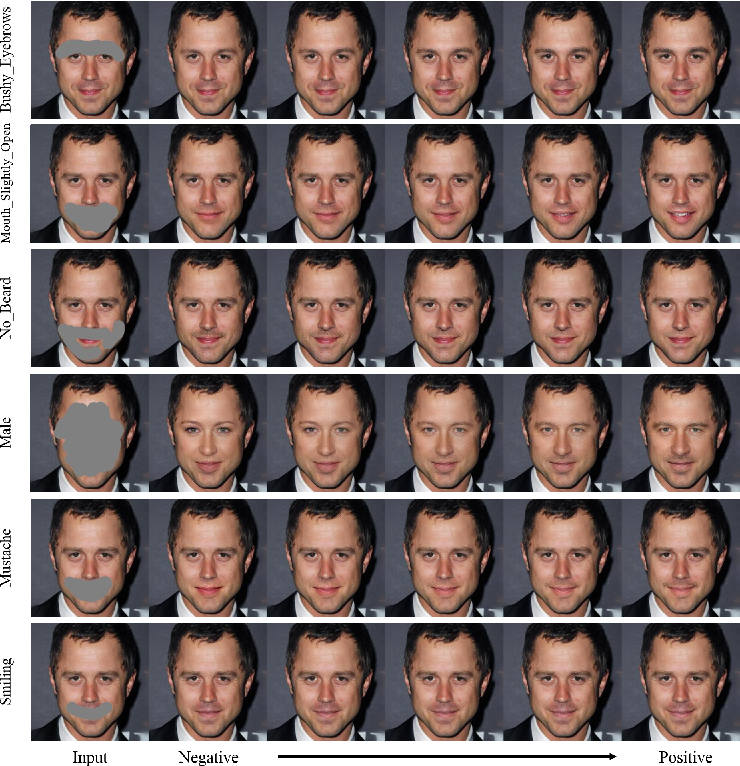
This brings us to a crucial question: What is the best way to define these target regions for a machine learning model?
A Spectrum of Vision Tasks
Computer vision offers several ways to analyze the content of an image, each providing a different level of spatial detail. Let's place them on a spectrum from coarse to fine-grained.
Lecture 11 | Detection and Segmentation
This segment from a Stanford lecture on computer vision introduces several key tasks beyond simple classification, providing a good overview of the landscape.
First, watch the brief refresher on image classification from this timestamp. This task assigns a single label to the whole image and provides no spatial information. Then, watch the introduction to the other tasks, particularly the definition of semantic segmentation from this clip, where the goal is to label every single pixel.
As the video explains, we can think of a hierarchy of tasks:
- Image Classification: Answers "What is in the image?" (e.g., "cat"). Provides one label for the entire image.
- Object Detection: Answers "What is in the image and where is it?" (e.g., "a cat in this box"). Provides bounding boxes around objects.
- Semantic Segmentation: Answers "What is the category of every pixel in this image?" (e.g., "these pixels are cat, these are grass"). Provides a pixel-level map of object categories.
- Instance Segmentation: A refinement of semantic segmentation that also distinguishes between individual instances of the same object (e.g., "this is cat #1, and this is cat #2").
For our goal of smile enhancement, we clearly need more than just classification. We need to tell the model where the smile is. This leaves us with object detection and segmentation as primary candidates.
Why Object Detection Is Not Enough
At first glance, object detection might seem like a plausible approach. We could train a detector to draw a bounding box around a person's mouth. However, this method has a critical flaw for our task.
Object detection vs Image Segmentation | Deep Learning | Machine Learning
This video from AI Sciences clearly explains the difference between object detection and image segmentation, highlighting the limitations of bounding boxes.
Watch the section on object detection from this timestamp. Pay close attention to the discussion of the two major challenges associated with bounding boxes: they are always rectangular and cannot determine an object's true shape.
As the video points out, the fundamental limitation of object detection for our purpose is the imprecision of bounding boxes.
- Coarse and Rectangular: A bounding box drawn around a smile would be rectangular. It would inevitably include large areas that are not part of the smile, such as the chin, cheeks, and parts of the nose.
- No Shape Information: The smile itself has a complex, curved shape. A bounding box completely fails to capture this contour.
If we were to instruct our generative model to "enhance the smile" within this rectangular region, it would have no way of knowing which pixels are teeth, which are lips, and which are surrounding skin. The result would be a messy, unnatural edit applied to a crude block of the face. For the fine-grained control needed for smile enhancement, object detection is simply too blunt an instrument.
The Justification for Semantic Segmentation
This brings us to semantic segmentation. Instead of drawing a rough box, semantic segmentation provides the most direct and precise answer to the question "Where is the smile?". It does this by assigning a category label to every single pixel of the image.
The output of a semantic segmentation model is a segmentation mask. This is an image-like data structure, with the same dimensions as the original input, where the value of each pixel corresponds to a class label (e.g., 0 for 'background', 1 for 'skin', 2 for 'lips', 3 for 'teeth').

This pixel-level mask is the ideal form of spatial guidance for our task. Here’s why:
- Pixel-Perfect Precision: It captures the exact, non-rectangular shape of the facial features we care about—the teeth, the lips, and the surrounding skin.
- Defines "Target" and "Preserve" Regions: With a mask, we can tell our diffusion model with absolute certainty: "These specific pixels are 'teeth' and are eligible for modification. All other pixels must be preserved."
- Enables Complex Interactions: We can use multiple classes (teeth, gums, lips) to enable sophisticated edits that respect the boundaries between different parts of the smile.
The value of this approach is not just theoretical; it is a cornerstone of modern generative models for image editing and inpainting. Leading research has shown that providing segmentation information is critical for achieving high-fidelity, localized results.
Let's look at two influential papers that make a strong case for this.
Case Study 1: Guiding Attribute Editing with MagGAN
The MagGAN paper tackles exactly the problem of localized face attribute editing. The authors identify the primary failure mode of earlier models as "inaccurately localized editing, where regions irrelevant to the desired attribute change are often edited."
[PDF] MagGAN: High-Resolution Face Attribute Editing with Mask-Guided ...
This paper provides a powerful justification for using masks in face editing. We will examine how they formulate the problem and use segmentation masks to solve it.
First, read the Introduction. Focus on the problem description, where they define the core concepts and highlight the issue of editing irrelevant areas. Next, read the paragraph in the introduction that begins "In order to address these challenges". This section explicitly states how a facial mask is used to provide geometric constraints and identify components for localized editing. Now, skim Section 3.2, "Loss functions for model training." Focus on the concept of the Mask-guided reconstruction loss (L_{mre}). You don't need to parse the full formula, but understand that its purpose is to penalize the model for making changes in regions outside the mask. The text starting with "The preserved mask..." explains how the mask is derived from a face parser. Finally, look at Section 5, "Ablation Study." The results in Table 3, particularly the comparison between (i) STGAN and (iii) STGAN w/ Lmre, show that adding the mask-guided loss dramatically reduces the Mask-aware Reconstruction Error (MRE), quantitatively proving that the mask helps preserve irrelevant regions. The text highlights this: "We observe that...".
The key takeaway from MagGAN is that by explicitly using a segmentation mask to define a loss function and to condition the generator, the model is forced to learn to edit only the relevant pixels. This directly justifies using a segmentation model to create such masks for our own smile enhancement pipeline.
Case Study 2: Improving Inpainting with SPG-Net
The task of "enhancing" a smile can be framed as an inpainting problem: we mask the original teeth and ask the model to generate new, improved teeth in their place. The SPG-Net paper provides compelling evidence that segmentation is crucial for high-quality inpainting.
[PDF] Segmentation Prediction and Guidance Network for Image Inpainting
This paper argues that the key to good inpainting is to first understand the scene's semantic layout. It demonstrates that guiding the process with segmentation leads to far superior results.
Read the Abstract. Note the central claim: existing methods that don't use segmentation "usually lead to blurry results on the boundary." Their solution is to use segmentation to "disentangle... inter-class difference and intra-class variation." Next, read the paragraph in the Introduction that starts "Another limitation...". This clearly states the problem and proposes the solution: use a segmentation mask as an "intermediate bridge" to guide the inpainting process. Finally, examine Section 4.3, "Ablation Study." Figure 5 provides a powerful visual justification. Compare the sharp result from the segmentation-guided method (d) with the blurry result from the baseline without segmentation (e). The text confirms this: "Comparing with our method, the baseline result is very blurred...".
SPG-Net shows that even if you don't have a pre-existing mask, it's beneficial to predict one first and then use it to guide the image generation process. This ensures that the generated content has sharp boundaries and respects the semantic layout of the scene. For our goal, this means the boundary between the enhanced teeth and the lips will be crisp and realistic.
Conclusion
We have constructed a thorough justification for our choice of semantic segmentation. While other methods for spatial localization exist, they are ill-suited for the precision required for facial enhancement.
Key Takeaways:
- Localized enhancement requires precise spatial control to modify target regions (e.g., teeth) while preserving surrounding areas and maintaining identity.
- Object detection is too coarse for this task, as its rectangular bounding boxes do not conform to the complex shapes of facial features.
- Semantic segmentation provides pixel-perfect masks that precisely delineate the boundaries of the target region, making it the ideal tool for guiding localized edits.
- This approach is heavily validated by state-of-the-art research, which demonstrates that using segmentation masks as a guide—either in the loss function or as a direct input condition—is critical for preventing artifacts and generating high-quality, realistic results.
Now that we have established why semantic segmentation is the right tool for the job, our next step is to understand how it works. In the next lesson, we will begin to deconstruct the anatomy of a segmentation model by exploring the foundational architecture that made modern segmentation possible: the Fully Convolutional Network (FCN).