Hello. In the previous lesson, you followed each track across a calendar to count its instructional days, then looked down a date to see which groups were in school. That distinction now becomes useful for understanding capacity. A multi-track school can enroll more students than it can seat at one time because different groups use the same rooms on different dates. The key is to keep three quantities separate: total enrollment, students present on a given day, and instructional days received by each student.
Capacity means seats available at the same time
Suppose a building has suitable classroom space for 750 students at once. On a single-track calendar, all enrolled students share the same instructional dates. Changing the placement of breaks does not, by itself, allow 1,000 students to attend on a day when the building can seat only 750.
Now divide 1,000 students into four tracks of 250. If their breaks are staggered so that exactly one track is away at a time, three tracks attend on any instructional day. The building holds 750 students, while the school has 1,000 enrolled students. When the absent track returns, another leaves; no group has to be permanently excluded from the building.
Read the California Department of Education’s short account of this mechanism. It distinguishes changing a shared calendar from rotating groups and gives an estimate of the capacity gain that schools may actually achieve.
Year-Round Education Program Guide - School Facilities (CA Dept of Education)
The California Department of Education explains why multi-track scheduling can increase a facility’s enrollment capacity without adding seats.
In the paragraph immediately following the guide’s “Introduction,” read from the track explanation. Continue through the capacity example. Focus on the distinction between the potential gain and the smaller gain the guide says four-track plans typically achieve.
The building has not gained physical seats. Instead, a seat can serve students from different tracks at different points in the year. Enrollment capacity can therefore rise even though simultaneous seating capacity remains 750.
The arithmetic—and the measure it does not change
For the evenly sized four-track example, each track contains one-quarter of the school’s enrollment. With one track on break, three-quarters attend. If is total enrollment and is the number of usable places available at once, the idealized capacity condition is:
With , that gives a potential enrollment of . Relative to seating 750 students together, the potential gain is one-third, or about 33 percent. This is the same reasoning behind the guide’s example of a 1,000-seat school potentially enrolling about 1,333 students.
That percentage describes additional students enrolled per available seat, not additional teaching time per student. In the simplified 45/15 rotation from the previous lesson, each track attends for 45 of every 60 potential school-day positions. Across four rotations, each student still has 180 instructional days and 60 break positions. The building can host instruction for different groups across a longer span of the year, but no individual track attends all those dates.
It helps to compare two totals that can sound similar:
- Per-student instruction: each student in the example receives 180 scheduled instructional days.
- Instruction delivered across the school: 1,000 students each receiving 180 days amounts to 180,000 student-days of instruction, spread across dates so that no more than 750 students attend at once.
By contrast, a 750-student school in which everyone attends for 180 days delivers 135,000 student-days. The multi-track school serves more students, not each student for more days. Counting the dates on which someone is in the building as though they were dates on which everyone attends would confuse these measures.
Why “one track off” is not enough on its own
The calculation depends on tracks being sized and scheduled so that daily attendance stays within the building’s limits. Imagine that the same 1,000 students were split into tracks of 200, 250, 250, and 300. When the 200-student track is away, 800 students remain. A building with 750 usable places would still be overcrowded, even though one of four tracks is on break.
More generally, if one track is off at a time, the busiest day occurs when the smallest track is away. The relevant test is the largest number present on any day, not simply the average attendance across the year. Equal-sized tracks make the theoretical maximum easy to see; real assignments may not divide so neatly.
The dated calendar below makes another feature of the plan visible: the four track rows do not all follow one shared sequence. It is a real calendar, rather than the perfectly regular blocks used in our model.
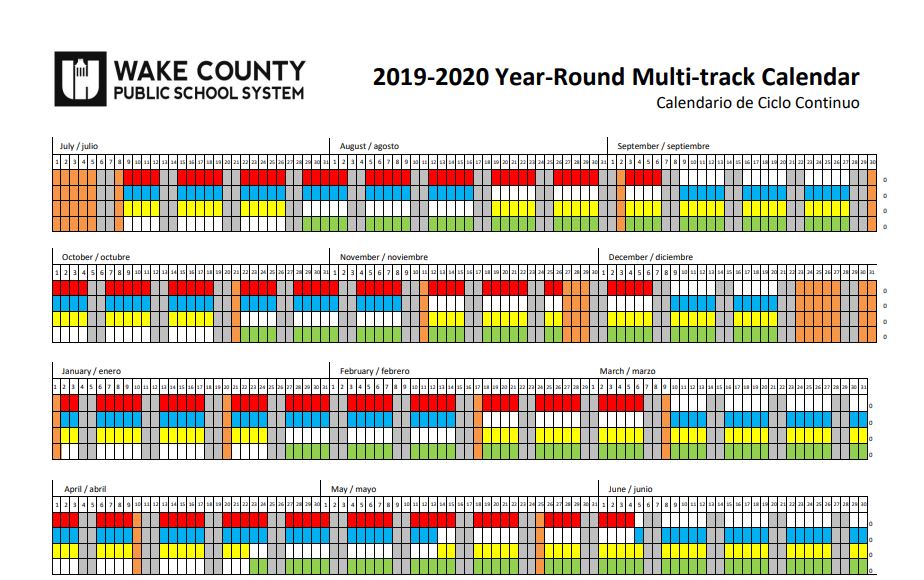
Looking down a date on the calendar is a way to investigate simultaneous use of the building. Looking along one row is a way to investigate one track’s schedule. The image should not be treated as proof that exactly three equally sized groups attend on every date: holidays, transitions, and local scheduling details complicate an actual calendar.
The California guide accordingly calls 33 percent a potential four-track gain and says that four-track plans typically expand seating capacity by about 25 percent. For a 1,000-seat building, a 25 percent gain would mean approximately 1,250 enrolled students, rather than the idealized 1,333. Those figures are about building capacity; they do not imply that students in the less-than-ideal plan receive fewer instructional days.
What the extra enrollment requires
Rotating attendance solves a particular problem: not all enrolled students need the building’s seats on the same dates. It does not remove every other constraint on operating a school. Rooms must be suitable for the groups using them; teaching staff must be available when their tracks attend; and shared facilities and services must handle the students present. A schedule that promises 750 classroom places but cannot accommodate its daily attendance elsewhere would not deliver the calculated capacity in practice.
There is also a limit to how freely break time can be used. If students on break return for optional extra instruction, they may need rooms while three regular tracks are already attending. That may be valuable instruction, but it cannot be assumed to fit into the same full-capacity calculation. Adding instruction during breaks is a separate decision from staggering the existing instructional days.
These conditions explain why a capacity estimate is a starting point for planning rather than a guaranteed result. They also distinguish multi-track scheduling from a single-track balanced calendar: when everyone attends and breaks together, there is no rotating group of vacant seats for another group to use.
Key takeaway
A four-track rotation can increase a building’s enrollment capacity by keeping one group on break while the other three use its fixed number of seats. Under equal-sized tracks and a perfectly maintained rotation, the potential gain is about 33 percent; practical gains may be smaller. Throughout, the instructional-day count must be checked for each student, not inferred from how many dates the building is open.
The next module turns from this scheduling mechanism to claims about learning. Its first lesson will examine seasonal achievement graphs, where a change in scores, a slower rate of learning, and a widening gap between groups can describe different things.