Hello! Welcome to your next lesson on building thread-safe data structures.
In our previous lesson, we successfully implemented a thread-safe stack using a single mutex to protect its critical sections. We concluded by noting a significant weakness in our design: when the stack was empty, our consumer threads would "busy-wait," spinning in a loop and wasting CPU cycles just to check for new items.
Today, we will address that inefficiency directly. Our goal is to design and implement a thread-safe queue using a mutex and condition variables. This pattern is a cornerstone of concurrent programming, often called the Producer-Consumer or Bounded Buffer problem. We'll see how condition variables allow threads to wait for work efficiently, completely eliminating the need for busy-waiting.
The Producer-Consumer Pattern
The producer-consumer pattern involves two types of threads:
- Producers: Threads that create data or tasks and add them to a shared buffer.
- Consumers: Threads that remove data or tasks from the buffer and process them.
A queue is the natural data structure for this, ensuring that items are processed in a First-In, First-Out (FIFO) order.
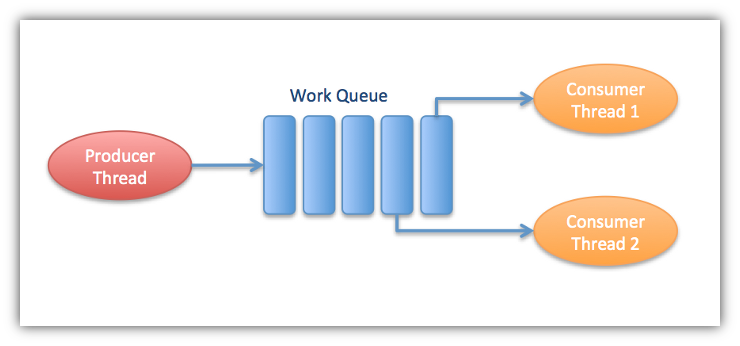
The Problem with Polling
Just as with the stack, our first step to making a queue thread-safe is to add a mutex to protect its shared state (the data array, head/tail pointers, and item count). However, this leads us back to the busy-waiting problem.
Imagine a dequeue function:
- Lock the mutex.
- Check if the queue is empty.
- If it is, what can the thread do? It cannot hold the lock and wait, as that would block producers from adding items, causing a deadlock.
- It must unlock the mutex and loop back to try again later.
This polling is inefficient. The CPU is consumed by threads that are doing no useful work.
CS170 Lecture notes -- Condition Variables
The lecture notes 'CS170 Lecture notes -- Condition Variables' from UC Santa Barbara provide an excellent, practical walkthrough of this exact problem. It starts with a mutex-only solution that highlights the drawbacks of polling.
Please read 'Solution 1: Synchronization using Mutexes Only'. Focus on the while(queued == 0) loop in the ClientThread and the while(dequeued == 0) loop in the TraderThread. This code demonstrates the polling pattern we want to eliminate. Note how the threads must repeatedly lock, check the condition, and unlock if the condition isn't met.
The Solution: Condition Variables
Condition variables (pthread_cond_t) are synchronization primitives that allow threads to block until a specific condition becomes true. They work in tandem with a mutex to provide a mechanism for efficient waiting.
The core functions are:
pthread_cond_init(): Initializes a condition variable.pthread_cond_wait(pthread_cond_t *cond, pthread_mutex_t *mutex): This is the key function. It is called while a thread holds a mutex. It atomically:- Unlocks the mutex.
- Puts the calling thread to sleep (waiting on
cond).
When the thread is woken up, it will re-acquire the mutex beforepthread_cond_waitreturns. This atomic operation is crucial for preventing race conditions.
pthread_cond_signal(pthread_cond_t *cond): Wakes up at least one thread that is currently waiting on the condition variablecond. If no threads are waiting, the signal is lost (it has no effect).pthread_cond_destroy(): Destroys a condition variable.
Let's watch a short video that explains the mechanics of these functions with a clear analogy.
The video 'Condition variables in C' from CodeVault clearly explains how pthread_cond_wait interacts with the mutex. This is the most critical concept to grasp.
Please watch the following segments: Initialization (9:43 - 10:46): See how to declare and initialize a pthread_cond_t. Waiting (10:46 - 11:51): Understand how pthread_cond_wait is used to put a thread to sleep. The Atomic Unlock/Relock (15:08 - 16:47): This is the most important part. Pay close attention to the explanation of how wait atomically unlocks the mutex before sleeping and re-locks it upon waking. This is what makes condition variables work without race conditions.
Implementing a Thread-Safe Queue
Now that we understand the basics of condition variables, let's apply them to our queue. A naive approach might use a single condition variable. However, a more robust and correct design for a bounded buffer uses two condition variables:
not_full: Used to signal that the queue is no longer full. Producers will wait on this condition if they find the queue is full. Consumers will signal this condition after they remove an item.not_empty: Used to signal that the queue is no longer empty. Consumers will wait on this condition if they find the queue is empty. Producers will signal this condition after they add an item.
The following video provides a complete walkthrough of building a task queue for a thread pool, which is precisely the producer-consumer pattern we're implementing.
Thread Pools in C (using the PTHREAD API)
The video 'Thread Pools in C' from CodeVault provides a fantastic, step-by-step implementation of a thread-safe task queue.
Watch how the implementation evolves: Protecting the Queue (10:58 - 14:52): The queue is first protected by a mutex, and the code to submit and retrieve a task is placed within a critical section. The Busy-Waiting Problem (14:52 - 17:32): The video demonstrates how the polling approach leads to 100% CPU usage, the exact problem we want to solve. Adding Condition Variables (17:32 - 20:37): This is the solution. Observe how pthread_cond_wait is used to efficiently wait for tasks and pthread_cond_signal is used to notify waiting threads.
Why a while Loop? And Why Two Conditions?
The video and our implementation use two critical patterns. It's important to understand the theory behind them.
-
The "Spurious Wakeup" and the
whileLoop:
A thread woken bypthread_cond_signalis not guaranteed that the condition it was waiting for is still true. Another thread might have acquired the lock first and changed the state. Also, on some systems, threads can wake up for other reasons (a "spurious wakeup"). Therefore, you must always re-check the condition in awhileloop afterpthread_cond_waitreturns. Anifstatement is incorrect. -
The Deadlock Risk with One Condition Variable:
If you use only one condition variable for both "full" and "empty" states, you can create a deadlock. A consumer might signal, intending to wake up a producer, but instead wake up another consumer. That second consumer would see the queue is still empty and go back to sleep. If all producers are asleep waiting for space, and all consumers are asleep waiting for items, the system is deadlocked. Using two distinct conditions (not_fullandnot_empty) prevents this ambiguity.
Let's read from the classic OSTEP book to solidify these two points.
The book 'Operating Systems: Three Easy Pieces' provides the definitive explanation for these design patterns.
Please read the following sections carefully: 'Better, But Still Broken: While, Not If' (Section 30.2, page 9-10): This explains exactly why you must use a while loop instead of an if statement. 'The Single Buffer Producer/Consumer Solution' (Section 30.2, page 12): This shows the correct solution using two condition variables, empty and fill, and explains why it avoids deadlocks. 'The Correct Producer/Consumer Solution' (Section 30.2, page 13-14): This presents the final, correct code for a general bounded buffer, which is exactly what we are implementing.
The Final Implementation
Here is a complete, runnable C program that implements a thread-safe queue using one mutex and two condition variables. It brings together all the concepts we've discussed.
#include <stdio.h>
#include <stdlib.h>
#include <pthread.h>
#include <unistd.h>

#define QUEUE_CAPACITY 10
#define NUM_PRODUCERS 3
#define NUM_CONSUMERS 3
#define ITEMS_PER_PRODUCER 8

// Encapsulated, thread-safe queue
typedef struct {
    int* values;
    int capacity;
    int count;
    int head;
    int tail;

    pthread_mutex_t mutex;
    pthread_cond_t not_full;  // Signaled when an item is removed
    pthread_cond_t not_empty; // Signaled when an item is added
} queue_t;

// Function prototypes
queue_t* queue_create(int capacity);
void queue_destroy(queue_t* q);
void queue_enqueue(queue_t* q, int value);
int queue_dequeue(queue_t* q);

void* producer(void* arg);
void* consumer(void* arg);

int main() {
    queue_t* q = queue_create(QUEUE_CAPACITY);
    pthread_t producers[NUM_PRODUCERS];
    pthread_t consumers[NUM_CONSUMERS];

    for (int i = 0; i < NUM_PRODUCERS; i++) {
        pthread_create(&producers[i], NULL, producer, q);
    }
    for (int i = 0; i < NUM_CONSUMERS; i++) {
        pthread_create(&consumers[i], NULL, consumer, q);
    }

    // Wait for all threads to finish
    for (int i = 0; i < NUM_PRODUCERS; i++) {
        pthread_join(producers[i], NULL);
    }
    for (int i = 0; i < NUM_CONSUMERS; i++) {
        pthread_join(consumers[i], NULL);
    }

    queue_destroy(q);
    return 0;
}

// --- Queue Implementation ---

queue_t* queue_create(int capacity) {
    queue_t* q = malloc(sizeof(queue_t));
    if (!q) return NULL;

    q->capacity = capacity;
    q->values = malloc(sizeof(int) * capacity);
    q->count = 0;
    q->head = 0;
    q->tail = 0;

    pthread_mutex_init(&q->mutex, NULL);
    pthread_cond_init(&q->not_full, NULL);
    pthread_cond_init(&q->not_empty, NULL);

    return q;
}

void queue_destroy(queue_t* q) {
    pthread_mutex_destroy(&q->mutex);
    pthread_cond_destroy(&q->not_full);
    pthread_cond_destroy(&q->not_empty);
    free(q->values);
    free(q);
}

void queue_enqueue(queue_t* q, int value) {
    pthread_mutex_lock(&q->mutex);

    // Wait while the queue is full
    while (q->count == q->capacity) {
        pthread_cond_wait(&q->not_full, &q->mutex);
    }

    // Add the item
    q->values[q->tail] = value;
    q->tail = (q->tail + 1) % q->capacity;
    q->count++;

    // Signal that the queue is no longer empty
    pthread_cond_signal(&q->not_empty);

    pthread_mutex_unlock(&q->mutex);
}

int queue_dequeue(queue_t* q) {
    pthread_mutex_lock(&q->mutex);

    // Wait while the queue is empty
    while (q->count == 0) {
        pthread_cond_wait(&q->not_empty, &q->mutex);
    }

    // Remove the item
    int value = q->values[q->head];
    q->head = (q->head + 1) % q->capacity;
    q->count--;

    // Signal that the queue is no longer full
    pthread_cond_signal(&q->not_full);

    pthread_mutex_unlock(&q->mutex);
    return value;
}

// --- Thread Logic ---

void* producer(void* arg) {
    queue_t* q = (queue_t*)arg;
    for (int i = 0; i < ITEMS_PER_PRODUCER; i++) {
        int item = (int)(pthread_self() % 100) * 1000 + i;
        queue_enqueue(q, item);
        printf("Producer %ld enqueued %d\n", pthread_self() % 100, item);
        usleep((rand() % 100) * 100);
    }
    return NULL;
}

void* consumer(void* arg) {
    queue_t* q = (queue_t*)arg;
    // Each consumer will consume a proportional share of total items
    int items_to_consume = (NUM_PRODUCERS * ITEMS_PER_PRODUCER) / NUM_CONSUMERS;
    for (int i = 0; i < items_to_consume; i++) {
        int item = queue_dequeue(q);
        printf("Consumer %ld dequeued %d\n", pthread_self() % 100, item);
        usleep((rand() % 200) * 100);
    }
    return NULL;
}
Test your understanding!
Consider what would happen if you replaced pthread_cond_signal with pthread_cond_broadcast in both queue_enqueue and queue_dequeue. A broadcast wakes up all threads waiting on a condition, not just one.
- Would the program still be correct? Why or why not?
- What would be the performance implications of this change?
Show answer
-
Correctness: Yes, the program would still be correct. The
whileloop is the key. When all waiting threads are woken up, they will each re-acquire the mutex one by one and re-check the condition (while (q->count == ...)). For a producer, only one will succeed in adding an item before the queue is full again, and the others will correctly go back to sleep. For consumers, only one will get an item before the queue is empty again. The logic is robust enough to handle this "thundering herd." -
Performance: The performance would likely be worse. A
broadcastcauses all waiting threads to wake up, contend for the mutex, and execute, even though only one can make progress. This leads to unnecessary context switches and CPU usage compared tosignal, which surgically wakes only one thread that can likely make immediate progress.broadcastis typically reserved for situations where multiple threads might be able to proceed after a state change, or when the signaling thread can't know which specific waiter should be woken up.
Conclusion
In this lesson, we built a robust and efficient thread-safe queue, solving the classic producer-consumer problem. This is a significant step up from our simple mutex-based stack.
Key Takeaways:
- Condition variables solve the busy-waiting problem by allowing threads to sleep until a condition is met.
pthread_cond_waitis the core function, which atomically unlocks the associated mutex and waits, then re-acquires the lock before returning.- You must always re-check the condition in a
whileloop afterpthread_cond_waitreturns to handle spurious wakeups and race conditions. - For the bounded buffer problem, using two condition variables (
not_fullandnot_empty) provides a clear and deadlock-free design by directing signals to the correct type of waiting thread.
Preview of the Next Lesson:
Our stack and queue implementations both use a single, coarse-grained lock that protects the entire data structure. While simple and correct, this can become a bottleneck. If one thread is adding an item, no other thread can do anything with the structure, even a non-conflicting operation.
In the next lesson, we will begin exploring more advanced locking strategies by analyzing the performance limitations of using a single lock for a linked list. This will set the stage for implementing fine-grained locking, a technique to improve concurrency.