Hello! Welcome to the first lesson in our module on implementing thread-safe data structures.
In the previous module, we concluded our study of deadlocks by implementing a lock-ordering hierarchy to solve the Dining Philosophers problem. That exercise demonstrated how to manage multiple locks safely across multiple threads. Now, we'll shift our focus from avoiding deadlocks to building practical, concurrent components.
Our goal for this lesson is to design and implement a thread-safe stack using a mutex. We will start with a standard, non-thread-safe stack, identify its vulnerabilities in a multi-threaded context, and then systematically add a mutex to protect its operations, ensuring data integrity. This is a foundational pattern for building any concurrent data structure.
The Problem: Race Conditions in a Simple Stack
Let's consider a basic stack. In a single-threaded program, it's a trivial data structure. But what happens when multiple threads try to push and pop from the same stack simultaneously?
The operations are not atomic. A single call to push, for example, involves at least two steps: placing the value in an array and incrementing the stack pointer/count. A thread can be preempted by the OS between these steps, leading to a race condition.
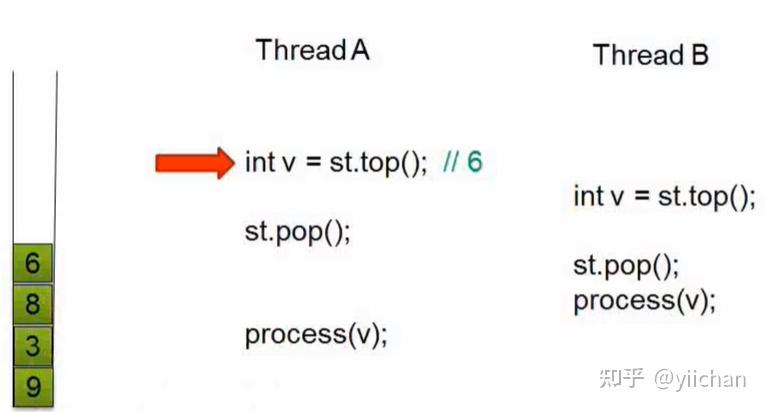
To make this concrete, let's start with a non-thread-safe stack implementation.
The web page 'Synchronization' from the University of Illinois provides an excellent starting point. It begins with a simple, thread-unsafe stack and then builds upon it.
Please read the short code block under the heading 'Thread-Safe Data Structures'. Focus on the first example, labeled '// A simple fixed-sized stack (version 1)'. This is our baseline implementation that we will make thread-safe.
The code for Version 1 is:
// A simple fixed-sized stack (version 1)
#define STACK_SIZE 20
int count;
double values[STACK_SIZE];

void push(double v) {
    values[count++] = v;
}

double pop() {
    return values[--count];
}

int is_empty() {
    return count == 0;
}
Consider two threads, T1 and T2, calling push() concurrently when count is 5.
- T1 executes
values[5] = value1; - The OS preempts T1 before it can execute
count++.countis still 5. - T2 executes
values[5] = value2;. This overwrites the value from T1. - T2 executes
count++.countis now 6. - T1 resumes and executes
count++.countis now 7.
The result is a disaster: T1's data is lost, and the count is incorrect, leaving a garbage value at index 6. The push, pop, and is_empty functions are all critical sections because they read from or write to the shared values and count variables.
An Attempt to Fix It (With Flaws)
To fix this, we need to ensure mutual exclusion. Only one thread should be allowed inside a critical section at any given time. A mutex is the perfect tool for this.
Let's look at a first attempt to add mutexes.
The same 'Synchronization' resource provides a flawed second version. Analyzing its mistakes is a great way to deepen our understanding.
Read the code block for '// An attempt at a thread-safe stack (version 2)'. Before reading the explanation that follows it, try to identify the errors yourself. There are two significant bugs.
What did you find?
Here are the two main errors in Version 2:
- It uses two different mutexes (
m1andm2). A mutex protects a critical section from other threads trying to acquire the same mutex. Using different mutexes forpushandpopprovides no protection between them. A thread could be pushing while another is popping, as they would acquire different locks (m1andm2), leading to the very race conditions we want to prevent. - The
is_emptyfunction never unlocks the mutex. It callspthread_mutex_lock(&m1)but returns without a correspondingpthread_mutex_unlock(). The first thread to callis_emptywill lockm1and never release it. Any subsequent thread callingpushoris_emptywill block forever, causing a deadlock.
A Correct, Encapsulated Implementation
The solution is to use a single mutex to protect all operations on a given stack instance. Furthermore, good software design dictates that the data and the synchronization primitive that protects it should be bundled together. Instead of using global variables, we'll create a stack_t struct that encapsulates the data, the count, and the mutex.
This final, correct version is also detailed in the Synchronization resource.
Let's look at the final, well-designed version from the 'Synchronization' resource. This demonstrates the standard pattern for creating a thread-safe object in C.
Read the code block under the heading '// Support for multiple stacks (each one has a mutex)'. This section presents a stack_t struct and functions like stack_create, stack_destroy, push, and pop that operate on it. This is the model you should follow.
Let's break down the key aspects of this superior design:
- Encapsulation: The
stack_tstruct holds thecount, thevaluespointer, and thepthread_mutex_t m. Any instance of the stack carries its own data and its own lock. This allows you to have multiple independent thread-safe stacks. - Lifecycle Management:
stack_create: Allocates memory for the struct and its internalvaluesarray. Crucially, it callspthread_mutex_init()to initialize the mutex for that specific stack instance.stack_destroy: Frees thevaluesarray and the stack struct itself. It properly cleans up by callingpthread_mutex_destroy().
- Mutual Exclusion:
- Every function (
push,pop,is_empty) that accesses shared data first callspthread_mutex_lock()on the stack's mutex. - Just before returning, it calls
pthread_mutex_unlock(). This ensures that all operations on the stack's internal state are atomic from the perspective of other threads.
- Every function (
Here is a complete, runnable example based on that design. Note that this implementation does not yet handle pushing to a full stack or popping from an empty one. We'll address that limitation in the next lesson.
#include <stdio.h>
#include <stdlib.h>
#include <pthread.h>
#include <unistd.h>

#define STACK_CAPACITY 10
#define NUM_PRODUCERS 2
#define NUM_CONSUMERS 2
#define ITEMS_PER_PRODUCER 5

// The encapsulated, thread-safe stack
typedef struct {
    int count;
    int capacity;
    pthread_mutex_t mutex;
    int* values;
} stack_t;

// Function prototypes for our stack
stack_t* stack_create(int capacity);
void stack_destroy(stack_t* s);
void stack_push(stack_t* s, int value);
int stack_pop(stack_t* s);

// Thread functions
void* producer(void* arg);
void* consumer(void* arg);

int main() {
    stack_t* s = stack_create(STACK_CAPACITY);
    pthread_t producers[NUM_PRODUCERS];
    pthread_t consumers[NUM_CONSUMERS];

    // Create producer threads
    for (int i = 0; i < NUM_PRODUCERS; i++) {
        pthread_create(&producers[i], NULL, producer, s);
    }
    // Create consumer threads
    for (int i = 0; i < NUM_CONSUMERS; i++) {
        pthread_create(&consumers[i], NULL, consumer, s);
    }

    // Join all threads
    for (int i = 0; i < NUM_PRODUCERS; i++) {
        pthread_join(producers[i], NULL);
    }
    for (int i = 0; i < NUM_CONSUMERS; i++) {
        pthread_join(consumers[i], NULL);
    }

    printf("All threads finished. Final stack count: %d\n", s->count);

    stack_destroy(s);
    return 0;
}

// --- Stack Implementation ---

stack_t* stack_create(int capacity) {
    stack_t* s = malloc(sizeof(stack_t));
    if (!s) return NULL;

    s->capacity = capacity;
    s->count = 0;
    s->values = malloc(sizeof(int) * capacity);
    if (!s->values) {
        free(s);
        return NULL;
    }
    pthread_mutex_init(&s->mutex, NULL);
    return s;
}

void stack_destroy(stack_t* s) {
    pthread_mutex_destroy(&s->mutex);
    free(s->values);
    free(s);
}

void stack_push(stack_t* s, int value) {
    pthread_mutex_lock(&s->mutex);

    // For this example, we assume the stack won't overflow
    if (s->count < s->capacity) {
        s->values[s->count++] = value;
    }

    pthread_mutex_unlock(&s->mutex);
}

int stack_pop(stack_t* s) {
    pthread_mutex_lock(&s->mutex);

    int value = -1; // Return -1 if stack is empty
    // For this example, we assume the stack won't underflow in the test
    if (s->count > 0) {
        value = s->values[--s->count];
    }

    pthread_mutex_unlock(&s->mutex);
    return value;
}

// --- Thread Logic ---

void* producer(void* arg) {
    stack_t* s = (stack_t*)arg;
    for (int i = 0; i < ITEMS_PER_PRODUCER; i++) {
        int item = (int)(pthread_self() % 100) * 100 + i;
        stack_push(s, item);
        printf("Producer %ld pushed %d\n", pthread_self() % 100, item);
        usleep((rand() % 100) * 1000); // sleep for 0-99 ms
    }
    return NULL;
}

void* consumer(void* arg) {
    stack_t* s = (stack_t*)arg;
    // Each consumer will try to pop the same number of items a producer makes
    for (int i = 0; i < ITEMS_PER_PRODUCER; i++) {
        // Simple busy-wait loop if stack is empty. We'll improve this in the next lesson.
        int item = -1;
        while(item == -1) {
             // Lock, check, pop, unlock all happens in stack_pop
             item = stack_pop(s);
             if (item != -1) {
                 printf("Consumer %ld popped %d\n", pthread_self() % 100, item);
             } else {
                 usleep(10 * 1000); // wait 10ms if stack was empty
             }
        }
    }
    return NULL;
}
Test your understanding!
A common operation for a stack is peek() (or top()), which returns the top element without removing it.
Your task: Implement int stack_peek(stack_t* s);.
Remember to:
- Protect the function with the same mutex.
- Handle the case where the stack is empty (e.g., by returning a special value like -1).
- Ensure you unlock the mutex before returning.
Show answer
Here is a correct implementation of stack_peek:
int stack_peek(stack_t* s) {
    pthread_mutex_lock(&s->mutex);

    int value = -1; // Value to return if stack is empty
    if (s->count > 0) {
        value = s->values[s->count - 1]; // Get value at the top index
    }

    pthread_mutex_unlock(&s->mutex);
    return value;
}
This function correctly locks the mutex to ensure it reads a consistent state of s->count and the s->values array. It handles the empty case and, critically, unlocks the mutex before it returns, preventing deadlocks.
Conclusion
In this lesson, we successfully designed and implemented a thread-safe stack. We saw how seemingly simple data structure operations can fail catastrophically under concurrent access and how a mutex can be used to enforce atomicity.
Key Takeaways:
- Any data structure that will be shared between threads must be explicitly designed for thread safety.
- The first step is to identify the critical sections—code that accesses shared, mutable state.
- A single mutex should be used to protect all critical sections associated with a single instance of a data structure.
- The best practice is to encapsulate the data and its corresponding mutex within a
struct, managing their lifecycle together withcreateanddestroyfunctions.
Preview of the Next Lesson:
Our current stack implementation has a significant inefficiency. In the consumer code, if the stack is empty, the thread spins in a loop, repeatedly calling stack_pop, burning CPU cycles just to check for work. This is called "busy-waiting."
In our next lesson, we will design and implement a thread-safe queue. As part of this, we will introduce a new, more powerful synchronization primitive: the condition variable. Condition variables allow threads to wait efficiently for a specific condition (like "the queue is no longer empty") without burning CPU, solving the busy-waiting problem.