Hello! Welcome back to our course on C programming with threads.
In our last lesson, we successfully built a lock-free stack. We saw how a naive implementation using compare-and-swap (CAS) could fail spectacularly due to the ABA problem, and we implemented a robust solution using a version counter and double-word CAS.
Today, we will take a step back to analyze the challenges of the ABA problem itself. The lock-free stack was just one example; this problem is a fundamental hurdle in any CAS-based algorithm that involves memory reuse. Our goal is to understand its root cause, see how it manifests in different scenarios, and analyze the trade-offs between various solutions. This deeper understanding is crucial for designing correct and efficient concurrent data structures.
The Anatomy of the ABA Problem
At its heart, the ABA problem is a case of mistaken identity. A CAS operation checks if a memory location's value is what you expect it to be. It has no inherent way of knowing what happened to that memory location between the time you first read the value and the time you perform the swap.
Let's watch a short, very memorable analogy that explains this perfectly.
Building a Lock-free Multi-producer, Multi-consumer Queue for Tcmalloc - Matt Kulukundis - CppCon 21
In this clip from a CppCon talk on building a lock-free queue, Matt Kulukundis gives a fantastic analogy for the ABA problem.
Watch from 25:40 to 27:10. Listen for the "glass of water" analogy and how it relates to the illusion of object permanence in programming.
As he says, you start with a glass of water (A), turn around, someone replaces it with vodka (B), and then replaces that with another glass of water (A). When you turn back, it looks identical, but its history is different, and trusting it could have surprising consequences.
A Concrete Example Revisited
Let's formalize this with the lock-free stack example we know. The following resource provides a clear, step-by-step walkthrough of the failure scenario.
24 ABA Problem, DCAS, GC, Pointer Tagging, Hazard ...
This section from the 'Parallel Programming' lecture notes gives a precise, step-by-step breakdown of how memory reuse in a lock-free stack leads to the ABA problem.
Read the section titled 'The ABA Problem Explained'. Follow the 6 steps that detail how Thread X, Thread Y, and Thread Z interact to corrupt the stack.
The key failure point is step 5: Thread X resumes and its CAS operation compareAndSet(A, B) succeeds because the current top pointer has been restored to A. The CAS is "tricked" into believing nothing has changed, leading to data structure corruption.
Beyond Pointers: A More General Problem
The ABA problem isn't limited to pointers in data structures. It can happen with any value that is read, operated on, and then updated with CAS.
Consider a shared bank balance:
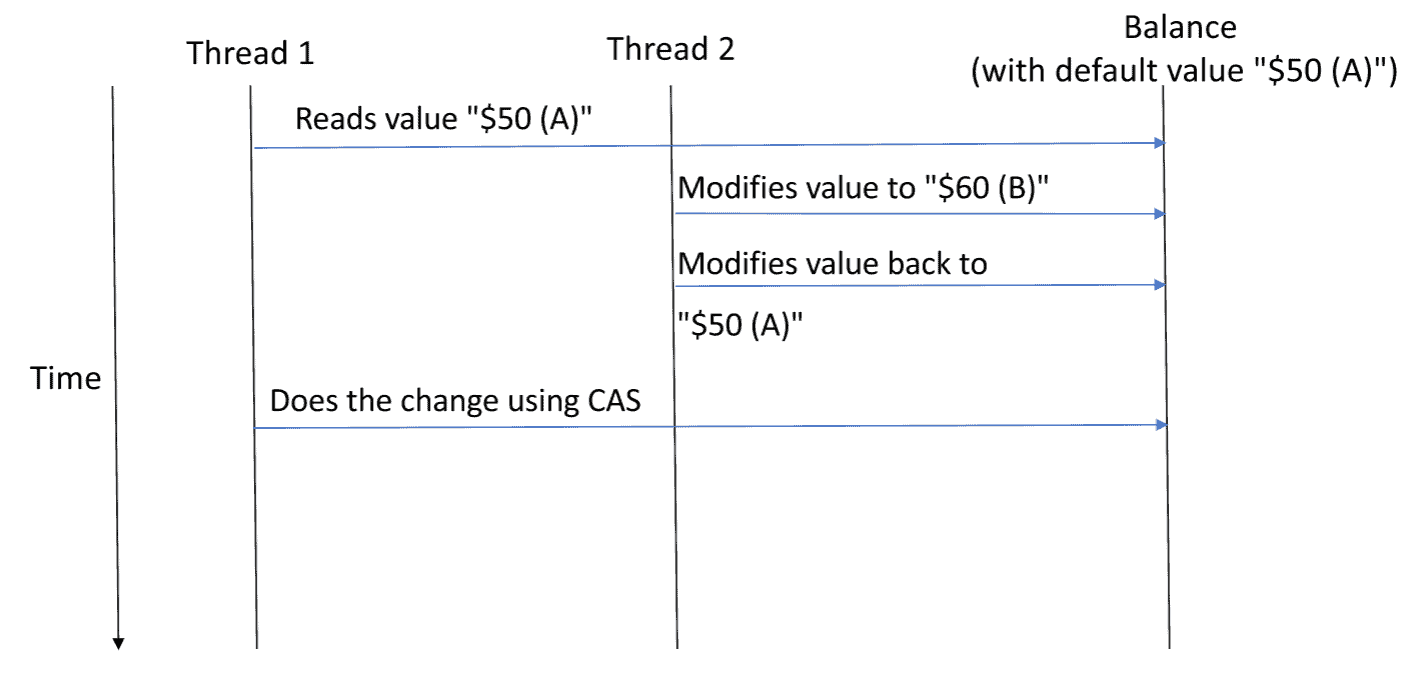
If Thread 1's goal was not just to change the balance, but also to log that a specific change occurred based on the initial state, its logic would now be flawed. It would operate under the false assumption that no other transactions happened.
Analyzing the Solutions and Their Trade-offs
Since the problem stems from being unable to distinguish the first 'A' from the second 'A', the solutions all revolve around making them distinguishable or preventing the second 'A' from appearing in the first place.
Solution 1: Versioning with Tags or Stamps
This is the approach we implemented in the previous lesson. By pairing the value (the pointer A) with a version counter, we create a wider atomic unit: (A, version 1). When the value is changed to B, the version is incremented. If it's changed back to A, it becomes (A, version 2).
Now, the CAS compare_and_swap((A, version 1), ...) will correctly fail, because the current value is (A, version 2).
This technique is often called Pointer Tagging, especially when the version bits are packed into unused portions of the pointer itself.
24 ABA Problem, DCAS, GC, Pointer Tagging, Hazard ...
Let's review the formal explanation of pointer tagging from the same lecture notes.
Read the section '3. Pointer Tagging'. It explains how unused bits in aligned pointers can be used for a tag and mentions Java's AtomicStampedReference as an example of this pattern.
- Pros:
- Very effective and conceptually straightforward.
- The intent is clear in the code.
- Cons:
- Requires hardware support for Double-Word Compare-and-Swap (e.g.,
cmpxchg16bon x86-64) to atomically handle the pointer and tag. - Can increase memory usage if the tag cannot be packed into the pointer.
- Requires hardware support for Double-Word Compare-and-Swap (e.g.,
An Advanced Optimization: Sometimes, you can find a version counter for free. The speaker in the CppCon talk we watched earlier found a clever way to do this. His lock-free queue used a large circular buffer. Instead of calculating an index into the buffer with a modulo operator (index % size), he just let the index integer grow. The high-order bits of the ever-increasing index acted as a huge, free version counter, making an ABA recurrence astronomically unlikely. This is a great example of leveraging domain-specific properties to create an efficient solution.
Solution 2: Deferred Reclamation with Hazard Pointers
This strategy takes a different approach. Instead of detecting that A was reused, it prevents A from being reused in the first place, at least for a little while. This is a critical technique in C where we don't have automatic garbage collection.
The core idea is that a thread "announces" its intent to access a particular node by placing a pointer to it in a public, per-thread "hazard" slot.
Before any thread can free or recycle a node, it must scan the hazard lists of all other threads. If the node it wants to free is "hazardous" (i.e., it appears in another thread's list), it cannot be freed yet.
24 ABA Problem, DCAS, GC, Pointer Tagging, Hazard ...
Hazard Pointers are more complex but are a powerful tool for memory management in non-GC lock-free algorithms. This section provides an excellent deep dive.
Read the entire section '4. Hazard Pointers'. Focus on understanding the core idea and the sequence of operations: Mark as hazardous, re-check, perform operation, and then clear the hazard pointer.
By ensuring a node isn't reclaimed while another thread might still be using it, Hazard Pointers solve two problems at once:
- Use-After-Free: Prevents crashes from dereferencing a freed pointer.
- ABA Problem: Since the node
Acannot be reclaimed and reused while Thread 1 holds a hazard pointer to it, theA -> B -> Asequence cannot happen with the same memory address.
- Pros:
- Solves both use-after-free and the ABA problem.
- Does not require special hardware like DWCAS.
- Crucial technique for safe memory reclamation in C/C++.
- Cons:
- Significantly more complex to implement correctly than tagged pointers.
- Can have performance overhead due to the need to scan hazard lists.
Test your understanding!
Imagine you are implementing a lock-free algorithm in C. You have two options to deal with the ABA problem:
- Use a tagged pointer (assuming your target hardware supports 16-byte CAS).
- Implement Hazard Pointers.
Which solution would you choose if your only concern was preventing the ABA problem itself, and why? What other problem does the choice of Hazard Pointers solve that tagged pointers alone do not?
Show answer
If the only concern was the ABA problem, the tagged pointer would be the simpler and more direct solution. It directly addresses the "mistaken identity" issue by adding a version number.
However, tagged pointers alone do not solve the use-after-free problem. A thread could still free a node's memory while another thread holds a pointer to it, leading to a dangling pointer dereference. Hazard Pointers solve both the ABA problem (by preventing memory reuse) and the use-after-free problem (by preventing premature memory reclamation). Therefore, in a real-world C implementation, Hazard Pointers (or a similar memory reclamation scheme) are often necessary anyway.
The Ultimate Challenge: Detection and Debugging
Perhaps the greatest challenge of the ABA problem is that it is a "Heisenbug." It may only manifest under heavy thread contention, on specific processor architectures, or after billions of operations. The symptom is often not an immediate crash but silent data corruption that is discovered much later, making it fiendishly difficult to trace back to the source.
Let's hear one last thought from the CppCon speaker about this.
Building a Lock-free Multi-producer, Multi-consumer Queue for Tcmalloc - Matt Kulukundis - CppCon 21
Here, the speaker reflects on the process of finding and fixing the ABA bug in his code.
Watch this very short clip from 44:37 to 44:49.
His slightly ironic tone when saying "we got to debug an ABA issue" highlights the reality: finding these bugs is a difficult, sometimes painful, but essential part of writing correct concurrent code.
Conclusion
You now have a much deeper appreciation for the subtleties of the ABA problem. It is not a simple edge case but a fundamental design challenge in optimistic concurrency.
Key Takeaways:
- The ABA problem arises from value-based comparison (CAS) combined with memory/value reuse.
- It is not limited to pointers and can affect any CAS-based logic, including simple numeric counters.
- Solutions either detect reuse (version counters, tags) or prevent reuse (Hazard Pointers, GC).
- Version Counters are simple but require hardware support (DWCAS). They do not, by themselves, prevent use-after-free errors.
- Hazard Pointers are more complex but solve both ABA and use-after-free, making them essential for lock-free C code.
- ABA bugs are notoriously difficult to reproduce and debug, making careful, proactive design paramount.
Preview of the Next Lesson:
Our discussion about the difficulty of debugging ABA bugs is a perfect lead-in to our next module, "Debugging Multithreaded Programs". In the next lesson, we will start with the fundamentals: learning how to use the GDB debugger to inspect the state of multiple threads, set thread-specific breakpoints, and navigate between backtraces. This is a foundational skill for diagnosing any multithreaded issue, from simple hangs to complex race conditions.