Hello! Welcome to the fifth lesson in our module on condition variables.
In the past few lessons, we've assembled a powerful set of tools: mutexes for protecting shared data, pthread_cond_wait for efficient waiting, the "wait-in-a-loop" pattern for robustness against spurious wakeups, and pthread_cond_timedwait for building responsive systems. Now, it's time to synthesize these concepts to solve a classic and highly practical concurrency problem.
Today's learning outcome is to design the logic for a thread-safe bounded buffer, which is the canonical solution to the producer-consumer problem. We will focus on establishing the correct synchronization logic and understanding why simpler approaches fail. This design is the foundation for countless real-world applications, from web server task queues to data processing pipelines.
The Producer-Consumer Problem
At its heart, the producer-consumer problem involves two types of threads coordinating through a shared data buffer:
- Producers: Threads that generate data or tasks and place them into the buffer.
- Consumers: Threads that retrieve data or tasks from the buffer and process them.
The bounded buffer is a shared, fixed-size queue that acts as the intermediary. Its fixed size introduces our primary synchronization challenges.
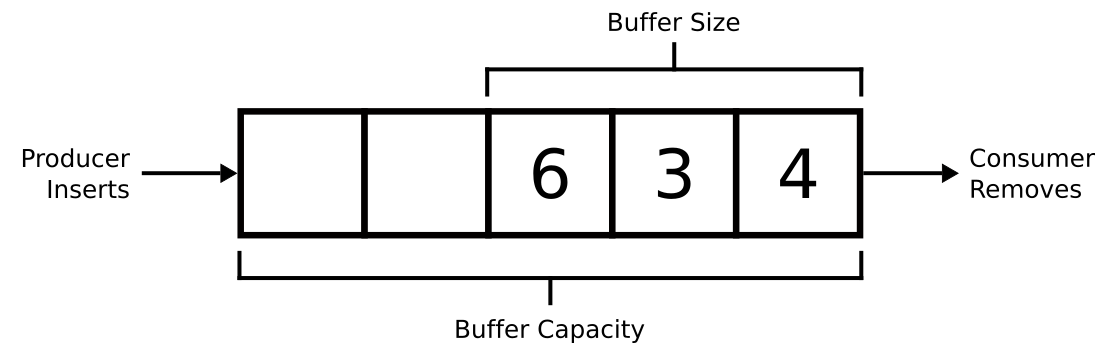
The rules of engagement are:
- Mutual Exclusion: Only one thread can modify the buffer's internal state at any given time to prevent data corruption.
- Producer Wait Condition: A producer must wait if the buffer is full. It cannot add an item until a consumer has made space.
- Consumer Wait Condition: A consumer must wait if the buffer is empty. It cannot remove an item until a producer has added one.
To understand the problem more formally, let's turn to a classic text on the subject.
The Producer/Consumer (Bounded Buffer) Problem
The book Operating Systems: Three Easy Pieces provides an excellent definition of the producer-consumer problem. Reading this will solidify the core concepts.
Read the section titled 'The Producer/Consumer (Bounded Buffer) Problem'. Focus on the definition of producers, consumers, and the role of the bounded buffer. Notice the real-world examples like web servers and UNIX pipes.
Why Simpler Approaches Fail: The Peril of Busy-Waiting
Given your experience with C, your first thought for synchronization might involve a mutex and a loop. For instance, a consumer could:
- Lock a mutex.
- Check if the buffer is empty.
- If it is, unlock the mutex and
sleep()for a moment before trying again. - If not, remove the item and unlock the mutex.
This approach, known as busy-waiting or spinning, is highly inefficient. The following videos demonstrate why this is a poor solution and motivate the need for a more elegant mechanism.
First, the CodeVault channel uses a gas station analogy to show how a simple loop with a mutex leads to a deadlock, where the consumer holds the lock while waiting, preventing the producer from ever being able to add fuel.
Watch from the beginning until 09:43. Pay close attention to the evolution from a simple if statement to a while loop with sleep, and the explanation of why the while loop deadlocks due to the mutex being held.
How to write a multithreaded webserver using condition variables (Part 3)
Next, Jacob Sorber's video on building a multithreaded web server tackles the same problem from a performance perspective, showing how busy-waiting wastes CPU and how sleep() creates an undesirable trade-off between responsiveness and CPU usage.
Watch from 00:45 to 02:24. This section clearly illustrates the problems of both constant checking (high CPU) and using sleep() (poor responsiveness).
As you've seen, busy-waiting either wastes CPU cycles or introduces arbitrary delays that hurt performance. The correct tool for this job is the condition variable, which allows a thread to suspend its execution efficiently until the state it's waiting for has potentially changed.
Designing the Logic: An Iterative Approach
Let's build our design step-by-step. The OSTEP chapter provides a superb walkthrough of incorrect attempts, which is the best way to understand why the final design is correct.
Attempt 1: One Mutex, One Condition Variable (Flawed)
Our first "real" design uses a mutex and a single condition variable, cond, for both producers and consumers.
- Producer Logic: Lock mutex,
while (buffer_full) { wait(&cond) }, add item,signal(&cond), unlock mutex. - Consumer Logic: Lock mutex,
while (buffer_empty) { wait(&cond) }, remove item,signal(&cond), unlock mutex.
This seems plausible. A producer signals when it adds an item, and a consumer signals when it removes one. However, a subtle but critical bug can lead to deadlock.
Imagine two consumers and one producer.
- Both consumers run, find the buffer empty, and
waitoncond. - The producer runs, adds an item, and
signalscond. This wakes up one of the consumers (say, Consumer 1). - The producer loops, finds the buffer is now full (if size=1), and
waits oncond. - Consumer 1 runs, consumes the item, and then
signalscond. Here is the bug: Who does it wake up? It might wake up the waiting Producer, which is correct. But it could just as easily wake up Consumer 2. - If Consumer 2 is woken up, it re-checks the condition, finds the buffer is empty again, and goes back to sleep.
- Now, the producer is asleep, Consumer 2 is asleep, and Consumer 1 is about to go to sleep. All threads are sleeping, and the system is deadlocked.
The following reading explains this failure case in detail. Your CS background will be valuable in tracing the thread state transitions.
Producer/Consumer: Flawed Solutions
This section from the OSTEP chapter meticulously traces the failure of a single-condition-variable solution. It's crucial for understanding the need for more directed signaling.
Read the sections that walk through the broken solutions. First, see how using an if instead of a while is wrong (a point we covered previously but is reinforced here). Then, focus on the second bug: the deadlock scenario that occurs even with a while loop when using only one condition variable. The thread trace diagram is particularly insightful.
Attempt 2: One Mutex, Two Condition Variables (Correct!)
The deadlock in the previous attempt occurred because a signal was sent to the "wrong" type of thread (a consumer woke a consumer). The fix is to use two separate condition variables to direct the signals appropriately:
not_full: Producers wait on this condition when the buffer is full. Consumers signal it after they remove an item.not_empty: Consumers wait on this condition when the buffer is empty. Producers signal it after they add an item.
This separation ensures producers only wake consumers and consumers only wake producers.
The Correct Producer Logic:
- Lock the mutex.
whilethe buffer is full:-
Wait on the `not_full` condition variable. - Add the item to the buffer.
- Signal the
not_emptycondition variable (waking a waiting consumer). - Unlock the mutex.
The Correct Consumer Logic:
- Lock the mutex.
whilethe buffer is empty:-
Wait on the `not_empty` condition variable. - Remove the item from the buffer.
- Signal the
not_fullcondition variable (waking a waiting producer). - Unlock the mutex.
This design is robust and correct. The following resources confirm this final design.
The Correct Producer/Consumer Solution
The OSTEP chapter concludes with this correct, two-variable solution. It also shows how the logic extends from a single-slot buffer to a multi-slot one.
Read 'The Single Buffer Producer/Consumer Solution' and 'The Correct Producer/Consumer Solution'. This presents the final, correct logic using two condition variables (empty and fill) and then generalizes it to a buffer of size MAX.
Solving the Producer – Consumer Problem with PThreads
These lecture slides from the University of Kansas also describe the correct approach and introduce the standard variable names notFull and notEmpty that you will see in many implementations.
Read the slides on 'Condition Variables', 'Library Calls', and 'Modifying producer_consumer.c'. This provides a practical summary of the functions and reinforces the two-condition-variable design pattern.
Test your understanding!
A developer implements the two-condition-variable design. However, in the producer's code, after adding an item to the buffer, they accidentally signal not_full instead of not_empty.
// BUGGY PRODUCER CODE SNIPPET
pthread_mutex_lock(&mutex);
while (count == MAX) {
pthread_cond_wait(¬_full, &mutex);
}
put_item(item);
// This is the bug:
pthread_cond_signal(¬_full); // Should be not_empty
pthread_mutex_unlock(&mutex);
What is the likely negative consequence of this bug, especially in a system with multiple producers and consumers?
Show answer
The likely consequence is deadlock.
Here's why:
- Producers signal
not_full. This signal is intended for other producers who are waiting because the buffer is full. So, a producer will wake up another producer. - However, consumers are waiting on
not_empty. Since producers never signalnot_empty, any consumer that finds the buffer empty will wait forever and never be woken up. - If all consumers eventually block waiting for items, no more space will ever be freed in the buffer.
- Eventually, all producers will fill up the buffer and also block, waiting on
not_full. Since no consumers are running to free up space and signal them, the producers will also wait forever.
The entire system grinds to a halt—a classic deadlock.
Conclusion
In this lesson, we have designed the complete logic for a thread-safe bounded buffer. We explored why naive busy-waiting is flawed and dissected why a single condition variable is insufficient, leading us to a robust and correct final design.
Key Takeaways:
- The producer-consumer problem requires careful synchronization to manage a shared, finite buffer.
- Busy-waiting is inefficient and should be avoided in favor of condition variables.
- A single condition variable is insufficient because it can lead to deadlocks where threads of the same type wake each other instead of the opposing type.
- The correct design uses one mutex for mutual exclusion and two condition variables for signaling:
- A
not_fullcondition for producers to wait on and consumers to signal. - A
not_emptycondition for consumers to wait on and producers to signal.
- A
- This two-condition design ensures that producers wake consumers, and consumers wake producers, preventing deadlocks and enabling efficient coordination.
Preview of the Next Lesson:
We have our blueprint. In the next lesson, we will transition from design to practice. You will implement a bounded buffer using one mutex and two condition variables for synchronization, turning this logic into a complete, working C program. We will focus on the data structures (like a circular array for the buffer) and the concrete pthreads function calls.