Hello! Let's continue our journey into thread synchronization.
In our last lesson, we introduced the core tools for coordinating threads: pthread_cond_wait, pthread_cond_signal, and pthread_cond_broadcast. We learned how they solve the deadlock problem of busy-waiting by allowing a thread to atomically release a mutex and sleep until another thread signals a change in state. We ended with a crucial preview: the call to pthread_cond_wait must always be wrapped in a while loop.
Today's lesson is dedicated entirely to that rule. Our goal is to implement the 'wait-in-a-loop' pattern to correctly handle spurious wakeups and other critical race conditions. By the end, you will not only know the pattern but understand precisely why it is the only correct way to use condition variables.
The Problem: Why an if Statement is Fragile
It might seem intuitive to check a condition with an if statement before waiting:
// THIS CODE IS BUGGY!
pthread_mutex_lock(&mutex);
if (buffer_is_empty) {
    pthread_cond_wait(&cond, &mutex);
}
// get item from buffer...
pthread_mutex_unlock(&mutex);
This code is fundamentally flawed and can fail in subtle but catastrophic ways. The core issue is that a thread returning from pthread_cond_wait has no guarantee that the condition it was waiting for is still true.
There are two primary reasons for this:
- Race Conditions (or "Intercepted Wakeups"): After a thread is signaled and woken up, there is a tiny but significant window before it re-acquires the mutex and resumes execution. In that window, another thread can run, acquire the lock, and change the state of the shared data.
- Spurious Wakeups: The POSIX threads specification explicitly allows for
pthread_cond_waitto return (i.e., for the thread to wake up) even if it was never signaled bypthread_cond_signalorpthread_cond_broadcast. This is a performance optimization in some operating system kernels.
A simple if statement is powerless against both of these scenarios. Let's dissect the first, more common problem with a detailed example.
Deep Dive: The Race Condition
Imagine a classic producer-consumer scenario with one producer, two consumers, and a buffer that can only hold one item. The logic seems simple: if the buffer is empty, a consumer should wait.
The textbook "Operating Systems: Three Easy Pieces" provides a fantastic analysis of how this can go wrong. We'll walk through its example of a broken implementation that uses an if statement.
Let's examine a detailed trace of how an if statement fails. The following reading from OSTEP presents a scenario with two consumer threads, Tc1 and Tc2, that exposes a critical race condition.
In the PDF, find the section with Figure 30.8, 'Producer/Consumer: Single CV And If Statement'. Read the accompanying text and study the thread trace in Figure 30.9. Focus on how consumer Tc2 'sneaks in' and consumes the data after the producer signals Tc1, but before Tc1 gets to run. This is the classic failure of using an if statement.
As the trace shows, the sequence of failure is:
- Consumer
Tc1finds the buffer empty and callspthread_cond_wait, releasing the lock and going to sleep. - The Producer (
Tp) acquires the lock, puts one item in the buffer, and callspthread_cond_signal, waking upTc1.Tc1is now ready to run but isn't running yet. - The critical moment: The OS schedules Consumer
Tc2to run beforeTc1.Tc2acquires the lock, finds the buffer is not empty, and consumes the item. - Finally,
Tc1runs. It returns from itspthread_cond_waitcall (re-acquiring the lock). Since it was inside anifblock, it proceeds immediately to the next line, assuming an item is available. Tc1attempts toget()an item from an empty buffer, causing an error or program crash.
The Solution: The "Wait-in-a-Loop" Pattern
The fix for this race condition is to change the if to a while.
// THIS IS THE CORRECT PATTERN
pthread_mutex_lock(&mutex);
while (buffer_is_empty) { // The while loop is the guard
    pthread_cond_wait(&cond, &mutex);
}
// get item from buffer...
pthread_mutex_unlock(&mutex);
When Tc1 returns from pthread_cond_wait in this corrected version, it is forced to re-evaluate the loop condition while (buffer_is_empty). It will discover the buffer is empty again (because Tc2 stole the item) and will correctly re-enter the wait state.
This leads to a fundamental principle of using condition variables.
Mesa Semantics: A Signal is a Hint
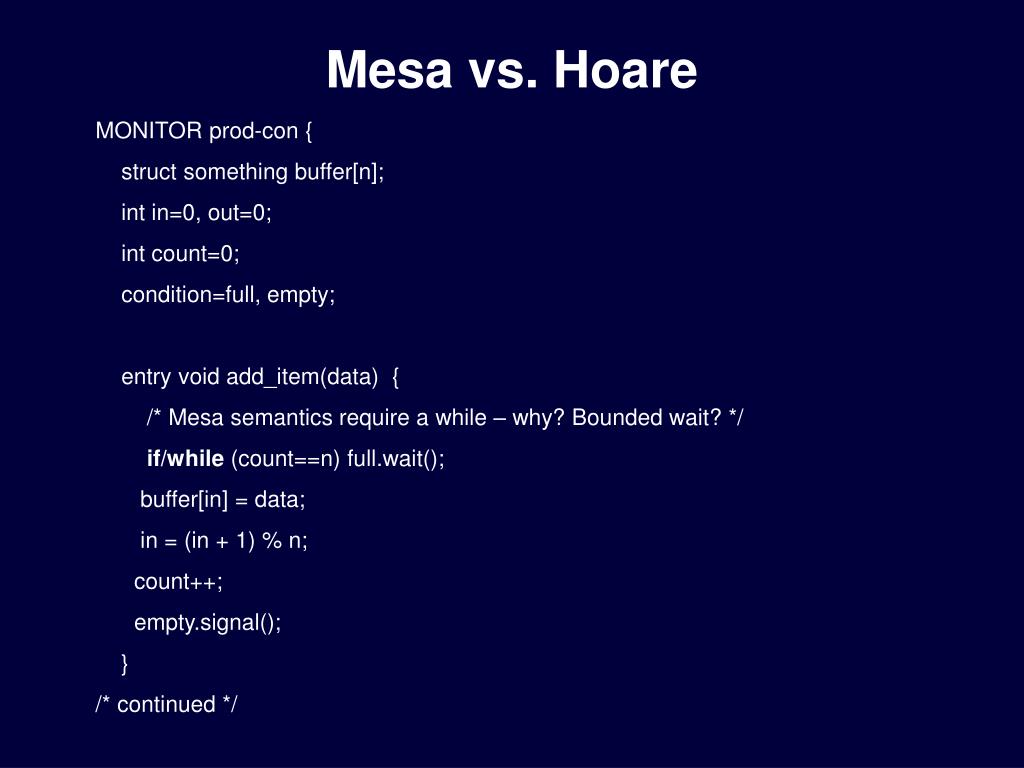
The behavior we've observed is known as Mesa semantics. It means a signal is just a hint that the state of the world may have changed in a way that's favorable to the waiting thread. It is not a guarantee. The woken thread is responsible for re-checking the state to confirm the condition is truly met. The while loop is the mechanism for this re-check.
The following reading explains this principle and shows the corrected code.
The OSTEP text also provides the fix and the theory behind it. This section introduces 'Mesa semantics' and shows how the while loop correctly implements this model.
Read the sections 'Mesa versus Hoare Semantics', 'Better, But Still Broken: While, Not If', and the 'TIP: USE WHILE (NOT IF) FOR CONDITIONS' (pages 9-14). This will solidify your understanding that a signal is just a hint and that the while loop is the standard, safe way to handle this.
The Second Reason: Spurious Wakeups
As if the race condition wasn't enough, there's a second, more esoteric reason for the while loop. The POSIX standard allows pthread_cond_wait to return even if no thread ever called signal or broadcast.
Why is this allowed? In some OS implementations, it's more performant for the kernel to occasionally wake a thread spuriously than to implement the complex logic required to prevent it 100% of the time.
For you as a programmer, the implication is simple: you can never assume that waking from pthread_cond_wait means the condition you're waiting for has been met. The while loop handles spurious wakeups automatically and robustly, as the thread will simply check the condition, find it false, and go back to sleep.
Parallel Programming - CS 3410
This point about spurious wakeups is a formal part of the pthreads specification. Let's see it mentioned in another clear, concise source.
From the Cornell CS notes, read the 'Condition Variables' section. Pay attention to the paragraph starting with 'The specification for pthread_cond_wait allows for spurious wakeups...'. It explicitly states this possibility and reinforces that the while loop is the correct way to handle it.
Seeing the Pattern in Action
Let's watch a video segment that puts this all together in a running program.
Returning to the CodeVault 'Condition variables in C' video, the presenter's code naturally uses the wait-in-a-loop pattern. He walks through the execution flow, showing how a thread can wake up and go back to sleep multiple times.
Please watch from 12:42 to 15:08. Observe how the car thread checks the while (fuel < 40) condition after each wakeup. It is signaled multiple times by the fuel_filling thread, but only proceeds after the condition is finally true. This is the wait-in-a-loop pattern in action.
Test your understanding!
A developer is building a thread-safe logger. Multiple threads can call log_message(), which adds a message to a queue. A single, dedicated writer_thread consumes messages from this queue and writes them to a file.
The writer_thread contains the following (buggy) code:
void* writer_thread(void* arg) {
    while (1) {
        pthread_mutex_lock(&queue_mutex);
        if (queue_is_empty(&log_queue)) {
            // Wait for a signal that a message has been added
            pthread_cond_wait(&queue_cond, &queue_mutex);
        }
        // This call will crash if the queue is empty!
        char* msg = queue_pop(&log_queue);
        pthread_mutex_unlock(&queue_mutex);

        write_to_file(msg);
        free(msg);
    }
    return NULL;
}
Describe a plausible sequence of events that would cause this program to crash due to a spurious wakeup.
Show answer
Here is a plausible sequence of events:
- The
writer_threadstarts, locks the mutex, and finds the queue is empty. It callspthread_cond_waitand goes to sleep. - No other threads add any messages. No call to
pthread_cond_signalis ever made. - Due to a spurious wakeup, the
writer_threadwakes up and returns frompthread_cond_wait. - Because it's in an
ifblock, it does not re-check if the queue is empty. It proceeds to the next line. - It calls
queue_pop(&log_queue)on a queue that is still empty. - The
queue_popfunction likely tries to dereference aNULLpointer or access an invalid memory location, causing the program to crash.
Changing if (queue_is_empty(...)) to while (queue_is_empty(...)) would fix this bug completely. In the event of a spurious wakeup, the thread would re-check the condition, find the queue is still empty, and go back to sleep safely.
Conclusion
Today we've solidified one of the most important patterns in concurrent programming. The "wait-in-a-loop" pattern is not a suggestion; it is a requirement for writing robust, correct multithreaded code with condition variables.
Key Takeaways:
- Always wrap
pthread_cond_waitin awhileloop that checks the condition you are waiting for. - This pattern protects against race conditions where another thread changes the state after you are signaled but before you run (an "intercepted wakeup").
- It also protects against spurious wakeups, where the system wakes your thread without any signal having been sent.
- This approach correctly implements Mesa semantics, where a signal is only a hint, and the woken thread is responsible for re-validating the program's state.
Preview of the Next Lesson:
What if a thread can't afford to wait forever? In our next lesson, we will explore pthread_cond_timedwait. This function allows a thread to wait on a condition but give up after a specified amount of time, a crucial feature for building responsive and fault-tolerant systems.