Introduction
Hello! In our last lesson, we covered how to answer yes/no questions with はい (hai) and いいえ (iie). We ended with a practical scenario: a helpful local asks you, "You don't understand Japanese, right?" (Nihongo wa wakarimasen ne?), and you correctly reply, "はい、わかりません (Hai, wakarimasen)" to agree with their statement.
That exchange is the perfect starting point for today's lesson. We are going to officially learn two of the most critical phrases for any traveler: how to state that you don't understand and how to ask for help in English. These are your essential "escape hatches" for when communication gets difficult.
By the end of this 30-minute lesson, you'll be able to confidently say "I don't understand" and politely ask "Do you speak English?", ensuring you can navigate language barriers during your trip.
Your Go-To Phrase: "I don't understand"
When someone is speaking to you in Japanese and you can't follow along, your first and most important tool is the phrase わかりません (wakarimasen).
わかりません (Wakarimasen) - "I don't understand."
This is a polite and direct way to signal that you are having trouble. In your IT work, you might think of this as a try-catch block for communication; when you encounter a "language exception," wakarimasen is the first step in handling it gracefully.
Using this phrase is not seen as a weakness. In fact, it's often appreciated as an honest signal that the other person should slow down or try a different approach.
To understand the cultural nuances and practical applications of this phrase, please read the following section from an article we've used before.
15 Essential Japanese Phrases for Tourists - AA Japan Tours
The article '15 Essential Japanese Phrases for Tourists' from AA Japan Tours has an excellent section on wakarimasen that explains its politeness and how people are likely to respond.
Please read section 13, titled 'Wakarimasen (分かりません) – I Don’t Understand'. Pay close attention to the 'Why It’s Handy' and 'Cultural Insight' parts, which explain how this simple phrase can lead to more help.
As the article suggests, you can make it even more polite by adding Sumimasen (which we learned means "excuse me" or "sorry") at the beginning:
すみません、わかりません。 (Sumimasen, wakarimasen.) - "Excuse me, I don't understand."
Asking for Help: "Do you speak English?"
After you've established that you don't understand, the logical next step is to see if you can switch to a language you both know. This is where your second key phrase comes in.
えいご を はなせます か? (Eigo o hanasemasu ka?) - "Do you speak English?"
Let's quickly break this down:
- えいご (Eigo): English language
- を (o): The object particle, marking "English" as the thing being spoken.
- はなせます (hanasemasu): "can speak" (the polite form)
- か (ka): The question marker
It is considered very polite to ask this before simply starting to speak English. It shows consideration and respect.
The same article provides excellent context for this phrase as well.
15 Essential Japanese Phrases for Tourists - AA Japan Tours
Let's return to the AA Japan Tours article to learn more about asking for help in English.
Now, please read section 11, titled 'Eigo wa hanasemasu ka? (英語は話せますか?) – Do You Speak English?'. Focus on the advice to add 'Sumimasen' at the beginning to be extra polite.
Note: The article uses the particle は (wa) instead of を (o). Both Eigo o hanasemasu ka? and Eigo wa hanasemasu ka? are correct and understood. We'll stick with o for now as it's more grammatically standard for this pattern, but be prepared to hear both.
Putting It All Together: A Practical Sequence
Now, let's combine these phrases into a logical sequence you can memorize for your trip.
Situation: Someone at a train station gives you directions, but they speak too quickly for you to understand.
-
Get their attention politely and state the problem:
すみません、わかりません。
(Sumimasen, wakarimasen.)
"Excuse me, I don't understand." -
Ask if you can switch to English:
えいご を はなせます か?
(Eigo o hanasemasu ka?)
"Do you speak English?"
This two-step process is a clear, polite, and highly effective way to handle a language barrier.
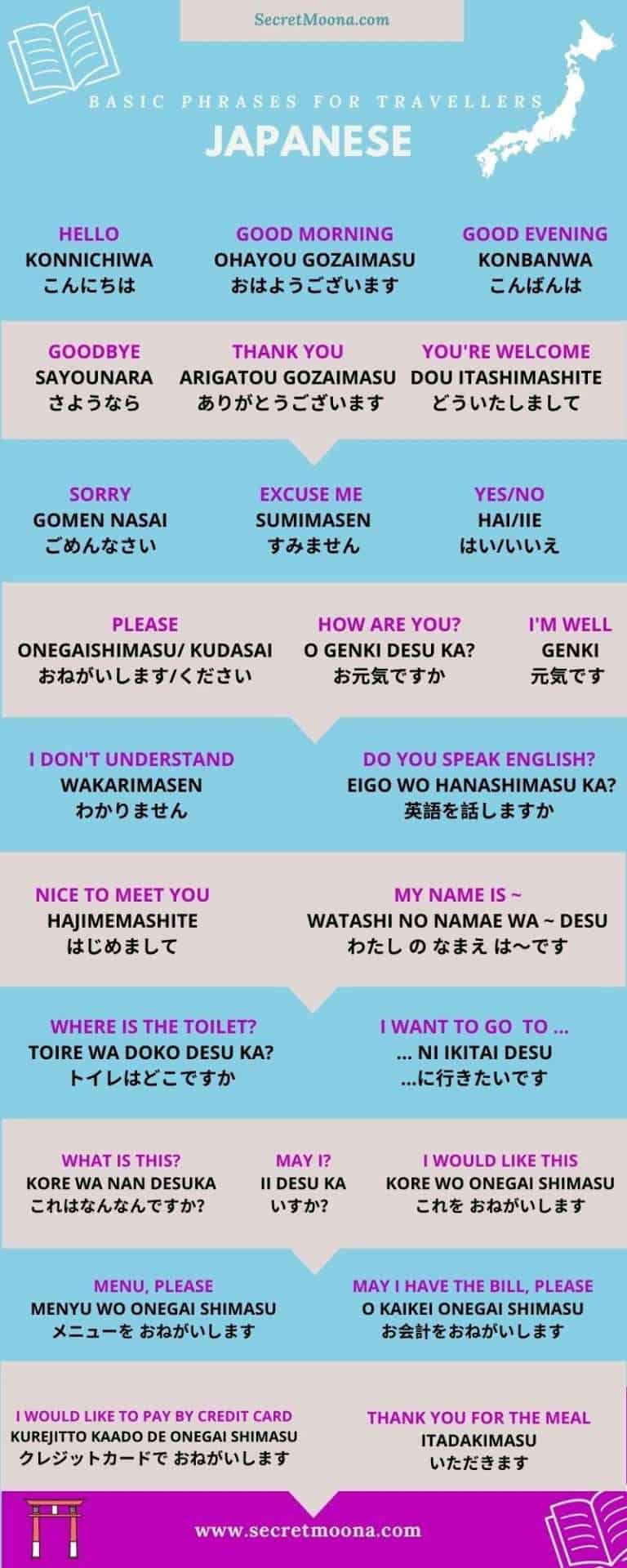
Here is a helpful infographic that includes both of the phrases we learned today. You can use it as a quick visual reminder.
Another Useful Phrase: "One More Time, Please"
Sometimes, you almost understand and just need the person to repeat themselves, perhaps a bit more slowly. In this case, instead of saying you don't understand, you can use another helpful phrase.
もう いちど おねがいします。 (Mou ichido onegaishimasu.) - "One more time, please."
- もう いちど (Mou ichido): "one more time"
- おねがいします (onegaishimasu): "please" (our versatile request phrase)
This is a great alternative to use when you feel like you're on the verge of understanding.
Conclusion
Excellent work today. You've just learned the two most important phrases for navigating communication difficulties. Knowing how to politely signal that you're lost is just as valuable as knowing how to ask for what you want.
Key Takeaways:
- To state you don't understand, use わかりません (wakarimasen).
- To ask if someone speaks English, use えいご を はなせます か? (Eigo o hanasemasu ka?).
- A polite and effective sequence is: 「すみません、わかりません。えいご を はなせます か?」 (Sumimasen, wakarimasen. Eigo o hanasemasu ka?).
- If you just need something repeated, use もう いちど おねがいします (Mou ichido onegaishimasu).
Preview of the next lesson:
Now that we've finished building our foundation of essential phrase patterns, we can start applying them to specific, real-world travel scenarios. In our next lesson, we will move into the "Dining and Ordering Food" module and begin with the very first step of eating out: walking into a restaurant and requesting a table for your party.