Introduction
Welcome back! In our previous lesson, you learned how to read the essential signs for 営業中 (eigyōchū - Open) and 準備中 (junbichū - Closed/Preparing). Now that you know how to tell if a store is open and you've picked out your items, the final step is paying at the cashier.
This lesson will teach you how to indicate your preferred payment method. We will focus on one of the most useful "plug-and-play" phrases for travelers: [Method] de onegaishimasu. By the end of this lesson, you will be able to confidently state whether you're paying with cash, a credit card, or an electronic travel card.
The Key Phrase: ... de onegaishimasu
When you're at the register and ready to pay, you can tell the cashier how you want to pay using a simple pattern.
- Pattern:
[Payment Method]+で (de)+お願いします (onegaishimasu) - Meaning: "By [Payment Method], please."
You may recall the phrase onegaishimasu from our earlier lessons on making polite requests. Here, it works in a similar way. The particle で (de) is used to indicate the means or method by which you are doing something—in this case, paying.
Core Payment Vocabulary
To use this pattern, you first need to know the words for common payment methods. The following article from Coto Japanese Academy introduces the core phrase and provides a helpful vocabulary list.
Japanese Shopping Phrases: Make Your Payment Smooth
This article, 'Japanese Shopping Phrases: Make Your Payment Smooth', introduces the essential pattern for payments and lists the Japanese words for cash, credit cards, and more.
Please read the section 'Payment Methods and Corresponding Phrases'. Focus on the 'Vocabulary Table' to learn the words for 'Cash', 'Credit Card', 'Debit Card', and 'IC Card'. Note the pattern introduced just above the table: '(Payment method) de onegai shimasu'.
Based on the reading, here are the most important terms to remember:
| English | Japanese (Katakana/Kanji) | Romaji |
|---|---|---|
| Cash | 現金 | genkin |
| Credit Card | クレジットカード | kurejitto kādo |
| IC Card | ICカード | ai shii kādo |
A quick note on "credit card": While クレジットカード (kurejitto kādo) is the full term, in conversation it is almost always shortened to just カード (kādo).
Putting It All Together: Example Phrases
Now, let's combine the vocabulary with our pattern.
-
To pay with cash:
現金でお願いします
(Genkin de onegaishimasu) -
To pay with a credit card:
カードでお願いします
(Kādo de onegaishimasu) -
To pay with a transportation IC card (like Suica or Pasmo):
ICカードでお願いします
(Ai shii kādo de onegaishimasu)
You can also name the specific card, for example:Suicaでお願いします (Suika de onegaishimasu).
Recognizing Payment Options in Stores
How do you know which payment methods a store accepts? Most stores display logos of accepted payment methods near the entrance or at the cash register. Given your IT background, you'll recognize many of these systems immediately.
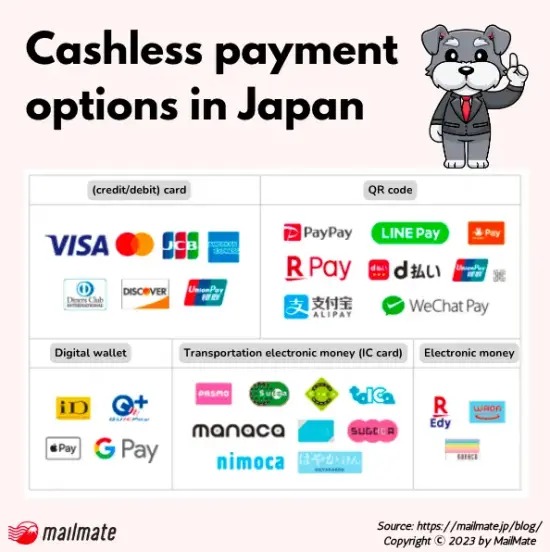
As you can see, major credit cards like Visa and Mastercard are widely accepted. You'll also see options for "Transportation electronic money" like Suica, which you will likely use for train travel, and "QR code" payments.

The sign on the right says こちらのバーコードを読み込んでください (kochira no bākōdo o yomikonde kudasai), which means "Please scan this barcode." You don't need to read the Japanese, but seeing the QR code is a clear signal that this type of payment is an option.
Practice Scenarios
Let's practice. Imagine you are at the cashier. How would you say the following?
- You want to pay with your credit card.
(Your answer should be:カードでお願いします- Kādo de onegaishimasu)
- You are buying a drink from a vending machine at a train station and want to use your Suica card.
(Your answer should be:Suicaでお願いします- Suika de onegaishimasu)
- You are at a small food stall at a market and decide to pay with cash.
(Your answer should be:現金でお願いします- Genkin de onegaishimasu)
This single phrase is incredibly versatile and will serve you well in almost any shopping situation.
Conclusion
Excellent work. You can now handle one of the most important interactions in any transaction: stating how you want to pay.
Key Takeaways:
- The essential phrase to indicate your payment method is
[Method] de onegaishimasu. - The most common payment vocabulary words are
現金 (genkin)for cash,カード (kādo)for credit card, andICカード (ai shii kādo)for electronic travel cards. - Keep an eye out for logos of payment systems near the register to know what's accepted before you pay.
Preview of the next lesson:
You've successfully paid for your item, but the interaction isn't over yet! The cashier will often ask a couple of final questions, such as "Do you need a bag?" (袋は要りますか? - Fukuro wa irimasu ka?) or "Do you need a receipt?" (レシートは? - Reshiito wa?). In our next lesson, we'll learn how to understand and respond to these common questions to complete your transaction smoothly.