Introduction
Welcome back! In our last lesson, you learned how to navigate one of the most essential public facilities by identifying restrooms and distinguishing between the kanji for male (男) and female (女).
Continuing our focus on reading signs for your trip, this lesson tackles two of the most important kanji for safety and awareness: 禁止 (kinshi), meaning "prohibition," and 注意 (chūi), meaning "caution." Understanding these will help you know what activities are forbidden and what potential hazards to watch out for, from train platforms to public parks. By the end of this lesson, you'll be able to spot and interpret these critical warnings.
1. Prohibition vs. Caution: The Two Key Warnings
In Japan, signs that warn you or forbid an action are very common. They are often marked with bright colors like red or yellow and sometimes include universal symbols. However, knowing the kanji is essential for situations where only text is used. The two most fundamental words you'll see are 禁止 (kinshi) and 注意 (chūi).
Let's look at them side-by-side.
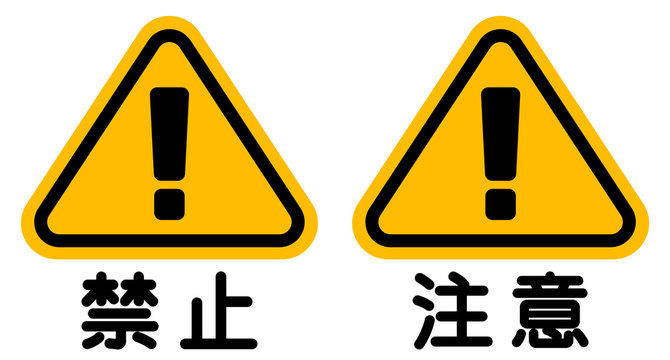
- 禁止 (kinshi) tells you that something is not allowed. It's a direct command: "Don't do this."
- 注意 (chūi) tells you to be careful or beware. It's a warning about a potential danger or something that requires your attention.
To get a quick overview, please read the "Cautionary Kanji" section from the following resource.
The Most Useful Kanji for Tourists Traveling in Japan
This article from The True Japan provides a concise list of useful kanji for tourists. We will focus on the section that introduces our key vocabulary for today.
Please read the short section titled 'Cautionary Kanji'. It introduces 禁止 (Kinshi) and 注意 (Chuu-i) and gives a brief explanation of their use.
2. Understanding Prohibition: 禁止 (kinshi)
The word 禁止 (kinshi) combines two kanji:
- 禁 (kin): to forbid
- 止 (shi): to stop (this kanji is a pictogram of a foot, representing stopping)
Together, they form a very clear meaning: "forbidden to stop" or more naturally, just "prohibited."
On signs, you will almost always see 禁止 placed after a noun or verb that describes the forbidden action. The pattern is: [Action] + 禁止.
Now, let's explore some real-world examples. The following resource is a photo gallery of warning signs in Japan. It's a perfect way to see how these kanji appear in their natural environment.
This photo guide by Philbert Ono contains numerous examples of real warning signs from all over Japan. It's an excellent tool for practicing your reading skills in a practical context.
Please browse through the first part of this photo gallery, from the beginning down to the 'No Bicycle/Motorcycle Parking' sign. As you look at the images, try to spot the word 禁止 and see if you can understand what is being prohibited based on the context, pictures, or other words.
After reviewing the gallery, you likely noticed several recurring patterns. Here are a few of the most common "prohibition" signs you'll encounter:
- 立入禁止 (tachiiri kinshi): No Entry / Keep Out. (You saw this in the "Danger, Keep Out" sign).
- 撮影禁止 (satsuei kinshi): No Photography.
- 駐車禁止 (chūsha kinshi) / 駐輪禁止 (chūrin kinshi): No Parking (for cars / for bicycles).
- 遊泳禁止 (yūei kinshi): No Swimming.
The key takeaway is to train your eye to spot the 禁止 characters. Even if you don't know the word in front of it, seeing 禁止 tells you immediately that something is not allowed here.
You might also see 厳禁 (genkin), which is a stronger form meaning "Strictly Prohibited." For example, 土足厳禁 (dosoku genkin) means "Taking off shoes is strictly required" (literally "Dirty feet strictly prohibited").
3. Understanding Caution: 注意 (chūi)
Now for our second key term, 注意 (chūi). This word tells you to pay attention. It's a warning, not a prohibition.
Let's break down the kanji:
- 注 (chū): to pour (in this context, to pour or direct your attention).
- 意 (i): mind, attention (this character combines 音 - sound and 心 - heart/mind, suggesting the "sound of the mind").
Together, they mean "to direct one's mind" or simply "caution/attention."
The pattern for caution signs is often: [Thing to be cautious of] + に/ご + 注意. The small characters に (ni) or ご (go) are particles or prefixes you can ignore for now; the important part is recognizing the noun followed by 注意.
Here is a very common example you might see on stairs or uneven ground.

Now, let's return to the photo gallery to see more examples of 注意 in action.
Let's look at the same photo gallery again, this time focusing on signs with the word 'chūi'.
Please look at the photos from 'Beware of Habu Snakes' down to 'Beware of Flashers!'. Focus on finding the word 注意 (chūi) on each sign and notice what hazard it's warning you about.
From the gallery, you saw several useful examples:
- ハブに注意 (habu ni chūi): Beware of Habu Snakes.
- 野生の猿にご注意 (yasei no saru ni go-chūi): Beware of Wild Monkeys.
Just like with 禁止, the key is to recognize the 注意 kanji. When you see it, you know to be alert and aware of your surroundings for a potential hazard, whether it's a slippery floor, a wild animal, or a low ceiling.
Conclusion
Great work today! You've just learned to read two of the most critical safety-related words you'll see on signs in Japan. Being able to distinguish between a prohibition and a caution is a vital skill that will help you navigate your trip safely and respectfully.
Key Takeaways:
- 禁止 (kinshi) means Prohibited. It tells you what you cannot do. The pattern is often
[Action] + 禁止. - 注意 (chūi) means Caution or Warning. It tells you what to be careful of. The pattern is often
[Hazard] + 注意. - Look for these words in red or yellow on signs, but be prepared to recognize them based on the kanji alone.
Preview of the next lesson:
In this lesson, we saw that the first kanji in 禁止, 禁 (kin), means "to forbid." This single character is often used to create other prohibition-related words. In our next lesson, we will leverage this knowledge to learn how to read two more very common signs: 禁煙 (kin'en) for "no smoking" and 非常口 (hijōguchi) for "emergency exit."