Introduction
Welcome to our final lesson! In our previous session, we covered how to get connected by asking for Wi-Fi access, another key phrase for your hotel stay. You learned how to ask "Is there Wi-Fi?" (Wi-Fi wa arimasu ka?) and how to request the password (Pasuwaado o oshiete kudasai).
Today, we'll complete your set of essential hotel phrases by learning how to check out. This is a simple but necessary interaction for a smooth departure. The phrase for this follows a pattern you are very familiar with, making it easy to learn and remember.
This lesson marks the last new piece of content in our course. We will conclude with a brief review of everything you've learned to prepare you for your trip to Japan.
1. The Check-Out Phrase
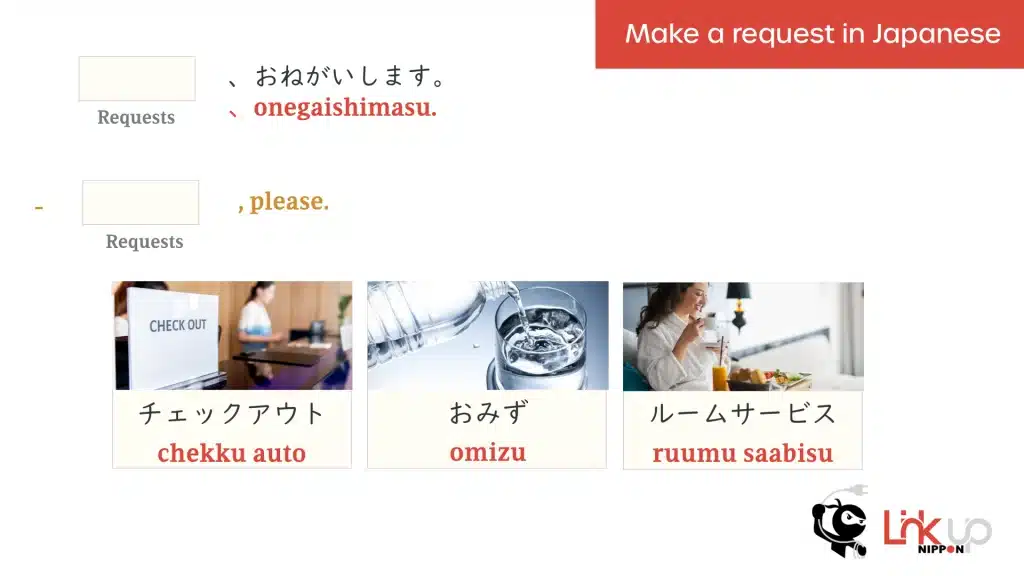
Checking out of a hotel in Japan is typically a very efficient process. The key is knowing the single phrase to initiate it. You'll be using the polite request pattern ...o onegaishimasu, which you've already mastered for ordering food and asking for amenities.
The phrase is:チェックアウト を お願いします。Chekkuauto o onegaishimasu.
"I'd like to check out, please."
Let's break it down:
Chekkuauto(チェックアウト): This is the Japanese word for "check out," borrowed directly from English and written in katakana.o onegaishimasu(をお願いします): The polite request pattern meaning "..., please."
This image provides a great visual reminder of how this pattern works for various requests, including checking out.
The following resource provides a clear, concise explanation of the check-out process and the main phrase.
Essential Japanese for a Smooth Hotel Stay
The article 'Essential Japanese for a Smooth Hotel Stay' by Speakable Japanese has a perfect section on this topic. It gives you the exact phrase and what to expect from the hotel staff.
Please read section '4. Checking Out (チェックアウト - Chekku-auto)'. Pay attention to the main phrase and the staff's typical reply.
2. The Check-Out Conversation
As you just read, the conversation is usually very short. You approach the front desk, say the phrase, and hand over your room key.
The word for "key" is kagi (鍵). While you don't necessarily need to say it, it's a useful word to recognize.
Let's look at the sample dialogue from the article again:
You:チェックアウトをお願いします。
(Chekku-auto o onegaishimasu.)
"I'd like to check out, please."
(You hand your room key (kagi) to the staff.)
Staff:はい、結構です。ありがとうございました。
(Hai, kekkō desu. Arigatou gozaimashita.)
"Yes, that's all. Thank you very much."
A couple of points about the staff's reply:
Kekkō desu(結構です) is a useful phrase that means "That's fine," or "No, thank you," depending on the context. Here, it means everything is settled.Arigatou gozaimashita(ありがとうございました) is the past tense ofarigatou gozaimasu. It's used to thank someone for a service that has been completed. You can use this yourself when leaving a restaurant or shop.
This next image provides another clear summary of the check-out phrase, along with other hotel-related expressions.

3. A Related Request: Storing Luggage
A common situation is wanting to explore the city for a few hours after you've checked out but before you head to the airport. In this case, you can ask the hotel to hold your luggage.
This phrase is a bit more complex, so it's best treated as a fixed expression to memorize.
10 Japanese Phrases You Can Use At A Hotel
The MATCHA article '10 Japanese Phrases You Can Use At A Hotel' includes this useful request in its section on checking out.
Please find the heading 'Checking Out' within the article and read the part that introduces the phrase 'Nimotsu wa azuke raremasuka?'.
As you saw, the phrase is:荷物は預けられますか?Nimotsu wa azuke raremasuka?
"Can I leave my bags here?"
Nimotsu(荷物) means "luggage" or "bags."
This is an extremely useful phrase for your last day in a city.
Conclusion and Course Wrap-Up
In this brief lesson, you learned the final key phrase for your hotel stay: how to check out smoothly and efficiently.
Key Takeaways:
- To check out, use the simple phrase:
Chekkuauto o onegaishimasu. - The staff will likely reply with
Hai, kekkō desu, confirming everything is in order. - To ask to store your luggage after check-out, use the fixed phrase:
Nimotsu wa azuke raremasuka?
Congratulations on completing the course!
When you started, you were a complete beginner. Now, in just a few months, you have built a practical foundation for your trip to Japan.
Let's quickly recap what you've accomplished:
- You can pronounce Japanese sounds and use essential greetings and politeness phrases.
- You can read hiragana and katakana, which will be invaluable for deciphering menus, signs, and station names. You also learned to recognize crucial kanji for navigation and safety.
- You have mastered several "plug-and-play" phrase patterns, including:
- Asking where things are:
...wa doko desu ka? - Asking if things are available:
...wa arimasu ka? - Requesting items:
...o kudasai / ...o onegaishimasu
- Asking where things are:
- You have specific, actionable phrases for key travel situations: dining, shopping, navigating public transport, and staying in a hotel.
You have focused on exactly what you need for a practical, enjoyable trip. Don't worry about being perfect. Your efforts to speak Japanese will be noticed and appreciated. Review these lessons, practice the phrases out loud, and get ready for an incredible experience.
I wish you a fantastic and memorable trip to Japan.
さようなら!(Sayounara!)