Introduction
Hello! In our last lesson, you mastered the pattern [Item] o onegaishimasu to politely ask for things you need at a hotel, like a towel or a taxi. This is a powerful phrase, but it's most effective once you have someone's attention.
This lesson focuses on that crucial first step: how to politely get someone's attention in the first place. We'll be learning one of the most versatile and essential words in Japanese: sumimasen (すみません). By the end of this lesson, you'll know how and when to use sumimasen to get help from a waiter, ask a stranger for assistance, or alert someone—a fundamental skill for navigating Japan.
1. The "Swiss Army Knife" of Japanese: Sumimasen
Most beginners learn that sumimasen means "excuse me" or "I'm sorry." While true, this barely scratches the surface. It's a multipurpose word used for apologizing, thanking, and, most importantly for our purpose today, getting someone's attention.
To get a feel for its versatility, let's start with a short article that illustrates this with a great real-world story.
Sorry for Saying Thank You: The Many Uses Of Sumimasen
The Tofugu article 'Sorry for Saying Thank You' opens with a perfect story about someone dropping their wallet. Notice how 'sumimasen' is used twice, with two different meanings.
Please read the introduction of the article, starting from 'Imagine yourself on the city streets of Japan' down to the paragraph that ends with '...an expression so important to the Japanese language and culture.'
As you saw in the story:
- The first
Sumimasen!was used to get the woman's attention ("Excuse me!"). - The second
Ah! Sumimasen!was used to express a mix of apology for the trouble and thanks for returning the wallet ("Oh! Thank you / I'm sorry for the trouble.").
This demonstrates how context is key. The image below provides a great visual summary of these different uses.
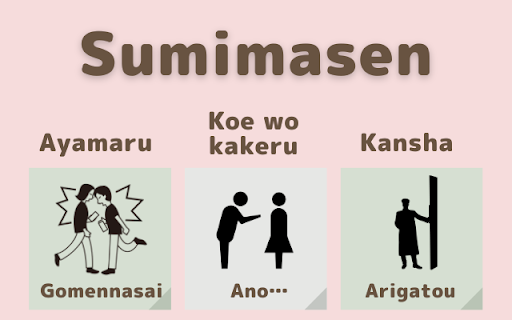
For your trip, the most practical and frequent use of sumimasen will be for getting attention.
2. How to Use Sumimasen to Get Attention
Using sumimasen is the standard, polite way to initiate a conversation with a stranger or get service. It's the equivalent of saying "Excuse me..." before you ask a question or make a request.
Let's look at a resource that explains this specific function very clearly.
Sorry for Saying Thank You: The Many Uses Of Sumimasen
The same Tofugu article has a section dedicated to this exact use case. It confirms that this is the polite way to interact with strangers.
Please read the short section titled '4. Getting Attention.'
Now, let's explore the most common travel situations where you'll need this. Another resource offers some very practical, down-to-earth advice.
Sumimasen - 7 Ways Of Your New Favorite Simple Japanese Word
The article from Kristen Abroad gives memorable, real-world examples for travelers, especially about using 'sumimasen' in restaurants.
Please read section '3. Making a request with sumimasen' and section '4. Sumi-ing at Restaurants and other “getting attention” uses'. Pay close attention to the advice about getting a waiter's attention.
Based on those readings, here are the key scenarios for your trip:
-
In a restaurant or cafe: This is where you'll use it most. Unlike in many Western countries, waitstaff in Japan will generally not approach your table unless called. To get service—to order, ask for water, or get the bill—you need to catch their attention by calling out
Sumimasen!. Don't be shy; it's normal to say it loud enough to be heard across a moderately noisy room. -
When asking for directions: Before you use a phrase like
駅はどこですか(Eki wa doko desu ka? - Where is the station?), you first need to politely get a stranger's attention. Approach them and start with a clearSumimasen... -
In a store: If you need help from a store clerk who is busy or not nearby, a simple
Sumimasenwill get their attention so you can ask your question (e.g.,... wa arimasu ka?- Do you have...?).
3. Practice: Combining Your Phrases
Now, let's connect today's lesson with what you've learned previously. The pattern is simple:
Step 1: Get attention with Sumimasen!.
Step 2: Make your request (e.g., ... o onegaishimasu).
Let's try a few scenarios.
Scenario 1: At a Cafe
You're seated and ready to order. The waiter is attending to another table. How do you get their attention and then ask for the menu?
- (Take a moment to think about the two steps.)
Answer:
- Call out:
すみません!(Sumimasen!) - When they approach, say:
メニューをお願いします。(Menyū o onegaishimasu.)
Scenario 2: At the Hotel
You're at the front desk, but the clerk is on the phone. You need to ask them to call a taxi for you. How would you do it?
- (Think about the two steps.)
Answer:
- Wait for a brief pause and say politely:
すみません...(Sumimasen...) - When they are available, say:
タクシーをお願いします。(Takushī o onegaishimasu.)
You can see how sumimasen acts as the perfect opening for all the useful request patterns you're learning.
Conclusion
In this lesson, you've unlocked one of the most crucial tools for interacting in Japan. While sumimasen has several meanings, its function as an attention-getter is indispensable for a traveler.
Key Takeaways:
Sumimasen(すみません) is your go-to phrase for politely getting someone's attention.- Use it confidently in restaurants to call for service. It is expected and not considered rude.
- Use it to initiate a conversation with anyone you need help from, whether it's a store clerk or a person on the street.
- The typical interaction pattern is:
Sumimasen!-> (wait for acknowledgement) -> Make your request.
Preview of the next lesson:
You now know how to use sumimasen for everyday, non-urgent help. But what if you find yourself in a genuine emergency? It's critical to know the difference between "Excuse me" and "Help me!" In our next lesson, we will cover the phrase tasukete kudasai (助けてください) and clarify exactly when—and when not—to use it.