Hello. Last time, you practised a gentle breathing rhythm as one way to steady yourself when stress rises. Breathing may ease the physical intensity of a moment, but it cannot tell you whether the conclusions running through your mind are accurate. This lesson adds a second skill: reframing a stress-amplifying thought into an alternative you can believe without denying the problem.
Allow about 35–40 minutes, including the short video, reading, and a few minutes of private written practice.
A thought can feel like a fact
Imagine receiving a message that says, “The totals in the report don’t match. Please correct them before tomorrow’s review.” The mismatch and the deadline are facts. “I’ve ruined everything; everyone will think I’m incompetent” is an interpretation of those facts. It might arrive so quickly that it feels like part of the message itself.
That distinction matters. The error needs attention, whether or not you reframe the thought. But the leap from there is an error to everyone will judge me may add stress without helping you correct it. Reframing does not mean declaring the situation harmless. It means giving the known facts and the unknowns their proper places.
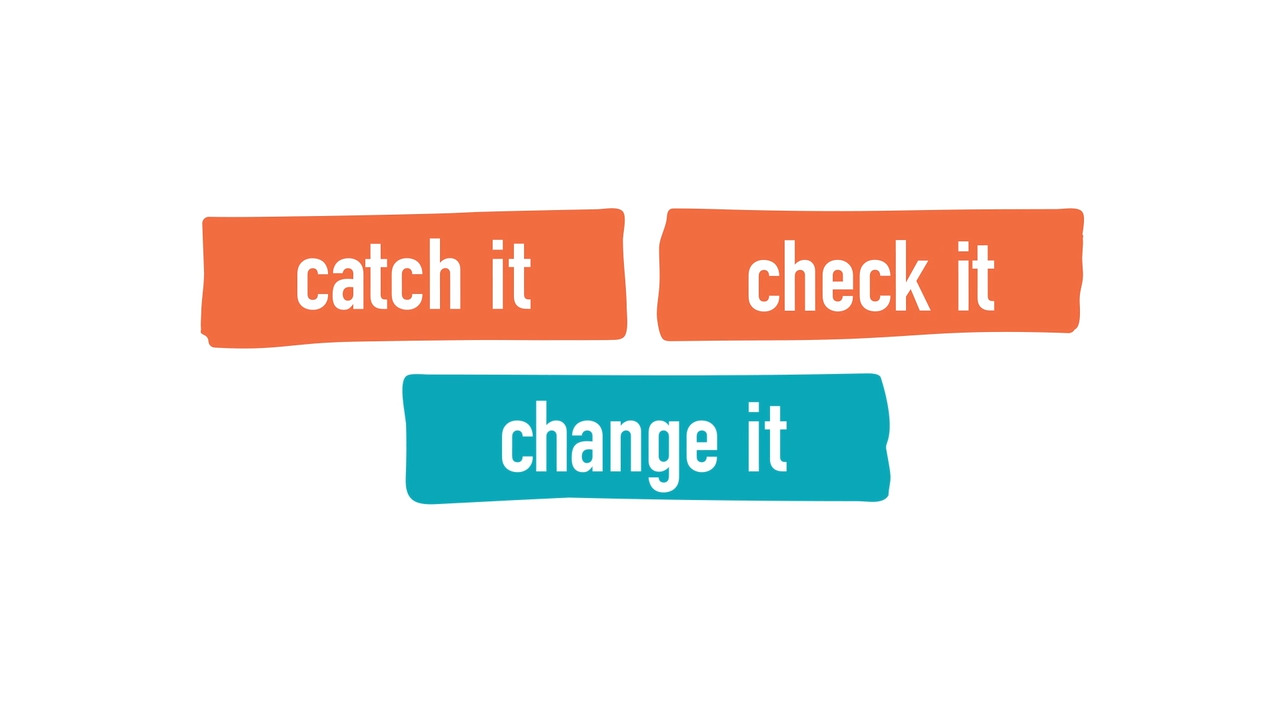
The NHS calls this approach “catch it, check it, change it.” The three phrases in the image are a reminder to notice the thought before treating it as a verdict.
CBT techniques to challenge unhelpful thoughts | Bupa Health
Watch “CBT techniques to challenge unhelpful thoughts” from Bupa Health for a concise demonstration of examining a thought against evidence.
Watch the full explanation. Notice the difference between recording what happened, identifying the exact thought, checking evidence, and forming a more measured view. The final check of emotional intensity is an observation, not a requirement to feel better.
The NHS reading gives you signs that a thought may be amplifying stress, such as assuming the worst or treating a situation as entirely good or entirely bad. These are clues to check a thought, not labels proving it false.
Reframing unhelpful thoughts - Every Mind Matters - NHS
Read the NHS Every Mind Matters guide for its practical “catch” and “check” steps.
Under “Steps and strategies to help you reframe unhelpful thoughts,” read “1. Know what to look for” and “2. Practise catching them,” from spotting patterns. Then, under “3. Check your unhelpful thoughts,” read from examining evidence. Focus on how the questions distinguish a likely outcome from one that merely feels certain.
Build an alternative that keeps the difficult part
Return to the report message. A useful check would separate three things:
- Evidence supporting concern: The totals do not match, and a correction is needed before the review.
- What has not been established: The message does not say that the whole report is unusable or that everyone has lost confidence.
- What remains possible: The size of the error is not yet known; checking the figures will provide better information.
A forced-positive replacement—“It’s fine; nobody will care”—dismisses the deadline and claims knowledge you do not have. A balanced replacement might be:
“The totals don’t match, and I need to find and correct the error before tomorrow’s review. I don’t yet know how much of the report it affects or what anyone thinks of me. I can check the figures and communicate what I find.”
This thought does not promise a good outcome. It acknowledges the task, leaves uncertainty as uncertainty, and makes an appropriate next action visible.
The same principle applies when the feared event has happened. If you missed a deadline, “I didn’t miss it” is not a reframe. “I missed the deadline, and that may cause problems. I can give an accurate update and find out what needs attention first” is more credible. A balanced thought can be uncomfortable and still be useful.
Reframing unhelpful thoughts - Every Mind Matters - NHS
Return to the NHS guide for the “change” step and its important reminder that changing a thought is not always possible.
Under “4. Change them,” begin at the change step, reading through “5. Use a thought record to help.” Then read “6. Don’t worry if you cannot change a thought,” from the reassurance. Notice that a neutral thought is enough and that the skill is useful even when the original thought does not immediately shift.
A brief way to practise
Set aside 5–7 minutes with a low-stakes example from your own day or a fictional one, such as a friend not replying to a message. Make four short notes:
- Situation: Record only what could be observed: “I sent a message yesterday and have not received a reply.”
- Automatic thought: Use the words that appeared in your mind: “They’re avoiding me.”
- Check: Note any evidence for that interpretation, what remains unknown, and at least one other plausible explanation. An alternative is a possibility, not a new fact.
- Balanced thought: Write one or two sentences that preserve what is known: “I haven’t had a reply, and I don’t know why. It may have nothing to do with me. I can leave time for a response or follow up once if needed.”
There is no need to persuade yourself that the most reassuring explanation is true. If you cannot find a convincing alternative, “I don’t know yet” may be the most accurate reframe available.
Reframing is also not a substitute for responding to a real problem. If the evidence points to a mistake to correct, a boundary to set, or a safety concern to address, take that evidence seriously. When you are too agitated to examine a thought, you can pause and return to it later; the gentle breathing you practised previously is one option if it feels comfortable. You do not have to argue with yourself at the peak of stress.
Key takeaways
Catch the precise thought, check it against evidence and uncertainty, then change it only as far as the facts allow. A balanced alternative can acknowledge a genuine difficulty without turning an uncertain outcome into a certainty or demanding that you feel positive. Next, you will add a brief, adaptable movement break to your set of stress responses.