In our last lesson, we surveyed the landscape of the Java Collections Framework, getting to know the core interfaces: List, Set, and Map. Now, we'll zoom in on the List interface to dissect its two most prominent implementations: ArrayList and LinkedList. Your goal is to not only learn how to use them but to understand their internal workings so you can explain their performance trade-offs—a classic and crucial topic for any software engineering interview.
We will start by looking under the hood to see how each is built, then analyze how that structure impacts the performance of common operations like accessing, adding, and removing elements. By the end, you'll be able to make an informed decision about which List implementation is right for a given task.
1. Internal Structures: Array vs. Nodes
The fundamental difference between ArrayList and LinkedList lies in their underlying data structures. This single distinction is the root cause of all their performance differences.
- An
ArrayListis internally backed by a simple dynamic array. It stores elements in a contiguous block of memory, just like a standard Java array, but with the ability to automatically resize itself when it runs out of space. - A
LinkedList, on the other hand, is a sequence of nodes. Each node contains an element and pointers (references) to the next and previous nodes in the sequence. In Java, it's a doubly-linked list.
This image provides a clear visual contrast between the two structures.

To solidify your understanding of these internal implementations, the following article from Baeldung offers a great conceptual breakdown.
This article clearly explains and illustrates the internal data structures of ArrayList and LinkedList.
Please read section 2, ArrayList, focusing on how it uses a backing array and handles resizing. Then, read the introduction to section 3, LinkedList, to understand its node-based structure with forward and backward pointers.
With that foundation, let's explore how these different architectures lead to drastically different performance characteristics.
2. Performance Trade-offs: A Tale of Two Lists
The choice between ArrayList and LinkedList is a classic engineering trade-off. What you gain in one area, you often lose in another. The key operations to consider are accessing data by index, adding/removing data, and iterating over the list.
The video below from "Coding with John" provides an excellent high-level explanation of these trade-offs.
LinkedList vs ArrayList in Java Tutorial - Which Should You Use?
This video walks through the core differences in implementation and how they affect the performance of common methods like get(), add(), and remove().
Watch the entire video from the beginning until the summary. Pay close attention to the following segments: The explanation of the underlying array in ArrayList versus the node-and-pointer structure in LinkedList. The comparison of the get(index) method, highlighting why ArrayList is much faster for random access. The walkthrough of add(index, element), showing why LinkedList is more efficient at insertion and removal.
Now, let's dive deeper into each operation with empirical evidence.
Accessing Elements: get(index)
As the video explained, ArrayList excels at random access. Because its elements are in a contiguous memory block, retrieving an element at a given index is a simple calculation: start_address + (index * element_size). This is an O(1) (constant time) operation.
LinkedList has no such advantage. To get the element at index i, it must start from the head (or tail, whichever is closer) and traverse the chain of pointers i times. This is an O(n) (linear time) operation. For large lists, this is incredibly slow.
Adding and Removing Elements: add() and remove()
Here, the tables turn.
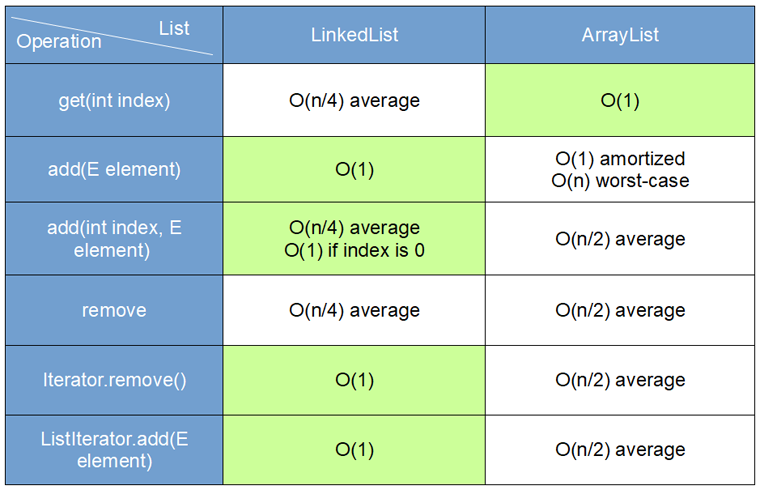
LinkedList: Adding or removing an element from the beginning or end is anO(1)operation because it only requires updating a few pointers (headortail). For insertions/deletions in the middle, the operation isO(n)because you first have to traverse to the correct position, but the actual modification is fast.ArrayList: Adding an element to the end is typicallyO(1)(amortized), but if the internal array is full, it triggers a costlyO(n)resize operation (creating a new, larger array and copying all elements). Inserting or removing from the middle or beginning is alwaysO(n)because all subsequent elements must be shifted one by one.
The image below summarizes the theoretical complexities. Note that notations like O(n/4) are used to indicate average-case behavior, but in standard Big O notation, we drop the constants, so O(n/4) and O(n/2) are simplified to O(n).
The Impact of Hardware: Cache-Friendliness
Theoretical Big O notation doesn't tell the whole story. Modern CPUs rely heavily on caching to achieve high performance. ArrayList is very "cache-friendly" because its data is stored contiguously. When you access one element, the CPU likely pulls a chunk of adjacent elements into its fast cache memory. Subsequent reads of nearby elements are then extremely fast.
LinkedList nodes, however, can be scattered all over the heap memory. Each time you follow a pointer to the next node, you may incur a "cache miss," forcing the CPU to fetch data from the much slower main memory. This phenomenon, known as pointer chasing, can make LinkedList significantly slower in practice, even for operations that seem theoretically efficient.
The following in-depth article from dev.java uses actual benchmarks to demonstrate these real-world effects. It's a fantastic resource for deepening your understanding beyond simple theory.
Choosing the Right Implementation Between ArrayList and ...
This article provides a rigorous, benchmark-driven comparison of ArrayList and LinkedList, covering performance and memory usage. It introduces important concepts like pointer chasing.
I recommend skimming the article to grasp the main conclusions. Focus your reading on these key sections: The initial complexity table to see the theoretical foundation. The conclusion of the "Reading Elements" section, specifically the explanation of pointer chasing and its impact. The "Iterating" section, especially the part warning against using an index-based loop with LinkedList. This is a critical mistake to avoid. The conclusion of the "Inserting Elements" section (Comparing the Insertion), which summarizes when LinkedList's insertion speed is actually beneficial. Finally, read the conclusion of the entire article: "Which Implementation Should You Choose?". This provides the final verdict.
3. Making the Choice: Practical Guidelines
Based on this deep dive, here is the rule of thumb for choosing between them:
-
Default to
ArrayList. For the vast majority of use cases,ArrayListis the superior choice. Its performance for random access is excellent, its memory footprint is lower, and its cache-friendly nature makes iteration very fast. The amortizedO(1)cost for adding to the end is perfectly acceptable for most applications. -
Use
LinkedListONLY for specific scenarios.LinkedListshould be considered when your primary operations are frequent additions and removals at the beginning or end of the list. This makes it a good implementation forQueues orDeques (double-ended queues). If you are building a list and know you will be inserting/deleting heavily from the start,LinkedListwill outperformArrayList's costly element shifting.
If you ever find yourself needing to frequently access elements by index in a LinkedList, you have likely chosen the wrong data structure.
Conclusion
You've now explored the critical differences between ArrayList and LinkedList, moving from their internal structure to their real-world performance implications. Understanding these trade-offs is a hallmark of a proficient developer who can write efficient and thoughtful code.
Here are the key takeaways:
ArrayListis backed by a dynamic array. It provides fastO(1)random access but slowO(n)insertion/deletion in the middle due to element shifting. It is generally more memory-efficient and cache-friendly.LinkedListis made of nodes with pointers. It offers fastO(1)insertion/deletion at its ends but suffers from slowO(n)access by index due to traversal. It has higher memory overhead and can be slowed down by pointer chasing.- Guideline: Start with
ArrayList. Only switch toLinkedListif you have a clear use case that heavily involves adding or removing from the head of the list.
In our next lesson, we will shift our focus to collections that prioritize uniqueness and fast lookups: HashSet and HashMap. These are incredibly powerful tools and are fundamental to solving a wide range of common programming problems.