Hello! Welcome to the first lesson in our module on the bridge between the analog and digital worlds. In the previous module, we concluded our journey through analog signal processing by mastering the complete design workflow for analog filters. You learned to transform a set of specifications into a final transfer function, , by choosing a filter type, calculating its order, and placing its poles and zeros.
Now, we pivot from the continuous domain of analog signals to the discrete world of digital processing. The fundamental question we must answer is: how can we convert a continuous, analog signal into a sequence of numbers without losing information? The answer lies in the sampling theorem, arguably one of the most important principles in modern engineering.
Today's learning outcome is to trace the historical development of sampling theory from Nyquist's work to Shannon's formulation. This isn't just a history lesson; it's a journey to understand the motivations, the context, and the brilliant insights that led to this cornerstone of the digital revolution. Understanding this story will clarify the crucial, and often misunderstood, distinction between the work of Harry Nyquist and Claude Shannon.
1. The Engineering Challenge: Limits of Communication
Long before digital audio or modern telecommunications, the first great engineering challenge in electronic communication was the telegraph. In the mid-19th century, sending messages across continents and oceans via submarine cables was a revolutionary but deeply problematic technology.
The core issue was that the long electrical cables acted as large, distributed low-pass filters. When sharp, distinct pulses of electricity (representing dots and dashes) were sent into one end of the cable, they would emerge at the other end smeared, attenuated, and overlapping. This severely limited the speed at which information could be reliably transmitted.
The Establishment of Sampling as a Scientific Principle— ...
To appreciate the problem that drove the initial research, let's turn to the article 'The Establishment of Sampling as a Scientific Principle' from the Notices of the AMS. It provides an excellent account of the early challenges in telegraphy.
Please read the section titled 'The Challenges of Communications Engineering'. Focus on how the physical properties of submarine cables (resistance and capacitance) limited the transmission speed, and how this practical problem motivated the theoretical work of Kelvin, Heaviside, and later, Nyquist.
As the reading highlights, early pioneers like Lord Kelvin applied Fourier's heat equation to model this signal degradation. They established that the transmission speed was fundamentally tied to the bandwidth of the channel. This set the stage for a more formal investigation into the ultimate limits of communication, a problem that would be taken up by the engineers at Bell Telephone Laboratories.
2. Harry Nyquist and the "Speed Limit" of a Channel (1928)
Enter Harry Nyquist, a Swedish-American engineer at Bell Labs. In the 1920s, Bell Labs was grappling with how to maximize the amount of information that could be sent through their expensive communication channels. Nyquist tackled this problem head-on, not by thinking about reconstructing a continuous waveform, but by asking a more direct question related to telegraphy:
"What is the maximum number of independent symbols (pulses) per second that can be transmitted through a channel of a given bandwidth without being distorted into one another?"
His analysis, published in the 1928 paper "Certain Topics in Telegraph Transmission Theory," provided a profound answer.
Nyquist - the amazing 1928 BREAKTHROUGH which showed every communication channel has a capacity
The video 'Nyquist - the amazing 1928 BREAKTHROUGH' provides an excellent visual narrative of Nyquist's work and its context. It clarifies his specific focus on telegraphy and data rate.
Please watch from 01:00 to 08:08. Pay close attention to: The description of the telegraphy problem (01:00 - 03:00). How Nyquist used Fourier analysis to understand what happens when a channel has limited bandwidth (03:14 - 04:43). Nyquist's novel approach of considering the signal only at discrete points in time and the resulting 'signaling theorem' (04:58 - 08:08).
As the video explains, Nyquist's key result, which we can call the Nyquist Signaling Theorem, states that to transmit independent symbols per second, a channel must have a minimum bandwidth of Hz.
Equivalently, a channel of bandwidth can support a maximum transmission rate of symbols per second.
This is a fundamental relationship between symbol rate and bandwidth. It's crucial to recognize what this is not saying. Nyquist's 1928 paper did not discuss sampling a continuous analog signal for the purpose of perfect reconstruction. It was concerned with the maximum rate of discrete symbols in a telegraphy system. The connection to what we now call the "sampling theorem" would be made explicit later.
3. A Case of Multiple Discovery
Nyquist wasn't the only one thinking about these problems. The pressure to efficiently use the communication spectrum led several researchers around the world to independently arrive at similar conclusions.
Nyquist–Shannon sampling theorem
The Wikipedia article on the Nyquist-Shannon sampling theorem has a detailed section on the theorem's complex history, highlighting the contributions of several other key figures.
Please read the section titled 'Historical background'. Pay attention to the names and contributions of: E. T. Whittaker (1915): A mathematician who developed the interpolation formula long before the engineering need was widely recognized. Karl Küpfmüller (1928): A German engineer who found a similar result to Nyquist around the same time. Vladimir Kotel'nikov (1933): A Russian engineer who independently proved the theorem for signal reconstruction while working on radio communications. In Russian literature, the theorem bears his name. Herbert Raabe (1939): A German engineer who, driven by the need to design time-division multiplexing systems for telephony, also derived the minimum sampling rate condition.
This pattern of multiple independent discovery underscores how pressing the problem was. From mathematicians laying the abstract groundwork to engineers in the US, Russia, and Germany solving practical problems in telegraphy, radio, and telephony, the idea that a band-limited signal was fully described by discrete samples was clearly an idea whose time had come.
Test your understanding!
An engineer in 1930 is trying to send Morse code at a rate of 40 dots per second over a new cable. Whose 1928 work would be most directly applicable to determining the minimum channel bandwidth they need?
Later, an engineer in 1950 is designing the first digital audio recorder and wants to know the minimum sampling rate required to capture a 15 kHz audio signal without loss of information. Whose 1949 formulation would they most likely be applying?
Show answer
The 1930 engineer would be directly applying Nyquist's work on the relationship between symbol rate and channel bandwidth. They would conclude they need a channel with at least Hz bandwidth.
The 1950 engineer would be applying Shannon's formulation of the sampling theorem. They would conclude they need to sample at a rate of at least Hz, or 30,000 samples per second.
4. Claude Shannon and the Birth of Information Theory (1949)
The person who unified these ideas and gave them a rigorous mathematical foundation within a revolutionary new framework was Claude Shannon, another giant from Bell Labs.
In his landmark 1948 and 1949 papers, which founded the field of Information Theory, Shannon wasn't just solving one engineering problem; he was creating a universal mathematical theory of communication. Within this work, he formally proved what we now call the sampling theorem.
Shannon's formulation was essentially the dual of Nyquist's result:
- Nyquist (1928): Transmitting symbols at a rate of requires a channel of bandwidth .
- Shannon (1949): A continuous signal perfectly band-limited to Hz can be perfectly reconstructed from its samples, if the samples are taken at a rate of samples per second.
Shannon explicitly formulated the reconstruction method using the sinc function and placed the theorem on a firm mathematical footing.
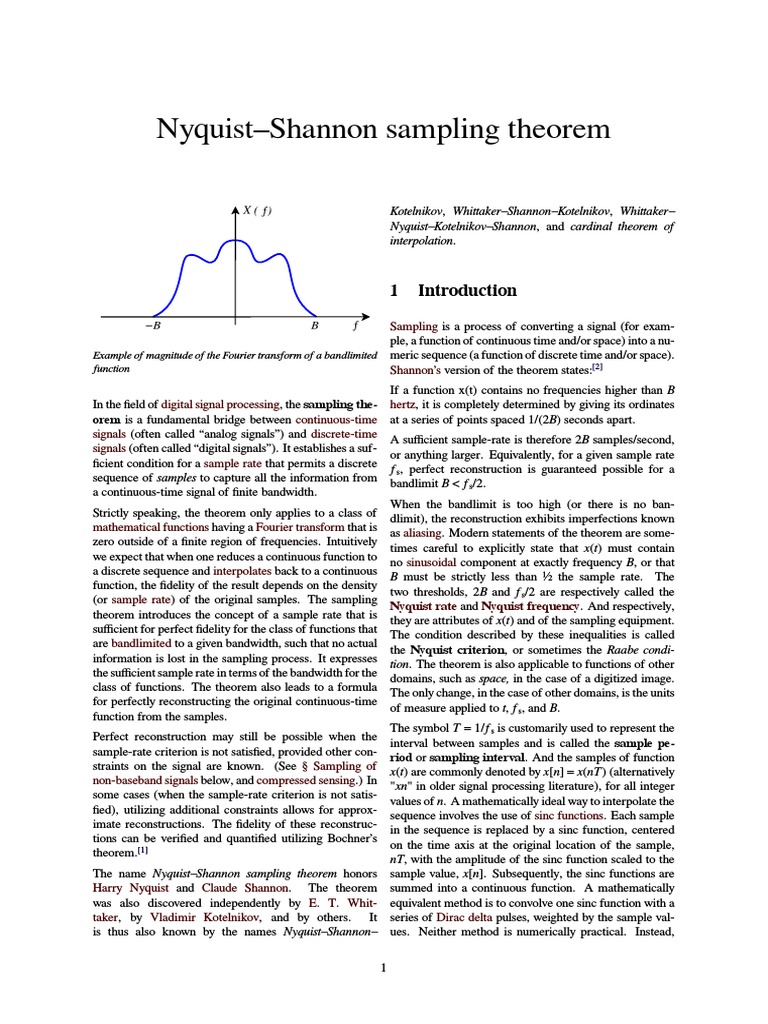
In his work, Shannon paid tribute to Nyquist's earlier insights by naming the critical sampling rate the "Nyquist rate" and the corresponding time interval the "Nyquist interval." This is how Harry Nyquist's name became permanently attached to a theorem about signal sampling and reconstruction, even though his original paper focused on the symbol rate of telegraphy.
Shannon Nyquist Sampling Theorem
This short video introduces Claude Shannon and gives a clear, modern statement of the sampling theorem that bears his name.
Please watch from 01:01 to 06:29. This will give you a sense of Shannon's immense contribution to information theory and provides the clear, concise statement of the theorem as we use it today, including the famous audio example.
Shannon's work provided the definitive theoretical statement that serves as the bedrock for all digital signal processing. He proved that, under the right conditions, the transition from the continuous world to the discrete world could be made without any loss of information.
Conclusion
Today, we've traced the intellectual lineage of the sampling theorem. We've seen how it grew from very practical engineering needs and was discovered by multiple brilliant minds working independently.
Key Takeaways:
- The development of the sampling theorem was driven by real-world engineering problems: maximizing telegraphy speed, avoiding radio interference, and enabling telephone multiplexing.
- Harry Nyquist's 1928 work established the fundamental relationship between a channel's bandwidth and its maximum symbol rate, showing a channel of bandwidth can carry symbols per second. This was about data rate, not signal reconstruction.
- The sampling theorem was a case of multiple independent discovery, with key contributions from Whittaker, Kotel'nikov, and Raabe, among others.
- Claude Shannon, in his 1949 founding papers on Information Theory, provided the formal, rigorous proof of the sampling theorem as we know it today. He proved the dual of Nyquist's result: a signal band-limited to Hz is perfectly defined by samples taken at a rate of Hz.
Preview of the Next Lesson:
Now that we have explored the who, when, and why behind the sampling theorem, our next lesson will focus on the how. We will derive the sampling theorem mathematically by analyzing the spectrum of an impulse-sampled continuous-time signal. You will see exactly how the process of sampling in the time domain affects the signal's representation in the frequency domain, providing a rigorous justification for the condition.