Hello! Welcome to the first lesson of our final and most exciting module: The End-to-End Data Science Project.
In previous modules, you've built a strong toolkit of individual skills—from exploratory data analysis and preprocessing to building and evaluating various machine learning models, including the PCA visualization you just mastered. Now, it's time to integrate all those pieces and apply them to a complete project, just as you would in a real-world data science role.
Today's lesson focuses on the single most critical stage of any data science project. Our learning outcome is to define a clear business problem and translate it into a machine learning task with success metrics. Getting this step right is paramount; a well-defined problem is halfway to a solution, while a poorly defined one almost guarantees failure, no matter how sophisticated your model is.
Let's begin laying the foundation for our project.
1. The Big Picture: From Business Need to ML Problem
Before writing a single line of code, a data scientist must think like a business strategist. The goal is to understand a real-world objective—like increasing sales, reducing customer churn, or improving safety—and determine if and how machine learning can help achieve it.
This flowchart provides a great high-level overview of the process we'll be discussing today.

The first crucial realization is that not all business problems require a machine learning solution. ML projects are resource-intensive. The first step is always to deeply understand the business requirement and its goals.
To explore this, let's watch a video that discusses how to think about this translation process and provides several classic examples.
How To Translate Business Ideas Into Data Science Solutions
In this video, Krish Naik explains the fundamental process of translating business ideas into data science solutions. Pay close attention to the examples he provides, as they are classic illustrations of this process.
Please watch the following segments: Understand the Business Requirement (01:52 - 03:00): Focus on the importance of defining clear goals before starting a project. Real-World Examples (03:00 - 05:01): Note how business challenges like customer retention (churn prediction), ATM placement, and content strategy (Netflix seasons) are framed as data science problems. The Role of Domain Experts (05:24 - 07:04): Understand why interacting with people who know the business area is critical for project success. The Importance of Data (07:04 - 07:59): Grasp why the availability and quality of data are make-or-break factors.
2. A Practical Guide to Brainstorming a Project
Krish Naik's video gave us the "what" and "why." Now, let's focus on the "how." How do you, as a data scientist, come up with a project idea and define its scope? There are generally two approaches:
- Data-First: You find an interesting dataset (e.g., on Kaggle, a government portal) and then explore it to find a problem to solve.
- Problem-First: You identify a problem or question you're interested in and then go find the data needed to solve it. This is often more challenging but can lead to more impactful and original projects.
The following video provides a fantastic, real-time demonstration of the "problem-first" brainstorming process.
Data Science Project from Scratch - Part 1 (Project Planning)
Watch data scientist Ken Jee walk through his thought process for planning a new project from scratch. This is a great example of how to narrow down your interests into a concrete, solvable problem.
Please watch these two key sections: Two Approaches to Ideas (01:14 - 03:26): Understand the difference between the data-first and problem-first approaches to project selection. Brainstorming a Project Idea (03:26 - 06:43): Observe how he starts with broad interests (sports, data science careers), weighs the pros and cons, and narrows them down to a specific, well-defined problem: predicting data science salaries.
After watching, take a moment to think. What's a problem in a domain you're interested in (like finance, sports, education, etc.) that could potentially be solved with data? You don't need a full plan, just an initial idea. We'll build on this throughout the module.
3. A Formal Framework for Problem Framing
Brainstorming is a creative process. To ensure our project is well-posed, we need to translate that creativity into a structured, formal definition. This involves breaking the problem down into specific machine learning components.
The following reading from Google's AI education platform provides an excellent framework for this.
This article explains how to formally frame a machine learning problem by defining its goals and outputs.
Read the following two sections: Start at 'Define the ideal outcome and the model's goal'. The table here is particularly useful for seeing how a high-level outcome translates into a specific model goal. Continue through 'Identify the output you need'. This section clearly defines classification and regression. Pay special attention to the discussion on when to choose a classification model even if the prediction seems numerical, especially when fixed thresholds are involved.
To reinforce this, another excellent resource breaks the process down into four key components.
Stage 2. Project Scoping And Framing The Problem
This article offers a systematic way to think about project scoping by identifying four key components.
Read from the section 'An Example On E-commerce Recommendation' down to the table in 'Key Components'. This will introduce you to the four parts of an ML problem frame: Inputs, Outputs, Objective Function, and ML Task Type.
Activity: Applying the Framework
Let's apply these frameworks to the "Data Scientist Salary Prediction" project from Ken Jee's video:
- Business Problem: Job seekers lack transparent salary information, making it difficult to evaluate offers and negotiate effectively.
- Ideal Outcome (Business Goal): Provide a tool that gives job seekers a realistic salary estimate based on job characteristics.
- ML Task Type: Regression, because we want to predict a continuous numerical value (salary).
- Inputs (Features): What data would the model use?
- Job Title (
Data Scientist,Data Analyst, etc.) - Seniority Level (
Junior,Senior,Lead) - Company Information (e.g.,
Size,Industry,Rating) - Location (
City,State) - Required Skills (e.g.,
Python,SQL,Spark)
- Job Title (
- Output (Prediction): The predicted salary, e.g.,
$125,000.
This structure transforms a vague idea into a concrete technical plan.
4. Defining Success: Business vs. Model Metrics
We've defined our task, but how will we know if our deployed model is actually successful? This requires defining two distinct types of metrics:
- Model Evaluation Metrics: These are offline metrics that tell us how well the model performs on a technical level (e.g., how small its prediction error is). For our salary predictor, this could be Root Mean Squared Error (RMSE) or Mean Absolute Error (MAE).
- Business Success Metrics: These are online metrics that measure whether the model is achieving the original business goal. They measure real-world impact.
Confusing these two is a common mistake. A model can have a great evaluation metric (low RMSE) but fail to achieve the business goal.
Let's return to the Google article to understand this critical distinction.
This section focuses on defining what success looks like from a business perspective, which is often different from a model's technical accuracy.
Read the section 'Define the success metrics'. Focus on the examples given for the weather and video apps, and how their success metrics (e.g., 'users spend 20% more time on the site') differ from model metrics like accuracy or precision.
For our salary prediction project:
- Model Evaluation Metric: RMSE of $5,000. This tells us our model's predictions are, on average, off by about $5,000. We can work to minimize this during training.
- Business Success Metrics: These measure the tool's actual usefulness.
- User Engagement: Number of salary predictions made per week.
- User Retention: Percentage of users who return to the tool.
- User Satisfaction: A simple survey asking, "How helpful was this estimate in your job search?" with a 1-5 rating.
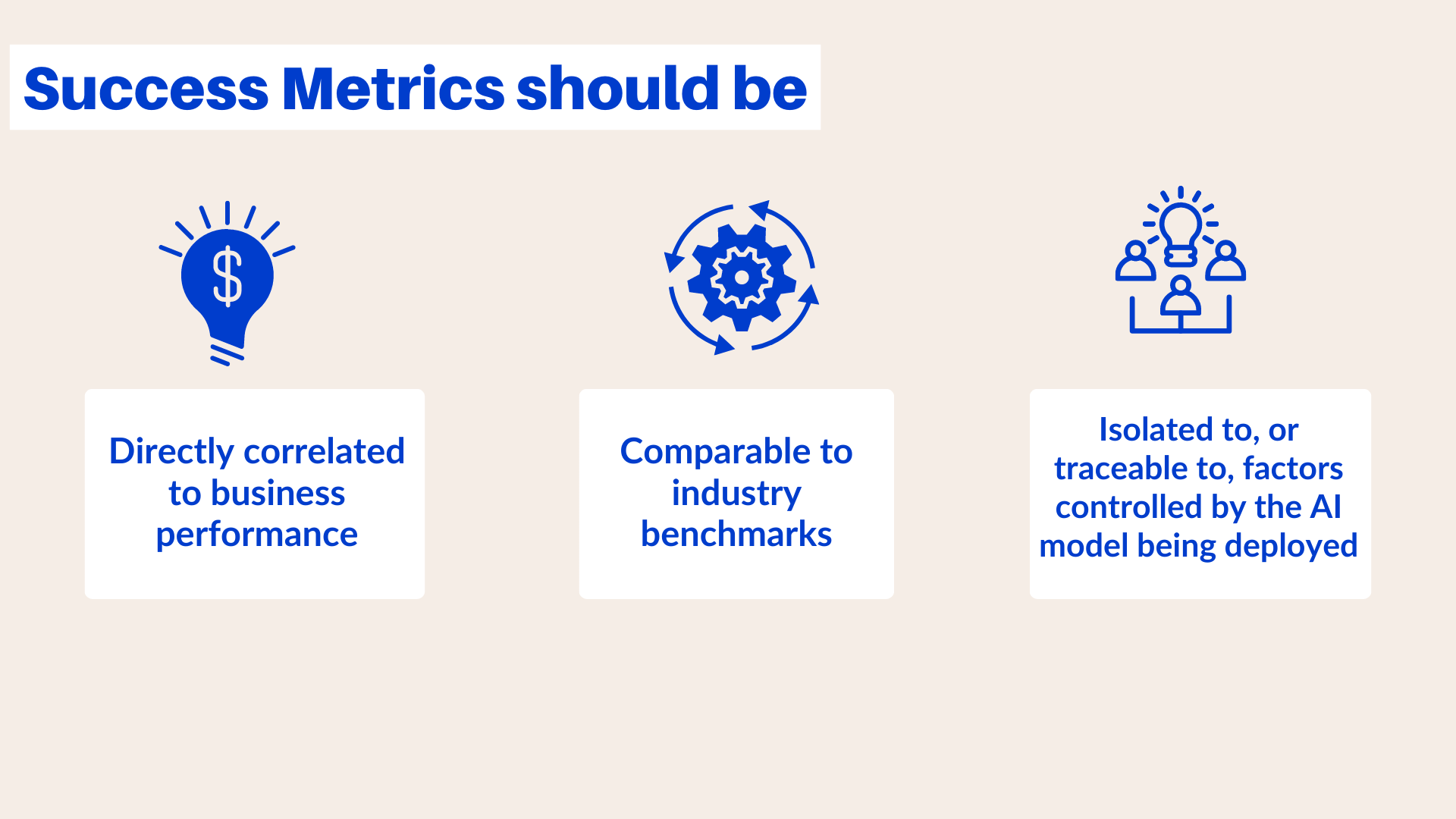
These business metrics are what ultimately determine if the project delivered value. The image below summarizes the qualities of good success metrics.
Conclusion
Congratulations! You have just navigated the most strategic and foundational part of a data science project. This initial thinking and planning phase is what separates successful, impactful projects from technical exercises.
Key Takeaways:
- Every data science project must start with a clear business problem and a desired business outcome.
- You must translate this business problem into a formal machine learning task by defining the ML task type (e.g., regression), inputs (features), and outputs (predictions).
- Success is measured on two levels: model evaluation metrics (like RMSE or accuracy) that guide model development, and business success metrics (like user engagement or cost savings) that measure real-world impact.
Preview of the next lesson:
Now that we understand how to frame a problem, it's time to get our hands dirty. In the next lesson, we will select a dataset for our course project and begin the first practical phase: "Execute a full project workflow: EDA, preprocessing, and feature engineering on a new dataset."