Hello! Welcome to the sixth lesson in our module on CPU and System Architecture.
In our last lesson, we took a deep dive into the microarchitecture, exploring how dynamic branch predictors use sophisticated hardware to learn from a program's history and mitigate the costly penalties of control hazards. We saw that components like the Branch History Table and techniques like tournament prediction are essential for keeping deep pipelines fed with the correct instructions.
Today, we're going to zoom out from the microarchitectural details to the higher-level design philosophy of the processor: the Instruction Set Architecture (ISA). This lesson directly addresses a classic interview topic that is critical for any role in semiconductor design.
Your learning outcome is to: Compare RISC vs. CISC architectures with concrete ARM vs. x86 examples relevant to semiconductor roles.
We will dissect this topic in four stages:
- Establish the "classic" textbook definitions of RISC and CISC.
- Deconstruct this classic view by showing how modern ARM and x86 architectures have converged.
- Analyze evidence showing that microarchitecture—not the ISA—is the primary driver of performance and power.
- Synthesize these points into interview-ready answers that demonstrate a sophisticated, modern understanding.
The Classic Debate: Simplicity vs. Complexity
Let's begin with the historical definitions that established the two opposing camps in processor design.
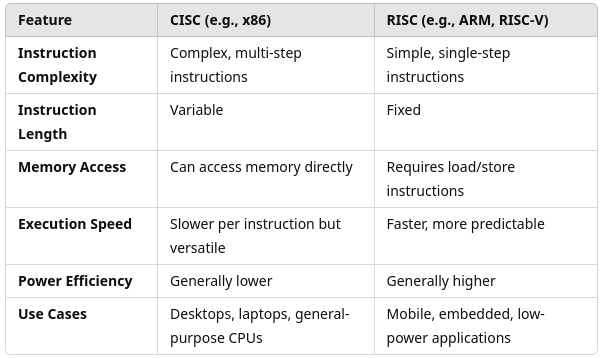
The core philosophical differences were:
-
Complex Instruction Set Computer (CISC):
- Goal: Make the hardware more powerful to simplify the compiler's job. One instruction should accomplish a complex task (e.g., load from memory, perform an operation, and store the result back to memory).
- Characteristics: Variable-length instructions, many addressing modes, and a focus on minimizing the number of instructions per program.
-
Reduced Instruction Set Computer (RISC):
- Goal: Simplify the hardware to enable faster, more regular execution. Complex tasks are broken down into a sequence of simple instructions by the compiler.
- Characteristics: Fixed-length instructions, a load/store architecture (data must be loaded into registers before operations), and a target of executing one instruction per clock cycle.
To get a better sense of the history and these foundational concepts, let's watch a few clips.
Arm vs x86 - Key Differences Explained
This video clearly explains the traditional definitions of CISC and RISC and provides a brief history of both the x86 and ARM architectures, which serve as our primary case studies.
Please watch the following segments from 'Arm vs x86 - Key Differences Explained' by Gary Explains: 00:23 - 03:48: A brief history of the x86 architecture. 03:48 - 05:40: The origins of ARM and its RISC philosophy. 13:33 - 15:41: The core explanation of CISC vs. RISC, covering instruction complexity, variable vs. fixed-length instructions, and the load/store architecture. Focus on understanding the 'textbook' differences presented here.
If the world of CPU design had stopped in the 1990s, our lesson could end here. However, the reality is far more interesting and nuanced—and knowing this nuance is what separates a good interview answer from a great one.
The Great Convergence: Blurring the Lines
The fundamental flaw in the classic debate is that it assumes processors execute the instructions as they are written. Modern high-performance processors do not.
The Micro-op (μop) Revolution
Starting with the Intel Pentium Pro (P6 microarchitecture), CISC processors began adopting a hybrid approach. The "front-end" of the processor decodes complex x86 instructions into a series of simple, RISC-like internal instructions called micro-operations (μops). It is these μops, not the original x86 instructions, that are sent to the "back-end" for execution in a highly pipelined, out-of-order core.
Effectively, a modern x86 processor is a RISC machine at its core, with a sophisticated translation layer on top.
RISC vs CISC - Is it Still a Thing?
This is the crucial twist. The clean separation between RISC and CISC breaks down in modern implementations. This video explains how CISC processors internally operate much like RISC processors.
Watch the segment from 08:18 to 10:58 in 'RISC vs CISC - Is it Still a Thing?'. Pay close attention to the explanation of how x86 CPUs break down CISC instructions into RISC-like 'micro-ops'. This is a fundamental concept in modern CPU design.
Counter-Arguments: ARM gets "Complex"
The convergence isn't a one-way street. As ARM pushed into higher-performance domains, its designs started adopting features once associated with the CISC world:
- ARM Instructions also Decode into μops: Contrary to the "one instruction, one action" philosophy, many modern ARM instructions also decode into multiple internal micro-operations to be executed.
- μop Caches are Everywhere: The process of decoding instructions (especially variable-length x86) consumes power and can be a bottleneck. High-performance x86 CPUs use a "μop cache" to store the decoded μops, so if the same code is executed again, the processor can skip the decode stage. High-performance ARM cores (like ARM's Cortex-A77 and later, and Samsung's custom cores) do the exact same thing. The presence of a μop cache on an ARM core is powerful evidence that its "simple" decode is not simple enough to escape optimization.
- Not a Pure Load/Store Architecture: Modern ARM ISAs include instructions that combine loads, operations, and stores, violating the pure RISC doctrine. For example,
LDADDloads a value from memory, adds a register value to it, and stores the result back to memory—a classic CISC-style operation.
The article "ARM or x86? ISA Doesn't Matter" from Chips and Cheese, which you can skim, provides excellent quotes and examples of this convergence, citing famous CPU architect Jim Keller. It directly challenges the idea of an x86 "decode tax" or an inherent ARM "power advantage." The key takeaway is that both architectures have become incredibly complex to extract maximum performance.
The Modern Verdict: It's All About the Microarchitecture
If the ISA isn't the main differentiator, what is? The answer, as we've seen in previous lessons, is the microarchitecture: the specific implementation of the caches, branch predictors, pipelines, and execution units.
A landmark 2013 academic study systematically analyzed this question by measuring real hardware.
[PDF] Power Struggles: Revisiting the RISC vs. CISC debate on contemporary ARM and x86 architectures
The ideas we've discussed are backed by rigorous academic research. The following paper is a foundational study that compared real ARM and x86 processors. Its findings are central to the modern, correct understanding of this topic.
Please read the following key sections. Focus on the high-level arguments and conclusions. Section 1: Introduction (Page 1): Understand the motivation for the study and why the debate needed revisiting. Section 2 & Table 1: Framing Key Impacts of the ISA (Page 2): This is a critical section. Pay close attention to Table 1, especially the row 'Modern refinements,' which summarizes how the classic differences have been marginalized. Section 6: Conclusions & Table 10 (Page 6): Read the final conclusion and review Table 10, which provides a concise summary of the key findings.
The study's conclusion is unambiguous: one ISA is not fundamentally more efficient than the other.
- An Intel i7 (x86) is high-performance because it has a powerful microarchitecture (wide issue, huge caches, aggressive predictors).
- A low-power ARM core is efficient because its microarchitecture is simpler.
- The study showed that a power-optimized Intel Atom (x86) could be more energy-efficient than a contemporary ARM Cortex-A9.
- Today, we see high-performance ARM cores from Apple (M-series) and Amazon (Graviton) that rival or exceed the performance of x86 server chips.
Performance and power are functions of design choices and engineering trade-offs made at the microarchitectural level, not pre-determined by the ISA.
Interview-Ready Synthesis
Let's distill this into clear answers for a high-stakes technical interview.
Q: "What are the differences between RISC and CISC? Which is better?"
A: "Historically, CISC architectures like x86 aimed to simplify programming by using complex, multi-cycle instructions, while RISC architectures like ARM favored simple, fixed-length instructions that could be executed quickly, shifting complexity to the compiler.
However, in modern high-performance CPUs, this distinction is largely irrelevant. Both have converged. Modern x86 processors translate complex instructions into simple, RISC-like micro-ops that are executed in an out-of-order core. Simultaneously, high-performance ARM cores have adopted more complex instructions and even use micro-op caches to reduce decode power, a technique pioneered in the x86 world.
Ultimately, neither is inherently 'better.' Performance and power efficiency are almost entirely determined by the microarchitectural implementation—the quality of the branch predictor, the size and speed of the caches, the width of the execution engine—and the underlying process technology. The ISA itself is not the primary driver of these metrics."
Q: "If the ISA doesn't matter for performance, what is the most significant difference between ARM and x86 today?"
A: "The biggest differentiator is the business model. ARM is an IP company; it licenses its ISA and core designs to other companies like Qualcomm, Apple, and NVIDIA. This allows them to create highly customized Systems-on-Chip (SoCs) and leverage the most advanced semiconductor foundries, like TSMC. Intel, traditionally, has been an Integrated Device Manufacturer (IDM), responsible for design, manufacturing, and sales. This difference in business model has profound strategic implications for time-to-market, customization, and access to cutting-edge fabrication processes."
Conclusion
Today we've dismantled a classic but outdated paradigm in computer architecture. While the historical context of RISC vs. CISC is important, a modern engineer recognizes that the lines have blurred to the point of being secondary to the implementation itself.
Key Takeaways:
- The classic definitions of RISC (simple instructions, load/store) and CISC (complex instructions, memory operations) provide historical context.
- Modern architectures have converged: x86 processors use a RISC-like micro-op engine internally, and high-performance ARM cores use CISC-like techniques such as μop caches and complex instructions.
- Performance, power, and energy efficiency are primarily a function of the microarchitecture and process technology, not the ISA.
- The most significant practical difference between the ARM and x86 ecosystems today is the business model (IP licensing vs. integrated manufacturing).
Preview of the Next Lesson:
Now that we understand the ISA is just one piece of the puzzle, we can explore how these cores are combined into systems. In the next lesson, we'll examine different multi-core architectures: Symmetric Multiprocessing (SMP) vs. Asymmetric Multiprocessing (AMP), and see how they impact scheduling, communication, and cache coherency in the SoCs designed by companies like Qualcomm and AMD.