Hello! Welcome to the next lesson in our RTOS module.
In our last session, we implemented the producer-consumer pattern using semaphores and a mutex. You saw how these primitives allow tasks to synchronize and safely share resources. However, as systems grow in complexity and acquire multiple locks, we introduce the risk of a catastrophic failure mode: deadlock. Understanding, preventing, and articulating your strategies for handling deadlock is a critical skill tested in senior embedded interviews.
Today's learning outcome is to identify the four necessary conditions for deadlock and apply prevention or avoidance strategies in a multitasking environment. We will dissect why deadlocks happen and arm you with the practical techniques required by companies like AMD, Nvidia, and Qualcomm to build robust, concurrent systems.
1. What is Deadlock? A Vicious Cycle
At its core, a deadlock is a state where two or more tasks are stuck in a circular waiting pattern. Each task is blocked, waiting for a resource that is held by another waiting task. Since all tasks are waiting, none can proceed to release the resource the others need, and the system grinds to a halt.
The classic analogy for this is the "Dining Philosophers Problem."
Introduction to RTOS Part 10 - Deadlock and Starvation | Digi-Key Electronics
To build a strong intuition for this problem, let's start with a video from Digi-Key that introduces the Dining Philosophers analogy and then demonstrates a very clear deadlock scenario in code.
Watch from the beginning to 01:43 to understand the analogy, and then from 03:34 to 06:13 to see how this translates into a real deadlock with two tasks and two mutexes in an RTOS context.
As you saw in the video, the deadlock occurred because:
- Task A locked
mutex1and then tried to lockmutex2. - Simultaneously, Task B locked
mutex2and then tried to lockmutex1. - Task A is now waiting for Task B to release
mutex2, while Task B is waiting for Task A to releasemutex1. Neither can proceed.
This is a scenario that can easily arise in complex embedded systems, for example when one task needs to access both an I2C bus and a DMA channel, while another task needs them in the reverse order.
2. The Four Necessary Conditions for Deadlock
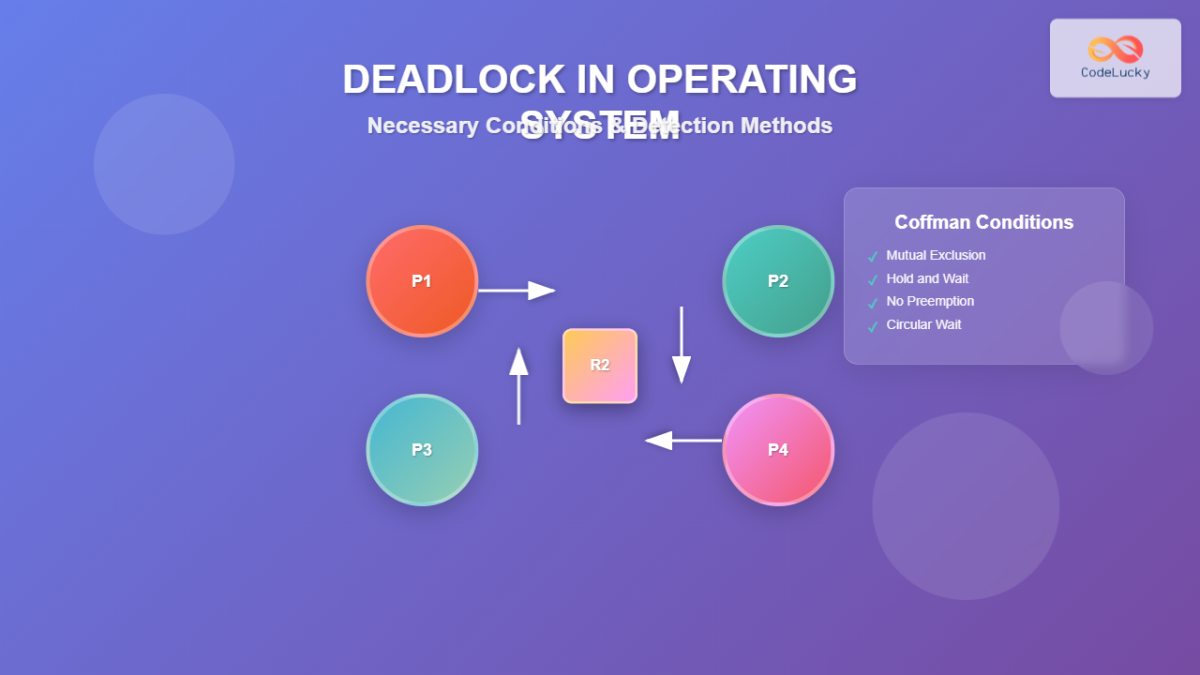
For a deadlock to occur, four specific conditions—often called the Coffman conditions—must all be met simultaneously. If you can break even one of these conditions, you can prevent deadlock.
Deadlock - Operating Systems | Simply Explained
This short video provides a concise and clear explanation of each of the four conditions.
Watch from 00:37 to 02:06. Focus on internalizing the name and definition of each condition.
Let's formally define them. For a more detailed breakdown, the "Deadlock" chapter from the University of Texas is an excellent resource.
This document formally lists and describes the four conditions required for deadlock to occur.
Read section 31.2, 'Conditions for Deadlock'. It's a short but precise summary of the four points.
To summarize, the four conditions are:
- Mutual Exclusion: At least one resource must be held in a non-shareable mode. Only one task can use the resource at any given time (e.g., a mutex).
- Hold and Wait: A task is holding at least one resource and is waiting to acquire additional resources that are currently being held by other tasks.
- No Preemption: A resource cannot be forcibly taken away from a task holding it. The task must release the resource voluntarily.
- Circular Wait: There exists a set of waiting tasks {T₀, T₁, ..., Tₙ} such that T₀ is waiting for a resource held by T₁, T₁ is waiting for a resource held by T₂, ..., and Tₙ is waiting for a resource held by T₀.
3. Strategies for Handling Deadlock
In an interview, you'll be expected to discuss how you would architect a system to handle deadlocks. There are three primary approaches:
- Deadlock Prevention: Design the system so that at least one of the four necessary conditions can never occur. This is a structural solution.
- Deadlock Avoidance: Use dynamic information about resource requests to ensure the system never enters an unsafe state that could lead to deadlock. This is an algorithmic approach.
- Deadlock Detection and Recovery: Allow deadlocks to happen, detect them, and then take action to recover (e.g., by rebooting or terminating tasks).
For most real-time and embedded systems, prevention is the most practical and widely used strategy.
4. Deadlock Prevention: Breaking the Conditions
Let's explore how to break each of the four conditions.
4.1. Breaking Circular Wait (Most Common Strategy)
The most effective and common way to prevent deadlock is to break the circular wait condition. This is achieved by enforcing a strict ordering on resource acquisition. This is also known as establishing a lock hierarchy.
If all tasks are required to acquire locks in the same predefined order, a circular dependency can never form. For example, if the rule is "always lock mutexA before mutexB," the deadlock scenario we saw earlier becomes impossible.
Introduction to RTOS Part 10 - Deadlock and Starvation | Digi-Key Electronics
The Digi-Key video you watched earlier demonstrates exactly how to implement this lock ordering solution.
Watch from 07:49 to 09:40. Observe how changing the code so both tasks acquire mutex1 before mutex2 completely resolves the deadlock.
This strategy is highly effective but requires disciplined programming and clear documentation of the lock order across the entire project. In a large system, you might assign a numerical level to each lock and enforce the rule that a task can only acquire a new lock if its level is higher than any lock it currently holds.
The Oracle documentation on multithreaded programming provides another excellent illustration of this principle.
Mutex Lock Code Examples (Multithreaded Programming Guide)
This guide from Oracle explains the concept of locking hierarchies and provides a clear table demonstrating the deadlock and the ordered locking solution.
Review 'Example 4–2 Deadlock' to see the problematic lock ordering. Then, read the text explaining 'Locking Hierarchies'. Finally, look at 'Example 4–5 Singly Linked List With Nested Locking' to see how this principle is applied in a practical data structure, where locks are always taken in list order to prevent deadlock.
4.2. Breaking Hold-and-Wait
You can break the hold-and-wait condition by ensuring that a task never holds one resource while waiting for another. The typical way to do this is to require tasks to acquire all necessary resources at once, atomically.
The UTexas PDF describes this technique. It involves using a 'gatekeeper' lock to make the acquisition of multiple other locks an atomic operation.
Read the subsection 'Hold-and-wait'. Pay attention to the use of the prevention lock. Note the discussion of its downsides: it can reduce concurrency and requires you to know all required locks upfront, which is difficult with code encapsulation.
This approach is less common because it can be inefficient, forcing tasks to lock resources long before they are needed, thereby reducing system concurrency.
4.3. Breaking No Preemption
To break the no-preemption condition, you need a mechanism to take a resource away from a task. This is usually implemented using a non-blocking trylock function.
The strategy is:
- Attempt to acquire a lock using
trylock. - If the lock is acquired, proceed.
- If the lock is not available (held by another task), instead of blocking, the function returns immediately. The task can then release any locks it currently holds and try the entire sequence again later.
Mutex Lock Code Examples (Multithreaded Programming Guide)
Let's turn back to the Oracle documentation for a practical code example of this technique using pthread_mutex_trylock.
Review 'Example 4–3 Conditional Locking'. Notice how Thread 2 uses pthread_mutex_trylock. If it fails to get m1, it unlocks m2 and retries, breaking the hold-and-wait cycle and preventing deadlock.
A key risk with this trylock approach is livelock. This is where two or more tasks are not blocked, but they are continuously releasing their locks and retrying in a way that they still make no progress. This is often mitigated by adding a small, randomized delay before retrying.
Also, using timeouts when attempting to acquire a lock (e.g., xSemaphoreTake(mutex, timeout) in FreeRTOS) is a good defensive practice. It doesn't prevent deadlock, but it prevents a task from being blocked indefinitely, allowing for error handling or recovery.
4.4. Breaking Mutual Exclusion
This is often the most difficult condition to break, as many resources (like a UART transmitter or a specific memory region) are inherently single-use. However, for some operations, you can design lock-free data structures using atomic CPU instructions (like Compare-And-Swap). This is an advanced topic but is highly relevant for performance-critical roles in semiconductor companies. By avoiding locks altogether, you eliminate the possibility of deadlock for that particular data structure.
5. Deadlock Avoidance: The Banker's Algorithm
Deadlock avoidance is a more dynamic approach. It requires the OS to have prior knowledge of the maximum number of resources each task might request. When a task requests a resource, the OS checks if granting the request would leave the system in a "safe state"—a state from which there is at least one sequence of execution that allows all tasks to complete. If not, the request is denied, and the task blocks, even if the resource is technically available.
The Banker's Algorithm is the classic example of a deadlock avoidance strategy. It's more of a theoretical concept for general-purpose systems but is good to know.
Read section 31.4, 'Avoidance via Scheduling'. Focus on understanding the core idea: a smart scheduler with advance knowledge of resource needs can create a schedule that guarantees no deadlock occurs. Note the conclusion that this is not a general-purpose solution.
In practice, the overhead of the Banker's Algorithm and the requirement to know all future resource needs make it impractical for most systems. However, the concept might be applicable in very specific, highly predictable safety-critical environments.
Conclusion
You now have a comprehensive framework for understanding and handling deadlocks—a critical skill for any senior embedded developer.
Key Takeaways:
- Deadlock requires four conditions to be met simultaneously: Mutual Exclusion, Hold and Wait, No Preemption, and Circular Wait.
- The most practical and common interview answer for preventing deadlock is to break the Circular Wait condition by enforcing a strict lock ordering (resource hierarchy) across the system.
- Other prevention strategies include:
- Breaking Hold and Wait by acquiring all locks atomically (can reduce concurrency).
- Breaking No Preemption using
trylockand retry mechanisms (risks livelock).
- Deadlock Avoidance (e.g., Banker's Algorithm) is a more theoretical approach that is rarely used in practice due to its high overhead and restrictive requirements.
Preview of the Next Lesson:
We've just tackled one of the two major hazards of concurrent programming. The other is priority inversion, where a high-priority task is indirectly blocked by a lower-priority task, leading to missed deadlines and system failure. In our next lesson, we will define priority inversion with a concrete scenario and explore standard RTOS-level solutions like the Priority Inheritance and Priority Ceiling Protocols.